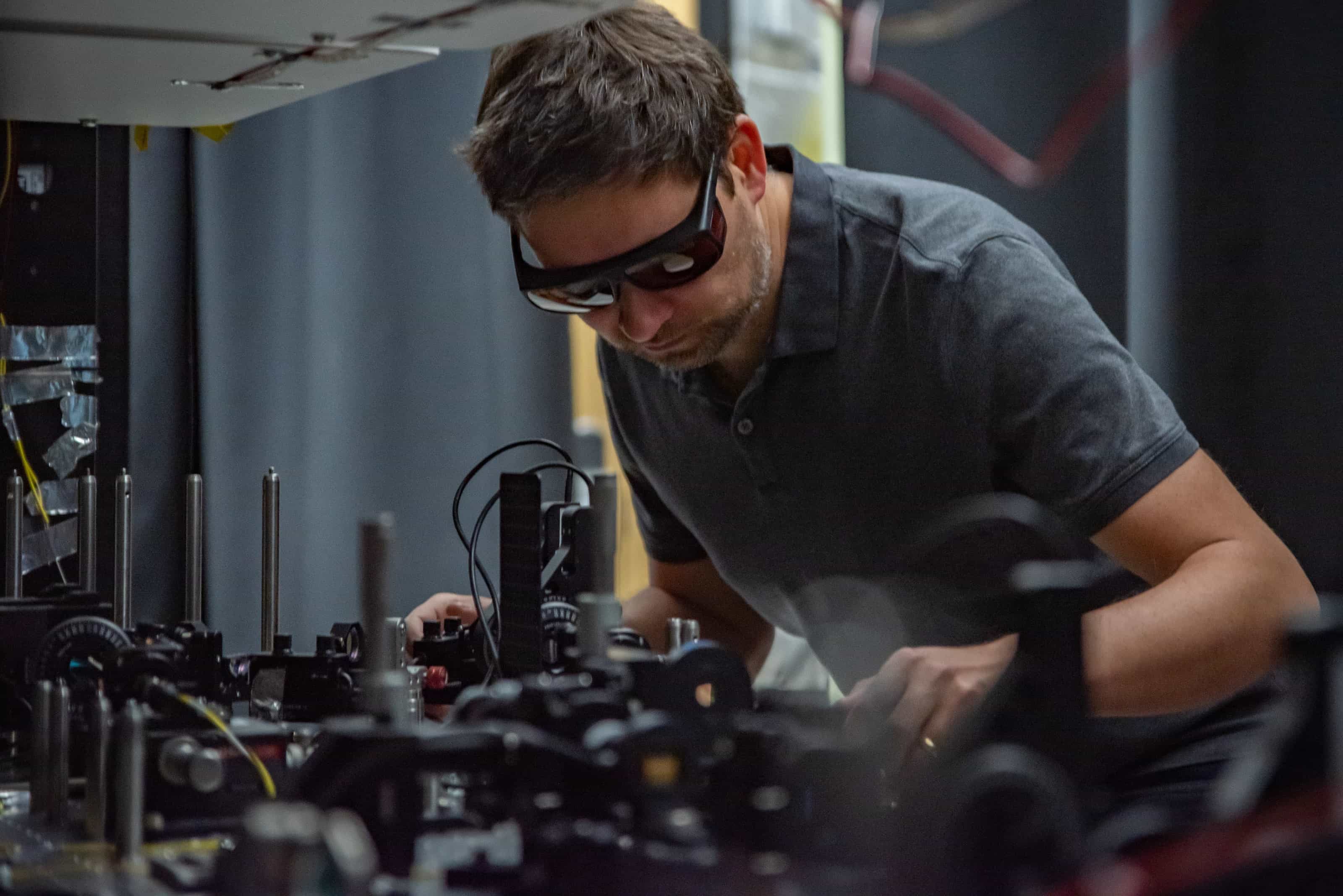
Krister Shalm working in lab · Image credit: R. Wilson/NIST · Public domain (NIST, US government work)
Topic
Quantum
The rules of the very small — stranger than intuition, and tested to extraordinary precision.
Quantum mechanics is the most precisely tested theory in science, and also the one that most offends common sense. Particles behave like waves until they are detected. Pairs of particles can share correlations that no local, pre-arranged plan could produce.
These articles stay close to what experiments actually show. Start with entanglement, see how entangled light is made in the lab, then follow a single photon through the quantum eraser — and find out what erasing really means.
Suggested reading order
Quantum entanglement: what it is (and isn’t)
Distant particles give results that no instructions they carry can explain, unless something passes between them or the experiments are rigged. Fifty years of tests agree. None of it lets you send a message faster than light.
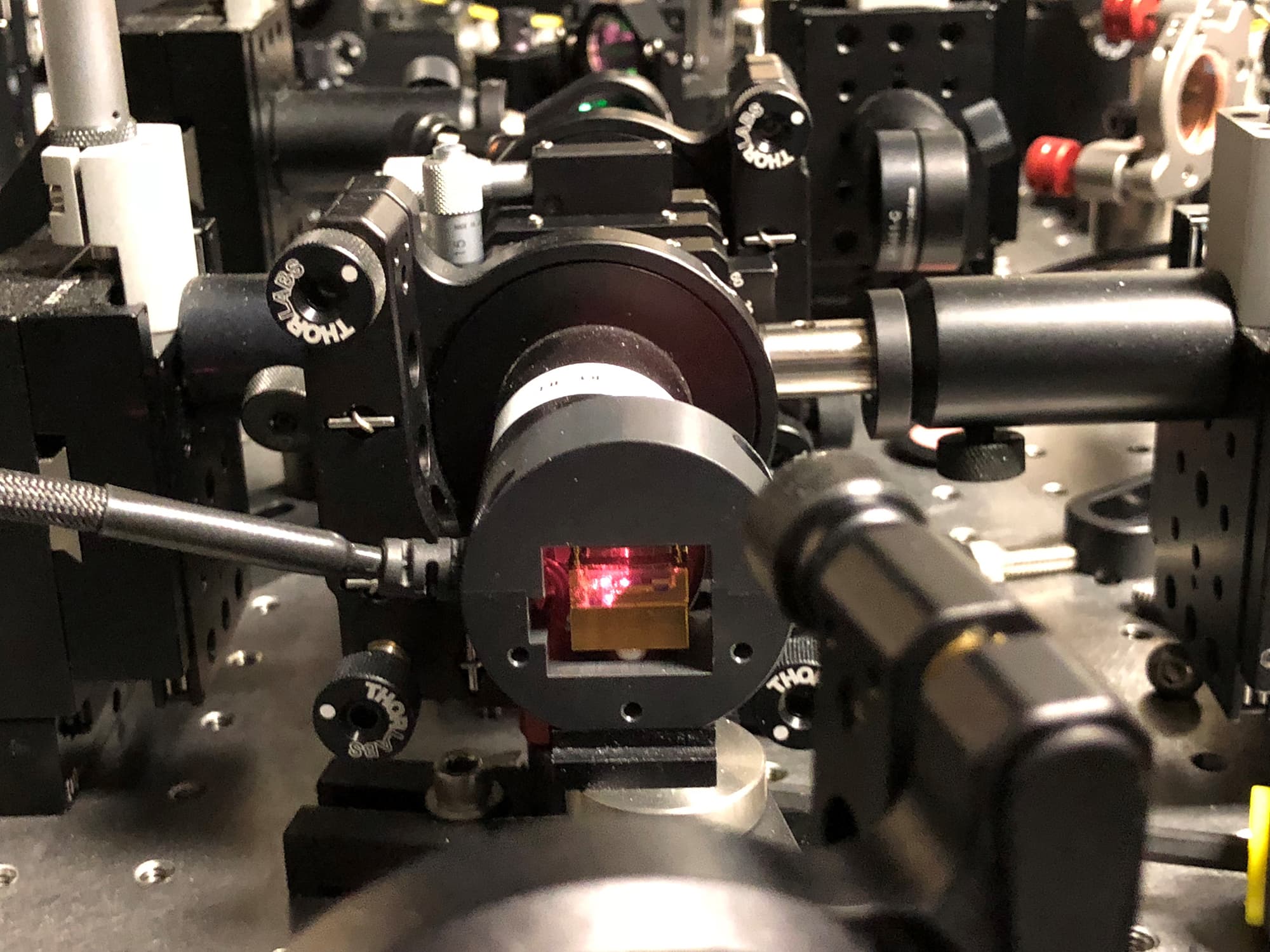
How entanglement is actually made
Shine a violet laser into the right crystal and, very rarely, one photon splits into two; with the right geometry, their polarizations are entangled. Here is the physics, from a lab bench to a satellite.
The quantum eraser: single photons, a double slit, and what “erasing” really means
Tag which slit each photon took and the stripes vanish. Erase the tag and they come back, but only in half the light. That half is the whole trick, and nothing travels back in time.
Key concepts
- entanglement
- A link between particles that are described by one shared state, so their measurement results are correlated in ways no pre-arranged plan can explain, however far apart they are.
- superposition
- A situation in which a quantum system is in a combination of possible states at once, with the outcome of a measurement not decided until it is made.
- photon
- The smallest possible packet of light of a given color; detectors register light as a series of these individual clicks.
- Bell inequality
- A limit on how strongly the results at two distant detectors can agree if each particle carries its own pre-set answers and nothing travels between the detectors; entangled particles break it.
- interference
- The pattern of bright and dark bands made when two overlapping waves add up in some places and cancel in others.
Other topics: Statistics of Discovery · Relativity · Cosmology · Particles & Neutrinos · Spaceflight