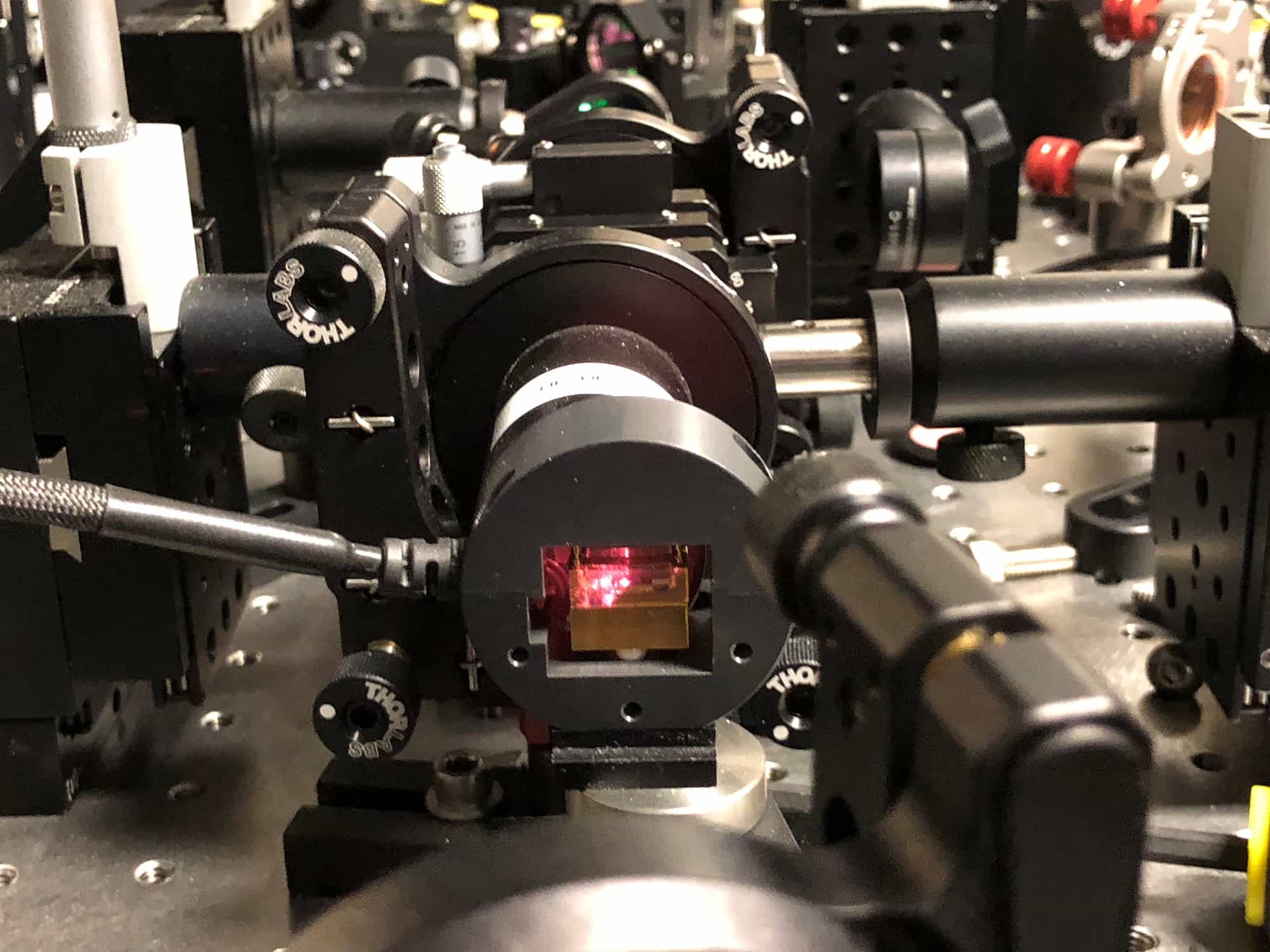
Creating Random Numbers with Quantum Mechanics · Image credit: Shalm/NIST · Public domain (NIST, US government work)
Quantum22 min read
How entanglement is actually made
Shine a violet laser into the right crystal and, very rarely, one photon splits into two; with the right geometry, their polarizations are entangled. Here is the physics, from a lab bench to a satellite.
Companion video: How entanglement is actually made (Part 1) ↓
Laboratories make entangled light with a laser and a sliver of transparent crystal, from a fraction of a millimetre to a centimetre or two long Reference 1Reference 2. Almost all of the laser light goes straight through. But every so often one particle of light, a photon, vanishes and two new ones appear in its place Reference 3. Catch those twins in the right directions and their polarizations (the direction in which each light wave wiggles, up-down or side-to-side) are entangled. Quantum theory gives neither photon a definite polarization until it is checked. Yet in the classic setup, check both for “up-down or side-to-side” and they come out opposite (ideally every time); check both along diagonal directions instead and their answers are still tightly linked, which is what lets such pairs beat the limits that ready-made answers would obey Reference 4Reference 2.
The process is called spontaneous parametric down-conversion (SPDC): “down-conversion” because one high-energy photon is converted into two lower-energy ones (“parametric” is a technical label you can safely ignore) Reference 3. This article follows one photon through the crystal and ends 500 km up, with the Chinese satellite Micius, which shared such pairs between two observatories 1,203 km apart Reference 2. What entanglement is (and isn’t) is the subject of our companion explainer. Testing it with a Bell experiment (a test that rules out pre-set answers) is a story for a future article.
A crystal that almost never splits light
In ordinary glass, photons slow down a little, bend at surfaces, and come out the same color. Some crystals behave more strangely. Their atoms are arranged with no center of symmetry: swap every point with the point directly opposite it through the center, and the crystal looks different. As a result, the electrons respond to a strong light wave in a lopsided way Reference 6. That lopsided response lets such a nonlinear crystal mix light: merge two photons into one of higher energy or, in reverse, split one photon into two Reference 3.
The split happens on its own, with no second beam to trigger it, hence spontaneous. Pre-quantum (“classical”) physics can’t explain it: with no second beam, nothing in that picture would start the split. Quantum theory predicts it, and gives each incoming “pump” photon only a tiny chance of splitting Reference 3.
How tiny? A review of the field puts the fraction of pump photons that split somewhere between one in a hundred thousand and one in a trillion, depending on the crystal and the setup Reference 3. Experiments collect only some of the pairs a crystal makes: those flying in the right directions with the right colors. The Micius satellite’s source, for example, delivered 5.9 million pairs per second into its collection optics from 30 milliwatts (mW, thousandths of a watt) of violet light with a wavelength of 405 nanometres (nm, billionths of a metre). That beam carries some 6 × 10¹⁶ photons per second, so about one photon in ten billion ended up as a collected pair; the crystal itself made more pairs than that Reference 2.
≈ 1 in 10 billion
Pump photons giving a collected pair · Micius source
5.9 million pairs per second delivered from about 30 mW of 405 nm violet light Reference 2. Our calculation.
Each split is a matter of chance, so pairs appear at unpredictable moments Reference 3. Experiments pick out the twins by coincidence counting: two detectors, and a record of only those clicks that arrive within a few billionths of a second of each other Reference 3Reference 2. The faint glow from such splits, called parametric fluorescence, was already being reported in 1967 Reference 7Reference 8. In 1970 David Burnham and Donald Weinberg showed that it comes in simultaneous pairs: shining an ultraviolet laser into a crystal of ammonium dihydrogen phosphate, they saw coincidences only when the two detectors sat where conservation of energy and momentum said the partners should go Reference 9.
For physicistsThe state that comes out, and what the rates count1 equation · pairs per pump photon
With a classical pump, the lowest-order output is (Eq. 25 of Ref. Reference 3)
with proportional to pump intensity, so the pair rate is linear in pump power; two pairs at once have probability of order Reference 3.
Per-pump-photon figures depend on what is counted (calc/micius.ts):
- Micius Reference 2: is the source brightness, estimated from coincidences in a 0.01% sample of the fiber-coupled output (Fig. 2 caption; the paper does not say whether detector efficiency was corrected for). Divided by photons s⁻¹ (30 mW at 405 nm), it gives pairs in the collected modes, not every split.
- Two-crystal type-I BBO (351.1 nm) Reference 1: about entangled pairs s⁻¹ mW⁻¹ in a 5 nm band, extrapolated from ~8% of the cone, is per pump photon; the authors’ 30 nm extrapolation gives . Both are band- and direction-limited lower bounds.
- Detected entangled pairs, 1995 type-II source: more than 1,500 s⁻¹ from 150 mW Reference 4, or per pump photon (only light near the crossings is collected).
Step by step
One photon in, two photons out
Figure: Side view: a violet beam of photons, drawn as dots, travels from the left toward a rectangular BBO crystal.
Figure: The beam passes straight through the crystal and out the other side. A note says 1 mW carries about 2.0 × 10¹⁵ photons per second and that in the satellite source described later about one in 10¹⁰ ends up as a collected pair.
Figure: One photon splits into two, drawn in orange, leaving the crystal on opposite sides of the beam, each labelled about 810 nm. The angles are drawn four times larger than the real 3 degrees or so.
Figure: Energy bars: a 3.06 eV bar for the 405 nm photon equals two stacked 1.53 eV bars for the two 810 nm photons.
Figure: Momentum arrows. Top: if all three photons were ordinary-polarized, the pump arrow would be 1.9% longer than the two daughter arrows placed end to end. Bottom: in BBO, with the pump and one daughter extraordinary and the pump at 41.6 degrees to the optic axis, the lengths match.
Figure: Two rings on a screen behind the crystal, one labelled H (extraordinary), one labelled V (ordinary), touching at the beam position. A dashed line joins one pair: a point on each ring, on opposite sides of the beam.
Figure: With the crystal tilted by 1.2 degrees the two rings overlap and cross at two points, marked in orange, 6.0 degrees apart.
The energy budget
A photon’s energy is set by its wavelength: the shorter the wavelength, the more energy it carries. Physicists measure such small energies in electronvolts (eV), the energy an electron picks up when pushed by one volt. A 405 nm violet photon carries 3.06 eV and an 810 nm photon carries 1.53 eV, so a violet photon can split into two 810 nm photons with nothing left over.
But “two 810 nm photons” is only the average. The crystal doesn’t insist on an even split. A pair might be one 800 nm photon and one 820.25 nm photon: unequal shares, same total. (Not 820 nm, because energy goes with one divided by the wavelength, so wavelengths don’t split evenly.) Uneven pairs leave at slightly different angles, thickening the cones described below. Experiments put color filters in front of the detectors that pass only a narrow band of wavelengths: a band 5 nm wide in the classic 1995 experiment, 20 nm wide at the satellite’s ground stations Reference 4Reference 2Reference 3.
The hard part: momentum
Momentum is the trickier bookkeeping. In empty space a photon’s momentum is also set by its wavelength, and a 405 nm photon carries exactly twice the momentum of an 810 nm one, so splitting it straight ahead into two 810 nm photons would balance perfectly. Inside a crystal, though, light slows down by a factor called the refractive index: an index of 1.69 means light’s wave crests advance 1.69 times slower than in vacuum. Slowed light has its crests packed closer together. That runs against school intuition, where a slower ball carries less momentum, but for light inside a material the momentum that must balance goes with how tightly the crests are packed, so it grows by the same factor Reference 3Reference 5.
Here’s the catch. In almost every transparent material, violet light is slowed more than infrared light Reference 3. In BBO, light with what is called the “ordinary” polarization (explained below) has an index of 1.692 at 405 nm but only 1.660 at 810 nm Reference 10. If those were the only indices on offer, the pump photon’s momentum would come out 1.9% larger than its two daughters’ combined.
That sounds small, but it is fatal. Pairs are made all along the crystal, and their light only builds up if it stays in step, like a crowd clapping in time. With a 1.9% mismatch, light made a little deeper in the crystal drifts out of step with light made earlier. After about 6 micrometres (μm, thousandths of a millimetre) it is fully out of step and starts cancelling what came before, so almost nothing comes out Reference 5. That distance is far shorter than any crystal in this story.
The way out, in BBO, is birefringence. In a birefringent crystal, how fast light travels depends on its polarization. For one polarization, called ordinary, the refractive index is the same in every direction. For the other, called extraordinary, the index changes with the angle between the light and a special direction in the crystal called the optic axis. In BBO the extraordinary index is the smaller one Reference 3. So by sending an extraordinary pump in at just the right angle, you can lower its index until the books balance.
This is phase matching: the condition that the new photons’ momenta add up exactly to the pump’s, so that light made throughout the crystal stays in step Reference 3. It comes in two flavors. In type-I, the two new photons have the same polarization. In type-II, they have perpendicular polarizations, one ordinary and one extraordinary Reference 3Reference 4. For type-II, with a 405 nm pump and two 810 nm photons travelling straight ahead, our calculation with modern measurements of BBO gives a pump angle of 41.6° to the optic axis Reference 10. Crystals are cut, their faces sliced at a chosen angle to the internal structure, so that this angle is reached when the laser hits the face squarely, then fine-tuned by tilting Reference 4.
Birefringence isn’t the only trick. In a periodically poled crystal, the crystal’s lopsidedness is manufactured to flip direction every few micrometres, right where the light would start cancelling itself. Each flip pulls the light back into step, so the split keeps building up without any special angle, and the light can even travel straight along one of the crystal’s natural axes Reference 5. One such material, periodically poled potassium titanyl phosphate (PPKTP), with its pattern repeating every 10.0 μm (one flip every 5 μm), has been used to split 405 nm photons into 810 nm pairs that leave together in a straight line, tuned by temperature rather than angle Reference 11. Micius carried this kind of crystal Reference 2.
For physicistsPhase matching in BBO and in periodically poled crystals5 equations · checks against published cuts
Energy and wavevector conservation are (Eqs. 4–5 of Ref. Reference 3)
A residual mismatch suppresses the output by ; light generated at different depths slips by π over the coherence length Reference 3Reference 5. In BBO (negative uniaxial) the extraordinary index follows the index ellipsoid (Eq. 35 of Ref. Reference 3),
and degenerate collinear type-II (, ) requires
With the Sellmeier equations of Tamošauskas et al. (Eq. 1 of Ref. Reference 10, valid 0.188–5.2 μm): , at 405 nm; , at 810 nm. All-ordinary waves would give , and .
Solving gives . Our same calculation with the older Eimerl (1987) Sellmeier fit, as reprinted in Ref. Reference 3 (Eqs. 33–34, with the first constant’s typo 2.27405 corrected to 2.7405), gives ; we have not opened the original Eimerl paper. Checks of the code against published cuts:
- Type-I doubling of 800 nm: 29.21° vs the 29.2° cut used in Ref. Reference 10.
- Collinear type-II 351.1 nm → 702.2 nm: 49.10° vs Kwiat et al.’s nominal 49.2° cut Reference 4.
Quasi-phase matching. Reversing the sign of with period Λ adds a grating wavevector, shifting the condition to ; first order () flips the sign every coherence length Reference 5. Because no birefringence is needed, all waves can propagate along a crystal axis without spatial (Poynting-vector) walk-off Reference 5.
Two cones of light
Phase matching doesn’t pick a single direction. Send one daughter photon slightly up and its partner slightly down, and the momentum books can still balance: the sideways pushes cancel because the partners leave on opposite sides of the beam Reference 4. The allowed directions form a ring, so the photons fly out along cones. In type-II each cone sits off to one side of the beam rather than centered on it, and there are two of them: ordinary and extraordinary light are slowed by different amounts, so their allowed directions differ Reference 4Reference 3. In the classic 1995 experiment the two cones were vertically and horizontally polarized, and every pair had one photon on each Reference 4.
Tilting the crystal by a degree or so changes everything. At the straight-ahead cut (the angle at which pairs could leave exactly along the beam), each cone’s edge just reaches the beam, so the two cones touch there. Tilt one way and they pull apart Reference 4; about 1.4° from the touching point, our calculation shows, the equal-color cones shrink to two narrow beams and then vanish Reference 12 (the crystal still makes unequal-color pairs, such as 782 nm plus 840 nm). Tilt the other way and the cones lean in toward the beam and cross along two lines Reference 4, which show up as two points on a screen behind the crystal. In our calculation, a tilt of about 1.2° puts the crossings 6° apart. Try it below.
Explorable · try it
Tilt the crystal, move the cones
3D VIEW · DRAG TO ROTATE · ANGLES DRAWN 4× LARGER THAN REAL · COMPUTED: calc/phase-matching.ts
Assumptions and simplifications
- A single-wavelength, parallel pump beam and pairs with exactly twice its wavelength; real filters pass a band, thickening each ring.
- BBO indices from Tamošauskas and colleagues (2018). Near the touching point a 0.2° error in the cut moves the crossings by nearly a degree, so treat the numbers as approximate.
- Tilt is measured outside the crystal, in the plane containing its optic axis, from the cut at which the cones just touch; angles are in air, after the exit face.
- Crystal thickness, beam width and sideways drift are ignored. The 3D view draws angles 4× larger than real; the flat ring view is true scale.
- The “351 → 702 nm (1995)” setting reproduces the 1995 crystal (cut 49.2°, tilted 0.72°): measured crossings 6.0° apart, our model 5.1°.
For physicistsHow the cones are computedvector phase matching · Snell’s law · comparison with experiment
For an extraordinary daughter with unit wavevector we solve
around the full azimuth; the ordinary partner is . The pump’s internal direction follows from Snell’s law with its own extraordinary index, and each daughter is refracted out through a face parallel to the entrance face (tangential conserved). A general method is given by Boeuf et al. Reference 13.
Checks against experiment:
- Two-crystal type-I source (cut 33.9°, 351.1 nm): computed external half-opening 2.95° vs 3.0° reported Reference 1.
- Kwiat et al. 1995 (cut 49.2°, external tilt 0.72°): internal pump angle 49.64° vs 49.63° reported; crossings 5.15° apart (Tamošauskas indices) or 5.99° (Eimerl fit) vs 6.0° measured Reference 4. The two index models’ phase-matching angles differ by 0.2°, enough to move the crossings by 0.8°.
- Tilt robustness: from each model’s own touching cut, 6° crossings need 1.229° (Tamošauskas) vs 1.237° (Eimerl).
A review quotes “about 3°” between the two photons for this kind of source Reference 3; we read this, as Kwon and colleagues’ 408 nm calculation supports (3.3°) Reference 12, as each photon’s angle from the pump: 3.0° at our 6° crossings. The crystal is not cut at 90°, where the cones would overlap on the beam, because the efficiency vanishes there (note 19 of Ref. Reference 4).
Where the cones cross
Look along one of the two crossing lines. A photon arriving there might be a horizontally polarized photon from one cone, or a vertically polarized photon from the other. Its partner, at the opposite crossing, is the reverse. If nothing in the experiment can tell these two possibilities apart, the pair is described by a superposition, a quantum combination of both at once: “horizontal here, vertical there” and “vertical here, horizontal there” Reference 4. That is polarization entanglement. Every pair is already entangled in energy and direction, because both photons share one pump photon’s energy and momentum Reference 1; the crossings add entanglement in polarization, which is far easier to work with in practice Reference 4.
It is more than each photon secretly leaving with an opposite polarization. Pairs like that would show no link at all when checked along diagonal directions. Entangled pairs stay linked there too, and checking diagonal directions is how experimenters show that both possibilities are truly present at once Reference 4. Turning that link into a test that no pre-set answers can pass is what a Bell experiment does.
The crossing-cone source was demonstrated in a 1995 experiment by Paul Kwiat, Anton Zeilinger and colleagues in Innsbruck and Maryland, who note that such a source had also been suggested by A. Garuccio Reference 4. Nearly all earlier down-conversion experiments discarded half their detected pairs. The type-II crossings gave the entangled state directly, with no detected pairs discarded Reference 4, though light away from the crossings goes unused Reference 1. Zeilinger later shared the 2022 Nobel Prize in Physics, whose citation begins “for experiments with entangled photons” Reference 14.
Erasing the clues
There is a catch, and it comes from the same birefringence that made phase matching possible. Inside the crystal, horizontally and vertically polarized photons travel at different speeds and drift slightly sideways relative to each other Reference 4Reference 3. Because one polarization is always the faster one, the order in which the two detectors fire could, in principle, reveal which cone each photon came from, and then the entanglement is lost Reference 4.
Kwiat’s team put the delay in their 3 mm crystal at 385 femtoseconds (millionths of a billionth of a second). Each photon is a burst of wave about that long, so a delay that size could reveal which arrived first Reference 4. Their fix was a half-wave plate, a thin optic that swaps horizontal and vertical polarization, in each beam, followed by a second BBO crystal half as long as the first. Why half? A pair born at the entrance face crosses all 3 mm, so the faster polarization builds up its full head start; a pair born at the exit gets none. With the polarizations swapped, the 1.5 mm crystal takes half of that full head start back: the entrance pair ends half a head start ahead, the exit pair half behind. Every pair that would arrive “horizontal first” now has a twin, born the same distance on the other side of the crystal’s middle, that arrives “vertical first” by the same amount, so timing no longer gives the answer away. The same trick largely corrects the sideways drift too Reference 4.
For physicistsWalk-off and its compensation2 formulas · a discrepancy we could not resolve
Pairs created near the entrance face of a crystal of length acquire a relative delay and lateral offset Reference 4
with the group velocities and the walk-off angle (cf. Eq. 37 of Ref. Reference 3; its Eq. 36 is written with phase indices). For 405 nm → 810 nm type-II BBO at the collinear cut, : 0.072 mm of offset and 0.19 ps of delay per millimetre.
Kwiat et al. report fs and mm for 3.0 mm at 702 nm, with coherence time “about the same” Reference 4. Our recomputation with either index model gives 0.77 ps and 0.21 mm. The paper’s delay equals ours for half the length, the mean delay over creation depths; we cannot tell which convention was intended. A 5 nm filter at 702 nm gives fs.
With a half-wave plate and an crystal in each arm, pairs created at from the middle interfere pairwise; a full-length crystal in one arm also works (note 24) Reference 4. A birefringent element or slight tilt sets α in , and wave plates in one arm select any of the four Bell states Reference 4.
From 1995 to the classroom
The 1995 source was not the violet-laser setup shown above. The team pumped a 3 mm BBO crystal with ultraviolet light at 351.1 nm from an argon-ion laser, so their twin photons came out at 702 nm rather than 810 nm. The crystal was cut at 49.2° and tilted by 0.72°, which put the two crossing lines 6.0° apart Reference 4.
It counted more than 1,500 entangled pairs per second, with a cleanliness score called visibility of 97.8 ± 1.0% (100% is perfect) Reference 4. The team violated a Bell inequality, a limit that pairs carrying pre-set answers can never beat, by more than 100 standard deviations, a measure of how far a result sits beyond what chance could easily produce (more on that here). Like all tests of its time, it relied on extra assumptions about the detectors and the source Reference 4.
Four years later Kwiat and colleagues introduced a brighter design: two thin type-I crystals stacked face to face, one rotated a quarter turn relative to the other Reference 1. Each crystal splits only one pump polarization, and both photons of its pairs share one polarization, at right angles to the pump’s. Pump with light polarized at 45°, half-horizontal and half-vertical, and a pair could have come from either crystal. If the two cones overlap well enough to hide which, pairs all the way around the cone are expected to be entangled, as “both horizontal” plus “both vertical”: instead of two crossing points, the whole ring becomes usable, which is why the design is brighter Reference 1. Here the photons always match instead of disagreeing; both kinds of pair are entangled. The design was more than ten times brighter per unit of pump power, with a raw visibility of 98.8 ± 0.2% (99.6% after subtracting accidental coincidences, clicks from unrelated photons that happened to arrive together) Reference 1.
With an affordable 405 nm violet diode laser, the two-crystal design became an undergraduate experiment. One 2002 classroom version used a 5 mW diode and two crystals 0.1 mm thick, and still violated a Bell inequality Reference 6.
Splitting pairs from orbit
In 2017 a team led by Jian-Wei Pan reported sending entangled photons from Micius, a 635 kg satellite orbiting about 500 km up, to two ground stations: Delingha, in Qinghai province, and the Gaomeigu Observatory near Lijiang, in Yunnan, 1,203 km apart Reference 2.
Its source used the same splitting physics but balanced momentum differently, with no BBO cones at all. A 405 nm laser diode pumped a 15 mm PPKTP crystal inside a loop of mirrors called a Sagnac interferometer Reference 2. The pump light was split by polarization and sent round the loop both ways at once, so a pair could be born from light going clockwise or anticlockwise. A polarizing beam splitter (an optic that sends horizontally and vertically polarized light in different directions) merged the two routes so that nothing reveals which, the same “hide the origin” trick as the crossing cones, giving polarization-entangled pairs at about 810 nm Reference 2Reference 11.
Why go to space? In fiber, every kilometre swallows the same fraction of the light, so losses multiply with distance. From orbit, most of the path is nearly empty space, where almost nothing absorbs the light; photons are still lost as the beam spreads and is pointed imperfectly, and to absorption and turbulence concentrated in the lowest 10 km or so of the atmosphere Reference 2Reference 15. For standard fiber the authors estimate 10⁻¹⁷ pairs per second from a source making 10 million pairs per second: about one pair every three billion years, by our arithmetic. Even the best commercial fiber of the time would have been about a trillion times (12 orders of magnitude) less efficient than the satellite, and, the authors estimate, fiber at silica’s physical loss limit would still lose by 5 to 7 orders of magnitude Reference 2. Despite heavy losses on the way down, the stations recorded about one photon pair per second, roughly eight in nine of them real pairs rather than chance clicks Reference 2.
The pairs arrived still entangled: the team estimated a fidelity (a score of how close the pairs were to perfect entanglement, where 1 is perfect) of at least about 0.87, with an uncertainty of 0.09 Reference 2. A Bell test gave a score of S = 2.37 ± 0.09, above the limit of 2 that any explanation based on pre-set instructions carried by each photon must obey, by about four standard deviations Reference 2. That is short of five, the traditional threshold for claiming a discovery in particle physics, as a preprint (a paper shared before formal peer review) by Louis Lyons discusses Reference 16 (see our five-sigma explainer). But this was a check, at a new distance, of an effect laboratory Bell tests had already confirmed many times, some by more than 100 standard deviations Reference 6Reference 4. In 2020 the same satellite delivered pairs to Delingha and Nanshan, 1,120 km apart, and the team used them for quantum key distribution, building a shared secret key at 0.12 bits per second Reference 17.
For physicistsMicius by the numberslink budget · fiber comparison · CHSH
- Link budget. for dB, so 64–82 dB is to . Times the 5.9 MHz brightness, that is 2.3 to 0.04 pairs per second, consistent with the measured 1.1 Hz average. Coincidence window 2.5 ns, 20 nm filters, signal-to-noise about 8:1 Reference 2.
- Fiber Reference 2: 2 × 600 km at 0.2 dB/km gives from ; at 0.16 dB/km, . The paper quotes 17 and 12 orders of magnitude, and 5–7 for silica’s limit (0.095–0.13 dB/km); our arithmetic from their link efficiency gives 17.3, 12.5 and 5–9.
- Geometry. Slant ranges 545–1,680 km (Delingha) and 560–1,700 km (Lijiang) Reference 2; our geodesic between the station coordinates is 1,204.5 km.
- State. Close to ; after distribution HV and VH dominated in H/V, ++ and −− in the diagonal basis (contrast 16:1); on board Reference 2.
- CHSH. 1,167 detected pairs (“trials”) in 1,059 s gave , ; the quantum maximum is . Freedom-of-choice is addressed under the additional assumption that hidden variables originate with the photon pair (Fig. 6 caption of Ref. Reference 2).
Open questions
A 2018 review noted that the process’s low efficiency limits applications, and listed efforts to improve it using optical fibers, light-guiding channels etched in silicon, semiconductor chips and engineered “metamaterials” Reference 3.
As of 2022, the Nobel committee reported that a satellite in a higher orbit was under construction that would distribute entangled pairs directly over 10,000 km Reference 15.
Finally, every long-distance Bell test has to contend with photon loss and with assumptions about how measurement settings are chosen, the so-called loopholes. Which of those assumptions the Micius test needed is the subject of a future article Reference 2.
How sure are we?
EVIDENCE LEVELS ARE EDITORIAL JUDGEMENTS OF THE WHOLE BODY OF EVIDENCE — NOT σ VALUES · What these mean
In a nonlinear crystal, a pump photon can split into two photons that share its energy and momentum.
Evidence level: EstablishedParametric fluorescence was reported in 1967 and shown in 1970 to come in simultaneous pairs; quantum-optics labs have used it ever since Reference 7Reference 8Reference 9Reference 3.
Photons collected at the crossings of type-II cones are polarization-entangled, once timing clues from the crystal are removed or made negligible.
Evidence level: EstablishedDemonstrated in 1995 with 97.8% visibility, then used for many later quantum-communication experiments Reference 4Reference 1.
Only a tiny fraction of pump photons split.
Evidence level: EstablishedA review puts it between about one in a hundred thousand and one in a trillion; collected-pair rates such as Micius’s (about one in ten billion) fit that picture Reference 3Reference 2.
By our calculation, a 405 nm type-II BBO source needs a cut near 41.6°, and a tilt of about 1.2° from the touching point puts the crossings 6° apart.
Evidence level: Strong evidenceOur model calculation with peer-reviewed index data. It matches a published cone angle and crystal cuts to 0.1–0.2° and the one published crossing separation to within about 1° (5.15° vs 6.0°), and the 1.2° tilt barely depends on the index data. An independent 408 nm calculation gives 41.5° Reference 10Reference 4Reference 1Reference 12.
Entangled photon pairs survived being split between ground stations 1,203 km apart by the Micius satellite.
Evidence level: Strong evidencePeer-reviewed, described by the Nobel committee, and extended by the same team in 2020; the Bell violation is about four standard deviations Reference 2Reference 15Reference 17. Reported: S = 2.37 ± 0.09, Bell-inequality violation by 4 standard deviations (raw coincidences)
What the video simplified
In the video: The Micius satellite used this setup to send entangled photons 1,200 km.
More precisely: Micius used the same splitting physics but different hardware and a different way of balancing momentum. Its source was a periodically poled (PPKTP) crystal inside a Sagnac interferometer, pumped at 405 nm, not crossing BBO cones. The 1,203 km is the distance between the two ground stations; each photon itself travelled 545–1,700 km Reference 2.In the video: A 405 nm violet laser in a BBO crystal makes the entangled pairs.
More precisely: That is a common modern version. The 1995 experiment that introduced the crossing-cones source used a 351.1 nm argon-ion laser and produced 702 nm photons Reference 4. The undergraduate 405 nm setup described above uses the two-crystal type-I design rather than type-II cones Reference 6Reference 1.In the video: About one in billions of photons splits.
More precisely: Fair as an order of magnitude for the pairs a bright source delivers: about one in ten billion pump photons for Micius Reference 2. Counting every split in every direction and color, the fraction depends strongly on the crystal and setup, from about one in a hundred thousand to one in a trillion Reference 3.In the video: The photon splits into two 810 nm photons.
More precisely: Only on average: the split can be uneven, for example 800 nm plus 820.25 nm. Filters keep the near-equal pairs Reference 4Reference 2.In the video: Taking photons where the cones intersect gives entanglement.
More precisely: Only once the crystal is tilted past the touching angle, and (unless the crystal is thin or the filters narrow) after compensating crystals erase the timing clues Reference 4.In the video: Momentum is conserved.
More precisely: True, but it is measured inside the crystal, where it depends on the refractive index. BBO balances it with birefringence and a cut accurate to a fraction of a degree; periodically poled crystals such as Micius’s use a built-in pattern instead Reference 3Reference 5Reference 2.
Further reading
Start here Accessible
The Royal Swedish Academy of Sciences, How entanglement has become a powerful tool (Popular science background, The Nobel Prize in Physics 2022) (2022). https://www.nobelprize.org/uploads/2022/10/popular-physicsprize2022.pdf (accessed 12 October 2026)Free
The Nobel committee’s plain-language story of entanglement experiments, from atoms to crystals to satellites.The Royal Swedish Academy of Sciences, Press release: The Nobel Prize in Physics 2022, Nobel Prize Outreach (2022). https://www.nobelprize.org/prizes/physics/2022/press-release/ (accessed 12 October 2026)Free
The 2022 Nobel announcement, with the prize citation and short summaries of each laureate’s work.
Go deeper Intermediate
C. Couteau, Spontaneous parametric down-conversion, Contemp. Phys. 59, 291–304 (2018). https://doi.org/10.1080/00107514.2018.1488463 · Free version: arXiv:1809.00127 [quant-ph]Free on arXiv
A readable review of down-conversion: the theory, BBO in practice, and what the photon pairs are used for.D. Dehlinger and M. W. Mitchell, Entangled photons, nonlocality, and Bell inequalities in the undergraduate laboratory, Am. J. Phys. 70, 903–910 (2002). https://doi.org/10.1119/1.1498860 · Free version: arXiv:quant-ph/0205171 [quant-ph]Free on arXiv
How to build a violet-diode entangled-photon source and a Bell test with undergraduate equipment.
Technical Primary literature
P. G. Kwiat, K. Mattle, H. Weinfurter, A. Zeilinger, A. V. Sergienko, and Y. Shih, New High-Intensity Source of Polarization-Entangled Photon Pairs, Phys. Rev. Lett. 75, 4337–4341 (1995). https://doi.org/10.1103/PhysRevLett.75.4337Paywall
The type-II crossing-cones source, with walk-off compensation and all four Bell states.P. G. Kwiat, E. Waks, A. G. White, I. Appelbaum, and P. H. Eberhard, Ultrabright source of polarization-entangled photons, Phys. Rev. A 60, R773-R776 (1999). https://doi.org/10.1103/PhysRevA.60.R773 · Free version: arXiv:quant-ph/9810003 [quant-ph]Free on arXiv
The two-crystal type-I source used in many teaching setups.D. S. Hum and M. M. Fejer, Quasi-phasematching, Comptes Rendus. Physique 8, 180–198 (2006). https://doi.org/10.1016/j.crhy.2006.10.022Free
A review of quasi-phase matching in periodically poled crystals.T. Kim, M. Fiorentino, and F. N. C. Wong, Phase-stable source of polarization-entangled photons using a polarization Sagnac interferometer, Phys. Rev. A 73, 012316 (2006). https://doi.org/10.1103/PhysRevA.73.012316 · Free version: arXiv:quant-ph/0509219 [quant-ph]Free on arXiv
The polarization Sagnac source with PPKTP, the design family used on Micius.N. Boeuf, D. A. Branning, I. Chaperot, E. Dauler, S. Guerin, G. S. Jaeger, A. Muller, and A. L. Migdall, Calculating characteristics of noncollinear phase matching in uniaxial and biaxial crystals, Optical Engineering 39, 1016–1024 (2000). https://doi.org/10.1117/1.602464Paywall
How to compute non-collinear phase matching in uniaxial and biaxial crystals.J. Yin et al., Satellite-based entanglement distribution over 1200 kilometers, Science 356, 1140–1144 (2017). https://doi.org/10.1126/science.aan3211 · Free version: arXiv:1707.01339 [quant-ph]Free on arXiv
The Micius entanglement-distribution experiment over 1,203 km.
References
Numbered in order of first citation. Journal articles link to their DOI; where a free version exists on arXiv we link it too. Preprints are marked as not peer reviewed.
- Reference 1: P. G. Kwiat, E. Waks, A. G. White, I. Appelbaum, and P. H. Eberhard, Ultrabright source of polarization-entangled photons, Phys. Rev. A 60, R773-R776 (1999). https://doi.org/10.1103/PhysRevA.60.R773 · Free version: arXiv:quant-ph/9810003 [quant-ph]Back to citation 1 of reference 1Back to citation 2 of reference 1Back to citation 3 of reference 1Back to citation 4 of reference 1Back to citation 5 of reference 1Back to citation 6 of reference 1Back to citation 7 of reference 1Back to citation 8 of reference 1Back to citation 9 of reference 1Back to citation 10 of reference 1Back to citation 11 of reference 1
- Reference 2: J. Yin et al., Satellite-based entanglement distribution over 1200 kilometers, Science 356, 1140–1144 (2017). https://doi.org/10.1126/science.aan3211 · Free version: arXiv:1707.01339 [quant-ph]Back to citation 1 of reference 2Back to citation 2 of reference 2Back to citation 3 of reference 2Back to citation 4 of reference 2Back to citation 5 of reference 2Back to citation 6 of reference 2Back to citation 7 of reference 2Back to citation 8 of reference 2Back to citation 9 of reference 2Back to citation 10 of reference 2Back to citation 11 of reference 2Back to citation 12 of reference 2Back to citation 13 of reference 2Back to citation 14 of reference 2Back to citation 15 of reference 2Back to citation 16 of reference 2Back to citation 17 of reference 2Back to citation 18 of reference 2Back to citation 19 of reference 2Back to citation 20 of reference 2Back to citation 21 of reference 2Back to citation 22 of reference 2Back to citation 23 of reference 2Back to citation 24 of reference 2Back to citation 25 of reference 2Back to citation 26 of reference 2Back to citation 27 of reference 2Back to citation 28 of reference 2Back to citation 29 of reference 2Back to citation 30 of reference 2
- Reference 3: C. Couteau, Spontaneous parametric down-conversion, Contemp. Phys. 59, 291–304 (2018). https://doi.org/10.1080/00107514.2018.1488463 · Free version: arXiv:1809.00127 [quant-ph]Back to citation 1 of reference 3Back to citation 2 of reference 3Back to citation 3 of reference 3Back to citation 4 of reference 3Back to citation 5 of reference 3Back to citation 6 of reference 3Back to citation 7 of reference 3Back to citation 8 of reference 3Back to citation 9 of reference 3Back to citation 10 of reference 3Back to citation 11 of reference 3Back to citation 12 of reference 3Back to citation 13 of reference 3Back to citation 14 of reference 3Back to citation 15 of reference 3Back to citation 16 of reference 3Back to citation 17 of reference 3Back to citation 18 of reference 3Back to citation 19 of reference 3Back to citation 20 of reference 3Back to citation 21 of reference 3Back to citation 22 of reference 3Back to citation 23 of reference 3Back to citation 24 of reference 3Back to citation 25 of reference 3Back to citation 26 of reference 3Back to citation 27 of reference 3Back to citation 28 of reference 3Back to citation 29 of reference 3Back to citation 30 of reference 3Back to citation 31 of reference 3
- Reference 4: P. G. Kwiat, K. Mattle, H. Weinfurter, A. Zeilinger, A. V. Sergienko, and Y. Shih, New High-Intensity Source of Polarization-Entangled Photon Pairs, Phys. Rev. Lett. 75, 4337–4341 (1995). https://doi.org/10.1103/PhysRevLett.75.4337Back to citation 1 of reference 4Back to citation 2 of reference 4Back to citation 3 of reference 4Back to citation 4 of reference 4Back to citation 5 of reference 4Back to citation 6 of reference 4Back to citation 7 of reference 4Back to citation 8 of reference 4Back to citation 9 of reference 4Back to citation 10 of reference 4Back to citation 11 of reference 4Back to citation 12 of reference 4Back to citation 13 of reference 4Back to citation 14 of reference 4Back to citation 15 of reference 4Back to citation 16 of reference 4Back to citation 17 of reference 4Back to citation 18 of reference 4Back to citation 19 of reference 4Back to citation 20 of reference 4Back to citation 21 of reference 4Back to citation 22 of reference 4Back to citation 23 of reference 4Back to citation 24 of reference 4Back to citation 25 of reference 4Back to citation 26 of reference 4Back to citation 27 of reference 4Back to citation 28 of reference 4Back to citation 29 of reference 4Back to citation 30 of reference 4Back to citation 31 of reference 4Back to citation 32 of reference 4Back to citation 33 of reference 4Back to citation 34 of reference 4Back to citation 35 of reference 4Back to citation 36 of reference 4
- Reference 5: D. S. Hum and M. M. Fejer, Quasi-phasematching, Comptes Rendus. Physique 8, 180–198 (2006). https://doi.org/10.1016/j.crhy.2006.10.022Back to citation 1 of reference 5Back to citation 2 of reference 5Back to citation 3 of reference 5Back to citation 4 of reference 5Back to citation 5 of reference 5Back to citation 6 of reference 5Back to citation 7 of reference 5Back to citation 8 of reference 5
- Reference 6: D. Dehlinger and M. W. Mitchell, Entangled photons, nonlocality, and Bell inequalities in the undergraduate laboratory, Am. J. Phys. 70, 903–910 (2002). https://doi.org/10.1119/1.1498860 · Free version: arXiv:quant-ph/0205171 [quant-ph]Back to citation 1 of reference 6Back to citation 2 of reference 6Back to citation 3 of reference 6Back to citation 4 of reference 6
- Reference 7: S. E. Harris, M. K. Oshman, and R. L. Byer, Observation of Tunable Optical Parametric Fluorescence, Phys. Rev. Lett. 18, 732–734 (1967). https://doi.org/10.1103/PhysRevLett.18.732Back to citation 1 of reference 7Back to citation 2 of reference 7
- Reference 8: D. Magde and H. Mahr, Study in Ammonium Dihydrogen Phosphate of Spontaneous Parametric Interaction Tunable from 4400 to 16 000 Å, Phys. Rev. Lett. 18, 905–907 (1967). https://doi.org/10.1103/PhysRevLett.18.905Back to citation 1 of reference 8Back to citation 2 of reference 8
- Reference 9: D. C. Burnham and D. L. Weinberg, Observation of Simultaneity in Parametric Production of Optical Photon Pairs, Phys. Rev. Lett. 25, 84–87 (1970). https://doi.org/10.1103/PhysRevLett.25.84Back to citation 1 of reference 9Back to citation 2 of reference 9
- Reference 10: G. Tamošauskas, G. Beresnevičius, D. Gadonas, and A. Dubietis, Transmittance and phase matching of BBO crystal in the 3−5 μm range and its application for the characterization of mid-infrared laser pulses, Optical Materials Express 8, 1410 (2018). https://doi.org/10.1364/ome.8.001410Back to citation 1 of reference 10Back to citation 2 of reference 10Back to citation 3 of reference 10Back to citation 4 of reference 10Back to citation 5 of reference 10
- Reference 11: T. Kim, M. Fiorentino, and F. N. C. Wong, Phase-stable source of polarization-entangled photons using a polarization Sagnac interferometer, Phys. Rev. A 73, 012316 (2006). https://doi.org/10.1103/PhysRevA.73.012316 · Free version: arXiv:quant-ph/0509219 [quant-ph]Back to citation 1 of reference 11Back to citation 2 of reference 11
- Reference 12: O. Kwon, Y.-W. Cho, and Y.-H. Kim, Single-mode coupling efficiencies of type-II spontaneous parametric down-conversion: Collinear, noncollinear, and beamlike phase matching, Phys. Rev. A 78, 053825 (2008). https://doi.org/10.1103/PhysRevA.78.053825Back to citation 1 of reference 12Back to citation 2 of reference 12Back to citation 3 of reference 12
- Reference 13: N. Boeuf, D. A. Branning, I. Chaperot, E. Dauler, S. Guerin, G. S. Jaeger, A. Muller, and A. L. Migdall, Calculating characteristics of noncollinear phase matching in uniaxial and biaxial crystals, Optical Engineering 39, 1016–1024 (2000). https://doi.org/10.1117/1.602464Back to citation 1 of reference 13
- Reference 14: The Royal Swedish Academy of Sciences, Press release: The Nobel Prize in Physics 2022, Nobel Prize Outreach (2022). https://www.nobelprize.org/prizes/physics/2022/press-release/ (accessed 12 October 2026)Back to citation 1 of reference 14
- Reference 15: The Nobel Committee for Physics, Scientific Background on the Nobel Prize in Physics 2022: “For experiments with entangled photons, establishing the violation of Bell inequalities and pioneering quantum information science”, The Royal Swedish Academy of Sciences (2022). https://www.nobelprize.org/uploads/2026/05/advanced-physicsprize-2022-5.pdf (accessed 12 October 2026)Back to citation 1 of reference 15Back to citation 2 of reference 15Back to citation 3 of reference 15
- Reference 16: L. Lyons, Discovering the Significance of 5 sigma, arXiv:1310.1284 [physics.data-an] (2013).Preprint · not peer reviewedBack to citation 1 of reference 16
- Reference 17: J. Yin et al., Entanglement-based secure quantum cryptography over 1,120 kilometres, Nature 582, 501–505 (2020). https://doi.org/10.1038/s41586-020-2401-yBack to citation 1 of reference 17Back to citation 2 of reference 17
Cite this article
Five Sigma, “How entanglement is actually made,” Five Sigma (12 October 2026), https://thefivesigma.com/articles/how-entanglement-is-made. Version of 12 October 2026.
Spotted an error?
We correct mistakes openly and log every change on our corrections page. Report an error in this article.
Was this article clear?
The video
60-second video · coming soonHow entanglement is actually made (Part 1)
Terms in this article
Keep reading
Quantum entanglement: what it is (and isn’t)
Distant particles give results that no instructions they carry can explain, unless something passes between them or the experiments are rigged. Fifty years of tests agree. None of it lets you send a message faster than light.
The quantum eraser: single photons, a double slit, and what “erasing” really means
Tag which slit each photon took and the stripes vanish. Erase the tag and they come back, but only in half the light. That half is the whole trick, and nothing travels back in time.