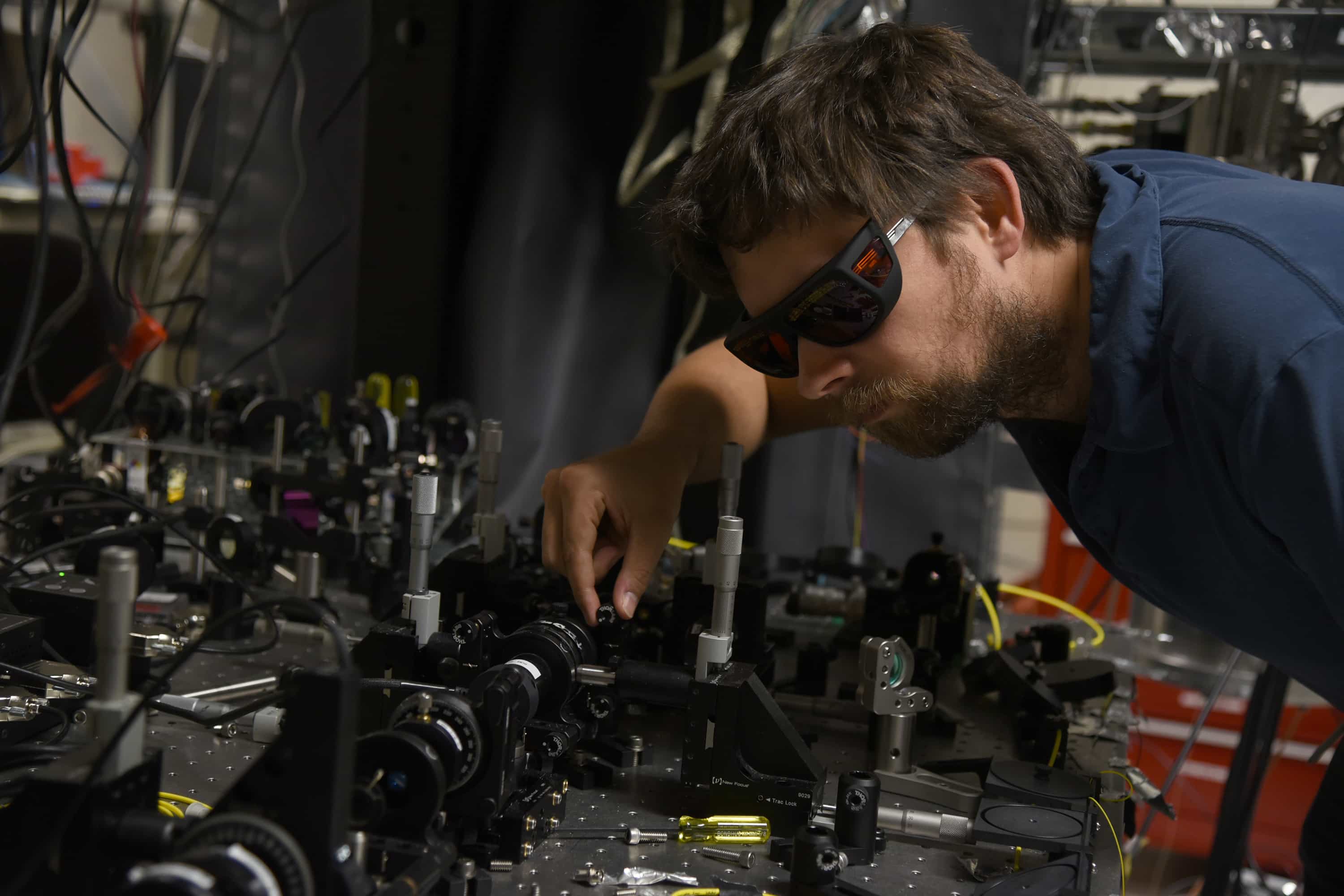
NIST Physicist Krister Shalm and the Bell test · Image credit: J. Burrus/NIST · Public domain (NIST, US government work)
Quantum22 min read
Quantum entanglement: what it is (and isn’t)
Distant particles give results that no instructions they carry can explain, unless something passes between them or the experiments are rigged. Fifty years of tests agree. None of it lets you send a message faster than light.
Companion video: Quantum entanglement — what it is (and isn’t) ↓
Contents
- Two stations and a stream of pairs
- The boring explanation: Bertlmann’s socks
- Bell’s twist: tilt one filter
- Fifty years of tests
- What it rules out, and what it doesn’t
- Why you still can’t send a message
- What entanglement is actually good for
- Open questions
- How sure are we?
- What the video simplified
- Further reading
- References
Picture two research stations, one on Earth and one on Mars. Halfway between them, a machine fires pairs of particles of light, one particle of each pair toward each station. Each station holds a filter at an angle of its own choosing and writes down, for every particle, a single word: passed or blocked.
Read either notebook alone and it looks like a record of coin flips, whatever the other station did. A radio message between the two takes at least 3 minutes, and up to 22 minutes, depending on where the planets are Reference 1Reference 2. Only when the two notebooks are finally laid side by side does a pattern appear. And the pattern is stronger than any plan the particles could have agreed on before they left.
No one has done this between planets; the farthest such test we found, in 2017, used two ground stations about 1,200 km apart, supplied by a satellite Reference 3. Nothing in the physics depends on the distance.
That pattern is called entanglement. It has been tested for half a century, in labs on five continents Reference 4, and testing it won the 2022 Nobel Prize in Physics Reference 5. The measurements are as solid as physics gets. What they mean for the nature of reality is still argued over. And one popular claim is simply wrong: entanglement cannot be used to send a message, at any speed.
Two stations and a stream of pairs
The particles in most such experiments are photons, the smallest possible packets of light. Light has a polarization: the direction, across its path, in which the light wave vibrates. A polarizing filter, like the one in polarized sunglasses, has its own direction. Two handy reference directions are horizontal and vertical: a horizontal filter passes horizontally vibrating light and blocks vertically vibrating light.
A single photon either passes or it doesn’t. If its polarization sits at an angle to the filter, quantum mechanics, the theory physicists use for atoms and light, only gives the odds. So each station’s notebook is a list of passes and blocks, which we can write as +1 and −1.
An entangled pair is different. Quantum mechanics describes the two photons together, by one shared quantum state (the full description of how a system responds to any measurement, odds included), not a separate state for each. In that description, neither photon has a polarization of its own. The pair is in a superposition, a combination of “both horizontal” and “both vertical” at once. What is fixed is only the relationship: the two photons give the same result whenever both filters point the same way, whatever that direction. This joint description is entanglement Reference 6. Whether each photon’s result is somehow already settled before it is measured is exactly what interpretations of quantum mechanics disagree about; more on that below. Erwin Schrödinger named entanglement in 1935, calling it “the characteristic trait of quantum mechanics” Reference 6Reference 7Reference 8.
First experimental fact: set both filters to the same angle, and the notebooks match line by line, perfectly in an ideal experiment, very nearly in real labs. Yet each list on its own is random Reference 9Reference 10.
For physicistsThe state, and the sign convention used on this page2 equations · conventions
Throughout this article the pairs are polarization-entangled photons in the Bell state
measured with linear polarizers at angles (Earth) and (Mars), outcomes . The joint probabilities are , so the correlation and the agreement rate are
This is the convention of Aspect, Grangier and Roger’s 1982 analysis (their Eq. 5, up to a reduction factor for imperfect polarizers and finite collection angles) Reference 10. For the anti-correlated state the sign flips, ; for spin-½ particles in the singlet state, with the angle between the analyzers Reference 11. Photon polarization repeats every 180°, so a polarizer angle corresponds to a spin angle . Every figure on this page uses : “same result” at equal angles.
Aspect, Grangier and Roger used a polarizing beam splitter with a detector on each output, so “blocked” was recorded, not inferred from silence Reference 10. Single-detector stations, including both 2015 photon tests, instead count a non-detection as an outcome, which the CH–Eberhard inequality uses Reference 12Reference 13. A pure two-particle state is entangled when it is not a product Reference 6.
The boring explanation: Bertlmann’s socks
Matching alone isn’t mysterious. In 1981 the physicist John Bell wrote an essay about his colleague Reinhold Bertlmann, who habitually wore two socks of different colors Reference 9Reference 14. Which color is on which foot is unpredictable, but once you see that one sock is pink, you know the other is not. Nothing travels from foot to foot; the socks were chosen that way in the morning.
Bell asked: isn’t entanglement just the same Reference 9? That was, in effect, the argument Albert Einstein, Boris Podolsky and Nathan Rosen had made in 1935. If you can predict with certainty what a distant measurement will show, without disturbing the distant particle, then the result must have been fixed in advance. Quantum mechanics, which only gives odds, must then be incomplete Reference 15.
In this picture each photon carries a hidden set of answers, one for every angle a filter might be set to. Physicists call these hidden variables: properties we can’t see, which decide the results. The worldview behind it has a name, local realism, and it has two parts. Realism: the results exist before anyone looks. Locality: what is done at one station cannot affect the other faster than light. Socks obey local realism; most of us assume everything does.
For physicistsEPR, Bohm, and what ‘local’ means formally1 equation · ~2 min
EPR’s criterion: “If, without in any way disturbing a system, we can predict with certainty … the value of a physical quantity, then there exists an element of physical reality corresponding to this physical quantity” Reference 15. Their example used position and momentum; the spin version is due to Bohm in 1951; photon-polarization versions followed Reference 6.
A local hidden-variable model writes every joint probability as
with independent of the settings Reference 16Reference 17. The factorization encodes locality; the setting-independence of is the separate assumption of measurement independence (“free choice”). Bell stressed that determinism is not assumed: with perfect correlations it is inferred from locality, and his general argument makes no use of it Reference 9.
Bell’s twist: tilt one filter
Socks handle matching filters perfectly. Bell’s 1964 insight, worked out for spinning particles, was to look elsewhere Reference 11. For photons: turn Mars’s filter 22.5° away from Earth’s and ask how often results still agree.
Quantum mechanics says about 85% of the time; at 67.5°, only about 15%. In between, agreement follows a smooth curve you can play with below Reference 10. Now try to build socks, that is, instructions, that do this. Bell wrote down a natural scheme in his 1964 paper. In its photon version, each pair carries a hidden direction, and a photon passes if its filter is within 45° of that direction. The photons then disagree only when one filter’s 45° zone covers the hidden direction and the other’s doesn’t, a quarter of the time: 75% agreement, and 25% at 67.5° Reference 11. It matches quantum mechanics at 0°, 45° and 90°, but not in between.
Could a cleverer scheme close the gap? Bell proved it can’t, and the core argument fits in a few lines Reference 9. Suppose every pair carries instructions and the notebooks always match at parallel filters. Compare 0°, 22.5° and 45°.
- Quantum mechanics says that at 0° versus 22.5° the results differ 14.645% of the time (the flip side of “about 85%” agreement). The same holds for 22.5° versus 45°.
- Because parallel filters always match, both photons in a pair must carry the same list. Take a pair whose list reads: pass at 0°, pass at 22.5°, block at 45°. It gives different results at 0° and 45°, so its answer had to flip somewhere along the way, here between 22.5° and 45°. Every pair that differs on the big step must also differ on at least one small step. So instructions that copy quantum mechanics on both small steps can make the results at 0° versus 45° differ at most 14.645% + 14.645% = 29.29% of the time.
- Quantum mechanics predicts 50%.
So no set of instructions can copy quantum mechanics on all three comparisons. This needs two further assumptions: what happens at one station doesn’t depend on the other’s setting (locality), and the source doesn’t know in advance which settings will be picked (“free choice”, more below). It also leans on the perfect match at parallel filters.
A version that real, imperfect experiments can test came in 1969, from John Clauser, Michael Horne, Abner Shimony and Richard Holt: the “CHSH” test, after their initials Reference 17. Each station switches between two settings, making four combinations. For each combination, take how often the results agree minus how often they disagree. Add three of those numbers and subtract the fourth. The total is called S. Instructions can never push it past 2. Quantum mechanics reaches 2√2, about 2.83, at the best angles, and no quantum state can do better Reference 6Reference 16. Limits like these are called Bell inequalities.
Step by step
Two stations, one ledger
The setup. Pairs fly out to Earth and Mars. Each station chooses a filter angle and records pass or block. Neither can tell the other anything for at least 3 minutes.
Figure: A pair source in the middle sends photons to an Earth station and a Mars station, both filters at 0°. A message between them takes 3.0 to 22.3 minutes.
Both filters at 0°. Each row of results looks like coin flips, but the two rows match square for square: 32 of 32. Socks could do this.
Figure: Both filters at 0°: two rows of 32 results, one per station, are identical, 32 of 32, though each looks random.
Tilt Mars’s filter to 22.5°. Now some results differ. Over 1,000 simulated pairs, entangled photons agree about 84% of the time and Bell’s instruction scheme about 74%, close to the expected 85% and 75%.
Figure: Mars tilted to 22.5°: a few results differ. Simulated entangled pairs agree 84.2% of 1,000 times (expected 85.4%); Bell’s instruction scheme 73.8% (expected 75.0%).
Sweep the angle from 0° to 90°. Quantum agreement follows a smooth curve. The instruction scheme is a straight line. They touch at 0°, 45° and 90° and differ most at 22.5° and 67.5°.
Figure: Agreement versus angle between filters: the quantum curve bows away from the straight instructions line, 85.4% versus 75.0% at 22.5°, 14.6% versus 25.0% at 67.5°.
Why instructions fail. Quantum mechanics gives 14.645% disagreement on each small 22.5° step. Instructions that copied that could disagree at most 29.29% on the big 45° step; quantum mechanics says 50%. Bell’s scheme escapes only by disagreeing 25% on each small step.
Figure: How often results differ: 14.645% for each 22.5° step, so instructions that copy that allow at most 29.29% for 45°. Quantum mechanics predicts 50.00%.
The score S, pair by pair. Early on, chance noise is large. After 100,000 simulated pairs, entangled pairs sit near 2.83; the instruction scheme hugs the limit of 2.
Figure: Running score S against pairs measured, log scale to 100,000: entangled pairs settle at 2.82 ± 0.01, near the quantum maximum 2.83; instructions settle at 1.99 ± 0.01, at the limit of 2.
Real experiments: all above 2. Filled points are loophole-free tests (explained below); two more, with photons, used a different score. Imperfect equipment keeps scores below 2.83.
Figure: Measured S with error bars, all above 2: Aspect 1982, 2.697; Weihs 1998, 2.73; Hensen 2015, 2.42; Rosenfeld 2017, 2.221; Micius 2017, 2.37; Storz 2023, 2.0747. Filled points are loophole-free.
No message. Whatever angle Mars picks, about half of Earth’s photons pass. The pattern exists only in the comparison, and the comparison travels at light speed or slower.
Figure: Share of Earth’s photons that pass for five Mars angles from 0° to 90°: all close to 50%. Earth’s results alone reveal nothing about Mars’s choice.
For physicistsCHSH, the local model, and the simulation behind the figure4 equations · ~4 min
The CHSH combination is
with for every local hidden-variable model. For with , , , , each term is and , the Tsirelson bound Reference 18Reference 16. Bell’s explicit local model (hidden unit vector, outcomes given by sign functions Reference 11) gives, in polarization language, for . At the CHSH angles it gives exactly ; in the symmetric geometry it gives for every . Among local models that reproduce the quantum values at 0°, 45° and 90°, the triangle bound below forces , so, if results depend only on the angle between the filters, 75% agreement at 22.5° is the best they can do.
The plain-language argument above is Bell’s 1981 “sock-washing” inequality in photon form Reference 9: with perfect same-angle correlation and instruction sets, , while quantum mechanics gives : .
The simulation samples quantum outcomes from the joint distribution, which uses both settings at once (itself nonlocal, Bell’s point); the instructions model draws and outputs within 45° of . Standard error: . Seed 20261012; 10,000 pairs give ; 100 pairs give , not distinguishable from 2. As a game: local strategies win at most 75% of rounds, ideal entangled pairs , with when the four setting pairs are equally frequent Reference 19Reference 20.
Try it yourself: turn the two filters below and watch where quantum mechanics pulls away from Bell’s instruction scheme.
Explorable · try it
Turn the dials: quantum pairs versus hidden instructions
Simulated pairs show the random scatter around each prediction.
Assumptions and simplifications
- Photon pairs prepared so that their results always match when the two filters are parallel.
- Perfect filters and detectors, no lost photons and no background noise. Real experiments see somewhat weaker correlations.
- “Instructions” means Bell’s simple local scheme (the straight line). No local scheme that also matches quantum mechanics at 0°, 45° and 90° can beat it on average, and none can push the S score past 2 Reference 11Reference 9Reference 17.
- The “Send 1,000 pairs” button runs a random simulation whose quantum part works out both stations’ results together, something isolated stations with instructions could not do.
Fifty years of tests
According to the Nobel committee, no experiment had tested the inequality before John Clauser and Stuart Freedman did so in Berkeley, in 1972 Reference 6Reference 21. Using photon pairs from calcium atoms and about 200 hours of data, they measured a cousin of S that instructions keep at zero or below (given a reasonable assumption about photons their detectors missed). They found 0.050 ± 0.008, in line with quantum mechanics Reference 21. The ± part is the measurement’s uncertainty; the Nobel committee calls the result six standard deviations, six times that uncertainty above zero Reference 6.
In Orsay, near Paris, Alain Aspect and colleagues sharpened the test. In 1982 they measured S = 2.697 ± 0.015. Quantum mechanics predicted 2.70 ± 0.05 for their real, imperfect equipment, below the ideal 2.83, with an uncertainty from small imperfections in the filters Reference 10.
Later that year they switched the filter settings while the photons were already on their way. Each switch, 6 m from the source, changed the setting about every 10 nanoseconds (billionths of a second), faster than light crosses the 12 m between the filters (40 nanoseconds) Reference 22Reference 6. But the switching followed a regular, almost repeating rhythm, which the authors called “quasiperiodic” rather than truly random. A hidden mechanism could in principle have predicted the settings, so the locality loophole (below) was not fully closed; the Nobel committee calls the experiment “not ideal” Reference 22Reference 6. In 1998 an Innsbruck team put the stations 400 m apart and chose each setting with a fast physical random-number generator, finding S = 2.73 ± 0.02 Reference 23.
Loopholes, and closing them
A Bell test rules out instructions only if its own setup leaves no back door. Physicists call these back doors loopholes. Two mattered most.
The locality loophole: if the stations are too close, or the settings chosen too early or too predictably, some slower-than-light signal could, in principle, tell one side what the other is doing. Distance and fast, truly random settings close it.
The detection loophole: detectors miss photons. Imagine instructions that say “if the filter is set where I would spoil the pattern, don’t show up.” If detectors miss many photons anyway, those no-shows go unnoticed, and the counted pairs can look more correlated than instructions allow Reference 16. For the simplest test, losing more than about one photon in six is already too many. The Nobel committee credits trapped ions (single charged atoms held by electric fields, read out almost every time) with closing it first, in 2001, but only micrometers apart, leaving the locality loophole open Reference 24Reference 6Reference 16.
In 2015 three teams closed both at once Reference 6Reference 20Reference 12Reference 13. In Delft, Hensen, Hanson and colleagues used two tiny defects in diamond, 1.3 km apart. In each, a nitrogen atom sits beside a missing carbon atom, trapping electrons whose spin (a tiny built-in magnetism) can hold a quantum state. Each defect sent a photon to a middle station; when both arrived just right, the distant electrons became entangled. That rarely worked: 245 successful rounds in 220 hours. In each, both sites had to choose a random setting and read out their electron within 4.27 microseconds (millionths of a second), the time light takes to cross between them. The result, S = 2.42 ± 0.20, is modest but meaningful: if the world ran on local instructions, a result this strong would turn up by luck at most about 4% of the time Reference 20.
That year, teams in Vienna and at the US National Institute of Standards and Technology (NIST) in Boulder, Colorado, closed both with photons, using superconducting detectors (cooled until electric current flows without resistance) that catch most photons Reference 12Reference 13. A Munich team followed in 2017 with atoms 398 m apart Reference 25, and in 2023 a team did it with superconducting circuits, a leading candidate technology for quantum computers (machines that compute with quantum effects), linked over 30 m Reference 26. All broke the limit.
The loophole that can’t be shut
One assumption is different in kind. The derivation assumes that the settings are chosen independently of whatever the particles carry. If the “random” choices and the particles were secretly correlated from the start, the whole argument would fail. Bell put it vividly: separate parts of the world would be “deeply and conspiratorially entangled, and our apparent free will would be entangled with them” Reference 9.
No experiment can rule this out: as the Delft team put it, no Bell test can exclude every conceivable local-realist theory, only those in which the settings really are free and the recorded results are final Reference 20. Experiments can only make it more far-fetched. In 2016 about 100,000 online-game players supplied settings for 13 experiments in 12 labs on five continents Reference 4. In 2018 an experiment on La Palma, in the Canary Islands, chose settings from the color of light emitted by quasars, the brilliant cores of extremely distant galaxies. Any conspiracy would have had to be arranged at least 7.8 billion years ago, when that light set out. But the test caught too few of its entangled photons to close the detection loophole, so it assumes the ones caught were typical, and that the quasar light arrived unaltered Reference 27. Another 2018 test, using starlight, reached back only about 11 years but closed both main loopholes at once Reference 28.
In October 2022 the Nobel Prize in Physics went to Aspect, Clauser and Anton Zeilinger “for experiments with entangled photons, establishing the violation of Bell inequalities and pioneering quantum information science”, the field of using quantum effects to store, send and process information Reference 5.
For physicistsLoophole details, efficiencies and reported significancesthresholds · p-values · ~3 min
Detection. For the CHSH test with maximally entangled states, a local model can reproduce the data unless the detection efficiency exceeds . Using partially entangled states and a Clauser–Horne/Eberhard inequality lowers the threshold to Reference 16Reference 29. Both 2015 photon tests took this route. Vienna had system heralding efficiencies of about 78.6% and 76.2% Reference 12. NIST had system efficiencies of 74.7% and 75.6% (the bare detectors were efficient), against a threshold of 72.5% once its background counts are included Reference 13. Freedman and Clauser, with far lower efficiencies, needed a supplementary assumption about the photons their detectors missed Reference 17Reference 16.
Statistics. Hensen et al. (any local-realist model, arbitrary memory, measured generator bias) obtained , wins in trials Reference 20; our binomial check, , reproduces it. Giustina et al. report a -value not exceeding for their CH–Eberhard violation, “corresponding to an 11.5 standard deviation effect” Reference 12. Shalm et al. report as small as , or after allowing for predictability of the setting choices Reference 13.
Free choice. Milky Way stars pushed free choice back 600 years Reference 30; Li et al. used 183 m and report Reference 28.
What it rules out, and what it doesn’t
Put together, the experiments show that three things cannot all be true: local realism’s two parts (results fixed in advance by properties the particles carry; nothing traveling faster than light) and free choice of the settings (plus the usual assumption that each measurement has a single result, which many-worlds denies). Which one goes is where physicists disagree, and so far the disagreement is about interpretation, not data Reference 6.
- Give up locality, in Bell’s sense. In Bohmian mechanics, also called pilot-wave theory because a wave guides the particles, everything is deterministic, but a result can depend on how the distant filter is set. It reproduces ordinary quantum mechanics, at least for particles well below light speed, and is openly nonlocal: an event in one place can instantly change hidden values in a distant one Reference 13Reference 6Reference 11. Bell himself concluded that we can’t rule out that what is done at one station somehow causes what happens at the other Reference 9.
- Give up results that exist before they are measured. Niels Bohr held that properties which cannot be measured together cannot both be said to have values, and the many-worlds interpretation says every possible result happens, each in a separate branch Reference 6Reference 31. Asher Peres and Daniel Terno argue that since quantum mechanics never gives the photons answers, nothing has to travel; only theories insisting on pre-set answers need faster-than-light influences Reference 32. That this avoids nonlocality is disputed: Bell argued that his theorem’s real target is locality, since in the ideal case pre-set results follow from locality itself Reference 9.
- Give up free choice. “Superdeterministic” theories deny that the settings are independent of the particles’ properties. Sabine Hossenfelder and Tim Palmer argue it deserves a hearing and might be testable, while acknowledging it is usually dismissed quickly Reference 33. We know of no experimental evidence for it.
The first two options make the same predictions Reference 6. In some interpretations something does happen instantly at a distance, but in none can the far station notice it, so it can’t carry a message.
Why you still can’t send a message
Look only at Earth’s notebook. Whatever Mars does, turning its filter, measuring or not measuring at all, about half of Earth’s photons pass and half are blocked, in a random order Reference 16. Mars’s choice leaves no trace in Earth’s results alone. That is the no-communication theorem, a theorem of quantum mechanics, not just a feature of particular experiments Reference 16Reference 32.
So even a faster-than-light influence, if one exists, can’t carry a message, which needs the receiver to see a change in their own notebook. Such an influence would only shape the pattern between the two notebooks, invisible until they are compared, and comparing them means sending ordinary information, at light speed or slower. With Mars between 54.6 and 401.4 million kilometers from Earth, that takes 3 to 22 minutes Reference 1Reference 2. Until then, neither station can learn anything about what the other one chose or did. Bell, who took seriously the possibility of some faster-than-light influence, noted that “messages” faster than light remain impossible in ordinary quantum theory combined with relativity Reference 9.
People have tried to get around this. A 1981 proposal for a faster-than-light “entanglement telegraph” failed, and working out why led to the no-cloning theorem, found by several physicists in 1982: an unknown quantum state cannot be copied Reference 32Reference 34. Copying is the crux. In the textbook description, once Mars measures, Earth’s photon is described as polarized either along Mars’s filter or across it Reference 6. But one photon answers only one pass-or-block question, so Earth can’t read that direction off; that is why Earth’s list still looks random. With many exact copies, Earth could measure them in different ways, find the direction, and so learn how Mars had measured. That would be a message. No-cloning closes the door.
The phrase “spooky action at a distance” comes not from the 1935 paper but from Einstein’s 1947 letter to Max Born Reference 9. It captures his unease, not a signal.
For physicistsNo-signaling, in one line1 equation
For the joint distribution above, Earth’s marginal is
independent of . Every quantum behavior satisfies , and symmetrically; the local set is strictly inside the quantum set, which is strictly inside the no-signaling set Reference 16. Earth does learn something on measuring: what Mars will see if Mars uses the same angle, .
What entanglement is actually good for
Not faster-than-light communication. But it is a genuine resource; the Nobel committee even argued that the loophole-free tests matter less for reconfirming quantum mechanics than for making secret codes (cryptography) more secure Reference 6.
Moving a quantum state. Quantum teleportation, proposed in 1993, rebuilds the exact quantum state of one particle on a distant particle, using a shared entangled pair plus an ordinary message Reference 35. No matter travels; the original state is destroyed, so nothing is copied, and because the ordinary message is needed, nothing outruns light. Groups in Innsbruck (led by Zeilinger) and Rome (led by Francesco De Martini) demonstrated it with photons in 1997 Reference 6Reference 36Reference 37. A Chinese team has since teleported photon states from the ground to the Micius satellite, over distances of up to 1,400 km; here one photon of the pair was sent up to the satellite itself Reference 38.
Secret keys. A secret key is a random string of 0s and 1s, known only to two parties, used to scramble their messages. In 1991 Artur Ekert proposed making keys from entanglement, a form of quantum key distribution: run a Bell test on part of the data to check for eavesdroppers, and turn the rest into the key Reference 39Reference 6. Newer versions go further: if the Bell score is high enough, the key stays secret even if you don’t trust how your own equipment works inside. In 2022 an Oxford team extracted such a key, 95,628 bits from 1.5 million entangled pairs in eight hours, between stations about 2 m apart Reference 19. A Munich team showed that buildings 400 m apart could in principle do the same: its estimated key rate is positive only for very long runs Reference 40. In 2026 a team in Hefei, China, ran the protocol through coils of fiber up to 100 km long, with both atoms in one laboratory. Through 11 km of fiber, its key would stay secret even over a run of realistic length; at 100 km, only for very long runs Reference 41. All still assume the labs are sealed against information leaking out Reference 19Reference 40. They are real demonstrations, still far from practical use.
Linking distant devices. Photons sent through optical fiber are lost steadily along the way, and quantum signals cannot simply be amplified, because amplifying means copying, which the no-cloning theorem forbids Reference 6. One answer is space: in 2017 the Micius satellite delivered entangled photons to ground stations 1,203 km apart, still beating the limit, S = 2.37 ± 0.09 Reference 3. Another, in development, is a chain of quantum repeaters that pass entanglement along in hops, using quantum memories (devices that hold a quantum state for a while without disturbing it) Reference 6.
Computing. Quantum computers store information in qubits (quantum bits); entanglement is part of why they might win, but no magic ingredient. Richard Jozsa and Noah Linden proved that for computations that stay in “pure” quantum states (no added randomness), a big speed-up needs entanglement spread across ever more qubits; for noisier, “mixed” computations it is less clear. Yet they argue it is misleading to view entanglement as a key resource for quantum computing’s power Reference 42. And most highly entangled states would be useless as the starting point for one leading style of quantum computer, which needs the right arrangement of entanglement, not just more Reference 43.
For physicistsDevice-independent key distribution, brieflyprotocol details
Device-independent QKD bounds Eve’s information from the CHSH score and the error rate on the key rounds, so it needs a detection-loophole-free violation. Nadlinger et al. report , no space-like separation, and a finite-size key; lab isolation is “arguably the most critical” remaining assumption Reference 19. Zhang et al.’s proof of concept estimates 0.07 secret bits per event, asymptotically Reference 40; Lu et al. estimate 0.112 bits per event with finite-size security through 11 km of fiber Reference 41.
Open questions
- What do Bell violations mean? Experiments cannot distinguish nonlocal hidden variables, no pre-existing values or many worlds; superdeterminism is a separate, untested idea Reference 32Reference 33.
- How far can the free-choice assumption be pushed? A long way, but the longest reach relied on extra assumptions, and none can remove it entirely Reference 27Reference 28Reference 20.
- Can entanglement be shared over continental distances, on demand? That needs quantum repeaters with good quantum memories, still in development; we found no sourced date for a working network Reference 6.
How sure are we?
EVIDENCE LEVELS ARE EDITORIAL JUDGEMENTS OF THE WHOLE BODY OF EVIDENCE — NOT σ VALUES · What these mean
Entangled pairs show correlations that match quantum mechanics and break Bell’s limit.
Evidence level: EstablishedSeen with photons, ions, atoms, electron spins and superconducting circuits since 1972, including several loophole-free tests Reference 21Reference 10Reference 24Reference 25Reference 20Reference 26.
Entanglement cannot be used to send a message.
Evidence level: EstablishedA theorem of quantum mechanics, never contradicted by experiment Reference 16Reference 32.
No theory of local hidden instructions can explain the results.
Evidence level: Strong evidenceLoophole-free tests on four kinds of system since 2015. The remaining assumption, free choice of settings, can be pushed back but never fully tested Reference 20Reference 12Reference 27. Reported: In one 2015 photon test, the chance that local instructions gave a result this strong by luck was at most 3.74 × 10⁻³¹, “an 11.5 standard deviation effect”, even allowing for memory of earlier rounds and imperfectly random settings Reference 12
Entanglement can secure keys without trusting how the equipment works inside.
Evidence level: Strong evidenceA finite-size key over about 2 m, and an estimated finite-size key rate through 11 km of fiber; up to 100 km of fiber only in the long-run limit. The labs must still be sealed against leaks Reference 19Reference 41.
Which interpretation is right: nonlocal hidden variables, no pre-existing values, or many worlds.
Evidence level: SpeculativeInterpretation: current experiments can’t distinguish it from the alternatives Reference 6Reference 32.
Superdeterminism: the settings were never really free.
Evidence level: SpeculativeProponents argue it could be tested Reference 33; we know of no experimental evidence for it.
What the video simplified
In the video: Measuring one particle instantly sets the state of the other.
More precisely:Nothing observable changes at the far station; each side’s results stay random, and the link shows up only in the comparison Reference 16. Whether anything “happens” at a distance depends on the interpretation Reference 32Reference 9.
In the video: The socks analogy fails.
More precisely:Socks (pre-set instructions) reproduce the perfect match at equal settings just fine; they fail at in-between angles such as 22.5°. That was Bell’s insight Reference 9Reference 11.
In the video: Bell proved that spooky action at a distance is real.
More precisely:Bell proved that no local hidden-variable theory can match quantum mechanics Reference 11. “Spooky action” (Einstein, 1947 Reference 9) is one reading of that, not the result.
In the video: The video put one station in Tokyo and one on Mars.
More precisely:Where on Earth the station sits barely matters: it changes the light-travel time to Mars by at most about 21 milliseconds Reference 44Reference 2. What matters is that comparing results takes 3–22 minutes Reference 1Reference 2.
In the video: Experiments have closed the loopholes.
More precisely:Locality and detection were closed together in 2015 Reference 20Reference 12Reference 13; free choice can be made more plausible, never proven Reference 20Reference 27.
In the video: Entanglement makes communication unhackable.
More precisely:Entanglement-based keys exist, but keys that are secure without trusting the devices have been demonstrated only over about 2 m, or 11 km of coiled fiber in one lab; 400 m and 100 km links only in the limit of very long runs; always with labs sealed against leaks Reference 19Reference 40Reference 41.
In the video: Entanglement lets you teleport things and powers quantum computers.
More precisely:Teleportation moves a quantum state, not matter, and needs an ordinary message too Reference 35. Entanglement is necessary for some quantum speed-ups but not sufficient Reference 42Reference 43.
Further reading
Start here Accessible
The Royal Swedish Academy of Sciences, Popular science background: How entanglement has become a powerful tool (2022). https://www.nobelprize.org/uploads/2022/10/popular-physicsprize2022-3.pdf (accessed 12 October 2026)Free
Illustrated introduction; note its loose talk of one particle “determining” the other.J. S. Bell, BERTLMANN'S SOCKS AND THE NATURE OF REALITY, Le Journal de Physique Colloques 42, C2–41-C2–62 (1981). https://doi.org/10.1051/jphyscol:1981202Free
Bell’s own essay; the sock sections need no equations.
Go deeper Intermediate
R. Bertlmann, Bell’s Universe: A Personal Recollection, in Quantum [Un]Speakables II, edited by R. Bertlmann and A. Zeilinger (Springer International Publishing, 2017), pp. 17–80. https://doi.org/10.1007/978-3-319-38987-5_3 · Free version: arXiv:1605.08081 [physics.hist-ph]Free on arXiv
Bertlmann’s memoir of working with Bell, socks included.The Nobel Committee for Physics, Scientific Background on the Nobel Prize in Physics 2022: “For experiments with entangled photons, establishing the violation of Bell inequalities and pioneering quantum information science”, The Royal Swedish Academy of Sciences (2022). https://www.nobelprize.org/uploads/2026/05/advanced-physicsprize-2022-5.pdf (accessed 12 October 2026)Free
From EPR through the experiments to quantum cryptography.B. Hensen et al., Loophole-free Bell inequality violation using electron spins separated by 1.3 kilometres, Nature 526, 682–686 (2015). https://doi.org/10.1038/nature15759 · Free version: arXiv:1508.05949 [quant-ph]Free on arXiv
A loophole-free test, clear about what it rules out.
Technical Primary literature
N. Brunner, D. Cavalcanti, S. Pironio, V. Scarani, and S. Wehner, Bell nonlocality, Rev. Mod. Phys. 86, 419–478 (2014). https://doi.org/10.1103/revmodphys.86.419 · Free version: arXiv:1303.2849 [quant-ph]Free on arXiv
The standard review of Bell nonlocality.R. Horodecki, P. Horodecki, M. Horodecki, and K. Horodecki, Quantum entanglement, Rev. Mod. Phys. 81, 865–942 (2009). https://doi.org/10.1103/revmodphys.81.865 · Free version: arXiv:quant-ph/0702225 [quant-ph]Free on arXiv
The standard review of entanglement theory.A. Peres and D. R. Terno, Quantum information and relativity theory, Rev. Mod. Phys. 76, 93–123 (2004). https://doi.org/10.1103/revmodphys.76.93 · Free version: arXiv:quant-ph/0212023 [quant-ph]Free on arXiv
Includes a skeptical take on “quantum nonlocality”.
References
Numbered in order of first citation. Journal articles link to their DOI; where a free version exists on arXiv we link it too. Preprints are marked as not peer reviewed.
- Reference 1: D. R. Williams, Mars Fact Sheet, NASA Goddard Space Flight Center (2025). https://nssdc.gsfc.nasa.gov/planetary/factsheet/marsfact.html (accessed 12 October 2026)Back to citation 1 of reference 1Back to citation 2 of reference 1Back to citation 3 of reference 1
- Reference 2: BIPM, Defining constants. https://www.bipm.org/en/measurement-units/si-defining-constants (accessed 12 October 2026)Back to citation 1 of reference 2Back to citation 2 of reference 2Back to citation 3 of reference 2Back to citation 4 of reference 2
- Reference 3: J. Yin et al., Satellite-based entanglement distribution over 1200 kilometers, Science 356, 1140–1144 (2017). https://doi.org/10.1126/science.aan3211 · Free version: arXiv:1707.01339 [quant-ph]Back to citation 1 of reference 3Back to citation 2 of reference 3
- Reference 4: The BIG Bell Test Collaboration, Challenging local realism with human choices, Nature 557, 212–216 (2018). https://doi.org/10.1038/s41586-018-0085-3 · Free version: arXiv:1805.04431 [quant-ph]Back to citation 1 of reference 4Back to citation 2 of reference 4
- Reference 5: The Royal Swedish Academy of Sciences, Press release: The Nobel Prize in Physics 2022, Nobel Prize Outreach (2022). https://www.nobelprize.org/prizes/physics/2022/press-release/ (accessed 12 October 2026)Back to citation 1 of reference 5Back to citation 2 of reference 5
- Reference 6: The Nobel Committee for Physics, Scientific Background on the Nobel Prize in Physics 2022: “For experiments with entangled photons, establishing the violation of Bell inequalities and pioneering quantum information science”, The Royal Swedish Academy of Sciences (2022). https://www.nobelprize.org/uploads/2026/05/advanced-physicsprize-2022-5.pdf (accessed 12 October 2026)Back to citation 1 of reference 6Back to citation 2 of reference 6Back to citation 3 of reference 6Back to citation 4 of reference 6Back to citation 5 of reference 6Back to citation 6 of reference 6Back to citation 7 of reference 6Back to citation 8 of reference 6Back to citation 9 of reference 6Back to citation 10 of reference 6Back to citation 11 of reference 6Back to citation 12 of reference 6Back to citation 13 of reference 6Back to citation 14 of reference 6Back to citation 15 of reference 6Back to citation 16 of reference 6Back to citation 17 of reference 6Back to citation 18 of reference 6Back to citation 19 of reference 6Back to citation 20 of reference 6Back to citation 21 of reference 6Back to citation 22 of reference 6Back to citation 23 of reference 6
- Reference 7: E. Schrödinger, Discussion of Probability Relations between Separated Systems, Mathematical Proceedings of the Cambridge Philosophical Society 31, 555–563 (1935). https://doi.org/10.1017/s0305004100013554Back to citation 1 of reference 7
- Reference 8: C. Lehner, Schrödinger's Notebooks and the History of the Einstein-Podolsky-Rosen Paradox, Institute for Quantum Optics and Quantum Information Vienna (2023). https://www.iqoqi-vienna.at/blogs/blog/schroedingers-notebooks-and-the-history-of-the-einstein-podolsky-rosen-paradox (accessed 12 October 2026)Back to citation 1 of reference 8
- Reference 9: J. S. Bell, BERTLMANN'S SOCKS AND THE NATURE OF REALITY, Le Journal de Physique Colloques 42, C2–41-C2–62 (1981). https://doi.org/10.1051/jphyscol:1981202Back to citation 1 of reference 9Back to citation 2 of reference 9Back to citation 3 of reference 9Back to citation 4 of reference 9Back to citation 5 of reference 9Back to citation 6 of reference 9Back to citation 7 of reference 9Back to citation 8 of reference 9Back to citation 9 of reference 9Back to citation 10 of reference 9Back to citation 11 of reference 9Back to citation 12 of reference 9Back to citation 13 of reference 9Back to citation 14 of reference 9Back to citation 15 of reference 9
- Reference 10: A. Aspect, P. Grangier, and G. Roger, Experimental Realization of Einstein-Podolsky-Rosen-Bohm Gedankenexperiment : A New Violation of Bell's Inequalities, Phys. Rev. Lett. 49, 91–94 (1982). https://doi.org/10.1103/physrevlett.49.91Back to citation 1 of reference 10Back to citation 2 of reference 10Back to citation 3 of reference 10Back to citation 4 of reference 10Back to citation 5 of reference 10Back to citation 6 of reference 10
- Reference 11: J. S. Bell, On the Einstein Podolsky Rosen paradox, Physics 1, 195–200 (1964). https://doi.org/10.1103/physicsphysiquefizika.1.195Back to citation 1 of reference 11Back to citation 2 of reference 11Back to citation 3 of reference 11Back to citation 4 of reference 11Back to citation 5 of reference 11Back to citation 6 of reference 11Back to citation 7 of reference 11Back to citation 8 of reference 11
- Reference 12: M. Giustina et al., Significant-Loophole-Free Test of Bell’s Theorem with Entangled Photons, Phys. Rev. Lett. 115, 250401 (2015). https://doi.org/10.1103/physrevlett.115.250401 · Free version: arXiv:1511.03190 [quant-ph]Back to citation 1 of reference 12Back to citation 2 of reference 12Back to citation 3 of reference 12Back to citation 4 of reference 12Back to citation 5 of reference 12Back to citation 6 of reference 12Back to citation 7 of reference 12Back to citation 8 of reference 12
- Reference 13: L. K. Shalm et al., Strong Loophole-Free Test of Local Realism, Phys. Rev. Lett. 115, 250402 (2015). https://doi.org/10.1103/physrevlett.115.250402 · Free version: arXiv:1511.03189 [quant-ph]Back to citation 1 of reference 13Back to citation 2 of reference 13Back to citation 3 of reference 13Back to citation 4 of reference 13Back to citation 5 of reference 13Back to citation 6 of reference 13Back to citation 7 of reference 13
- Reference 14: R. Bertlmann, Bell’s Universe: A Personal Recollection, in Quantum [Un]Speakables II, edited by R. Bertlmann and A. Zeilinger (Springer International Publishing, 2017), pp. 17–80. https://doi.org/10.1007/978-3-319-38987-5_3 · Free version: arXiv:1605.08081 [physics.hist-ph]Back to citation 1 of reference 14
- Reference 15: A. Einstein, B. Podolsky, and N. Rosen, Can Quantum-Mechanical Description of Physical Reality Be Considered Complete?, Phys. Rev. 47, 777–780 (1935). https://doi.org/10.1103/physrev.47.777Back to citation 1 of reference 15Back to citation 2 of reference 15
- Reference 16: N. Brunner, D. Cavalcanti, S. Pironio, V. Scarani, and S. Wehner, Bell nonlocality, Rev. Mod. Phys. 86, 419–478 (2014). https://doi.org/10.1103/revmodphys.86.419 · Free version: arXiv:1303.2849 [quant-ph]Back to citation 1 of reference 16Back to citation 2 of reference 16Back to citation 3 of reference 16Back to citation 4 of reference 16Back to citation 5 of reference 16Back to citation 6 of reference 16Back to citation 7 of reference 16Back to citation 8 of reference 16Back to citation 9 of reference 16Back to citation 10 of reference 16Back to citation 11 of reference 16Back to citation 12 of reference 16
- Reference 17: J. F. Clauser, M. A. Horne, A. Shimony, and R. A. Holt, Proposed Experiment to Test Local Hidden-Variable Theories, Phys. Rev. Lett. 23, 880–884 (1969). https://doi.org/10.1103/physrevlett.23.880Back to citation 1 of reference 17Back to citation 2 of reference 17Back to citation 3 of reference 17Back to citation 4 of reference 17
- Reference 18: B. S. Cirel'son, Quantum generalizations of Bell's inequality, Letters in Mathematical Physics 4, 93–100 (1980). https://doi.org/10.1007/bf00417500Back to citation 1 of reference 18
- Reference 19: D. P. Nadlinger et al., Experimental quantum key distribution certified by Bell's theorem, Nature 607, 682–686 (2022). https://doi.org/10.1038/s41586-022-04941-5 · Free version: arXiv:2109.14600 [quant-ph]Back to citation 1 of reference 19Back to citation 2 of reference 19Back to citation 3 of reference 19Back to citation 4 of reference 19Back to citation 5 of reference 19Back to citation 6 of reference 19
- Reference 20: B. Hensen et al., Loophole-free Bell inequality violation using electron spins separated by 1.3 kilometres, Nature 526, 682–686 (2015). https://doi.org/10.1038/nature15759 · Free version: arXiv:1508.05949 [quant-ph]Back to citation 1 of reference 20Back to citation 2 of reference 20Back to citation 3 of reference 20Back to citation 4 of reference 20Back to citation 5 of reference 20Back to citation 6 of reference 20Back to citation 7 of reference 20Back to citation 8 of reference 20Back to citation 9 of reference 20Back to citation 10 of reference 20
- Reference 21: S. J. Freedman and J. F. Clauser, Experimental Test of Local Hidden-Variable Theories, Phys. Rev. Lett. 28, 938–941 (1972). https://doi.org/10.1103/physrevlett.28.938Back to citation 1 of reference 21Back to citation 2 of reference 21Back to citation 3 of reference 21
- Reference 22: A. Aspect, J. Dalibard, and G. Roger, Experimental Test of Bell's Inequalities Using Time- Varying Analyzers, Phys. Rev. Lett. 49, 1804–1807 (1982). https://doi.org/10.1103/physrevlett.49.1804Back to citation 1 of reference 22Back to citation 2 of reference 22
- Reference 23: G. Weihs, T. Jennewein, C. Simon, H. Weinfurter, and A. Zeilinger, Violation of Bell's Inequality under Strict Einstein Locality Conditions, Phys. Rev. Lett. 81, 5039–5043 (1998). https://doi.org/10.1103/physrevlett.81.5039 · Free version: arXiv:quant-ph/9810080 [quant-ph]Back to citation 1 of reference 23
- Reference 24: M. A. Rowe, D. Kielpinski, V. Meyer, C. A. Sackett, W. M. Itano, C. Monroe, and D. J. Wineland, Experimental violation of a Bell's inequality with efficient detection, Nature 409, 791–794 (2001). https://doi.org/10.1038/35057215Back to citation 1 of reference 24Back to citation 2 of reference 24
- Reference 25: W. Rosenfeld, D. Burchardt, R. Garthoff, K. Redeker, N. Ortegel, M. Rau, and H. Weinfurter, Event-Ready Bell Test Using Entangled Atoms Simultaneously Closing Detection and Locality Loopholes, Phys. Rev. Lett. 119, 010402 (2017). https://doi.org/10.1103/physrevlett.119.010402 · Free version: arXiv:1611.04604 [quant-ph]Back to citation 1 of reference 25Back to citation 2 of reference 25
- Reference 26: S. Storz et al., Loophole-free Bell inequality violation with superconducting circuits, Nature 617, 265–270 (2023). https://doi.org/10.1038/s41586-023-05885-0Back to citation 1 of reference 26Back to citation 2 of reference 26
- Reference 27: D. Rauch et al., Cosmic Bell Test Using Random Measurement Settings from High-Redshift Quasars, Phys. Rev. Lett. 121, 080403 (2018). https://doi.org/10.1103/physrevlett.121.080403 · Free version: arXiv:1808.05966 [quant-ph]Back to citation 1 of reference 27Back to citation 2 of reference 27Back to citation 3 of reference 27Back to citation 4 of reference 27
- Reference 28: M.-H. Li et al., Test of Local Realism into the Past without Detection and Locality Loopholes, Phys. Rev. Lett. 121, 080404 (2018). https://doi.org/10.1103/physrevlett.121.080404 · Free version: arXiv:1808.07653 [quant-ph]Back to citation 1 of reference 28Back to citation 2 of reference 28Back to citation 3 of reference 28
- Reference 29: P. H. Eberhard, Background level and counter efficiencies required for a loophole-free Einstein-Podolsky-Rosen experiment, Phys. Rev. A 47, R747-R750 (1993). https://doi.org/10.1103/physreva.47.r747Back to citation 1 of reference 29
- Reference 30: J. Handsteiner et al., Cosmic Bell Test: Measurement Settings from Milky Way Stars, Phys. Rev. Lett. 118, 060401 (2017). https://doi.org/10.1103/physrevlett.118.060401 · Free version: arXiv:1611.06985 [quant-ph]Back to citation 1 of reference 30
- Reference 31: H. Everett, "Relative State" Formulation of Quantum Mechanics, Rev. Mod. Phys. 29, 454–462 (1957). https://doi.org/10.1103/revmodphys.29.454Back to citation 1 of reference 31
- Reference 32: A. Peres and D. R. Terno, Quantum information and relativity theory, Rev. Mod. Phys. 76, 93–123 (2004). https://doi.org/10.1103/revmodphys.76.93 · Free version: arXiv:quant-ph/0212023 [quant-ph]Back to citation 1 of reference 32Back to citation 2 of reference 32Back to citation 3 of reference 32Back to citation 4 of reference 32Back to citation 5 of reference 32Back to citation 6 of reference 32Back to citation 7 of reference 32
- Reference 33: S. Hossenfelder and T. Palmer, Rethinking Superdeterminism, Frontiers in Physics 8, 139 (2020). https://doi.org/10.3389/fphy.2020.00139 · Free version: arXiv:1912.06462 [quant-ph]Back to citation 1 of reference 33Back to citation 2 of reference 33Back to citation 3 of reference 33
- Reference 34: W. K. Wootters and W. H. Zurek, A single quantum cannot be cloned, Nature 299, 802–803 (1982). https://doi.org/10.1038/299802a0Back to citation 1 of reference 34
- Reference 35: C. H. Bennett, G. Brassard, C. Crépeau, R. Jozsa, A. Peres, and W. K. Wootters, Teleporting an unknown quantum state via dual classical and Einstein-Podolsky-Rosen channels, Phys. Rev. Lett. 70, 1895–1899 (1993). https://doi.org/10.1103/physrevlett.70.1895Back to citation 1 of reference 35Back to citation 2 of reference 35
- Reference 36: D. Bouwmeester, J.-W. Pan, K. Mattle, M. Eibl, H. Weinfurter, and A. Zeilinger, Experimental quantum teleportation, Nature 390, 575–579 (1997). https://doi.org/10.1038/37539 · Free version: arXiv:1901.11004 [quant-ph]Back to citation 1 of reference 36
- Reference 37: D. Boschi, S. Branca, F. De Martini, L. Hardy, and S. Popescu, Experimental Realization of Teleporting an Unknown Pure Quantum State via Dual Classical and Einstein-Podolsky-Rosen Channels, Phys. Rev. Lett. 80, 1121–1125 (1998). https://doi.org/10.1103/physrevlett.80.1121Back to citation 1 of reference 37
- Reference 38: J.-G. Ren et al., Ground-to-satellite quantum teleportation, Nature 549, 70–73 (2017). https://doi.org/10.1038/nature23675 · Free version: arXiv:1707.00934 [quant-ph]Back to citation 1 of reference 38
- Reference 39: A. K. Ekert, Quantum cryptography based on Bell’s theorem, Phys. Rev. Lett. 67, 661–663 (1991). https://doi.org/10.1103/physrevlett.67.661Back to citation 1 of reference 39
- Reference 40: W. Zhang et al., A device-independent quantum key distribution system for distant users, Nature 607, 687–691 (2022). https://doi.org/10.1038/s41586-022-04891-y · Free version: arXiv:2110.00575 [quant-ph]Back to citation 1 of reference 40Back to citation 2 of reference 40Back to citation 3 of reference 40Back to citation 4 of reference 40
- Reference 41: B.-W. Lu et al., Device-independent quantum key distribution over 100 km with single atoms, Science 391, 592–597 (2026). https://doi.org/10.1126/science.aec6243 · Free version: arXiv:2602.09596 [quant-ph]Back to citation 1 of reference 41Back to citation 2 of reference 41Back to citation 3 of reference 41Back to citation 4 of reference 41
- Reference 42: R. Jozsa and N. Linden, On the role of entanglement in quantum-computational speed-up, Proceedings of the Royal Society of London. Series A: Mathematical, Physical and Engineering Sciences 459, 2011–2032 (2003). https://doi.org/10.1098/rspa.2002.1097 · Free version: arXiv:quant-ph/0201143 [quant-ph]Back to citation 1 of reference 42Back to citation 2 of reference 42
- Reference 43: D. Gross, S. T. Flammia, and J. Eisert, Most Quantum States Are Too Entangled To Be Useful As Computational Resources, Phys. Rev. Lett. 102, 190501 (2009). https://doi.org/10.1103/physrevlett.102.190501 · Free version: arXiv:0810.4331 [quant-ph]Back to citation 1 of reference 43Back to citation 2 of reference 43
- Reference 44: D. R. Williams, Earth Fact Sheet, NASA Goddard Space Flight Center (2024). https://nssdc.gsfc.nasa.gov/planetary/factsheet/earthfact.html (accessed 12 October 2026)Back to citation 1 of reference 44
Cite this article
Five Sigma, “Quantum entanglement: what it is (and isn’t),” Five Sigma (12 October 2026), https://thefivesigma.com/articles/quantum-entanglement. Version of 12 October 2026.
Spotted an error?
We correct mistakes openly and log every change on our corrections page. Report an error in this article.
Was this article clear?
The video
60-second video · coming soonQuantum entanglement — what it is (and isn’t)
Terms in this article
Keep reading
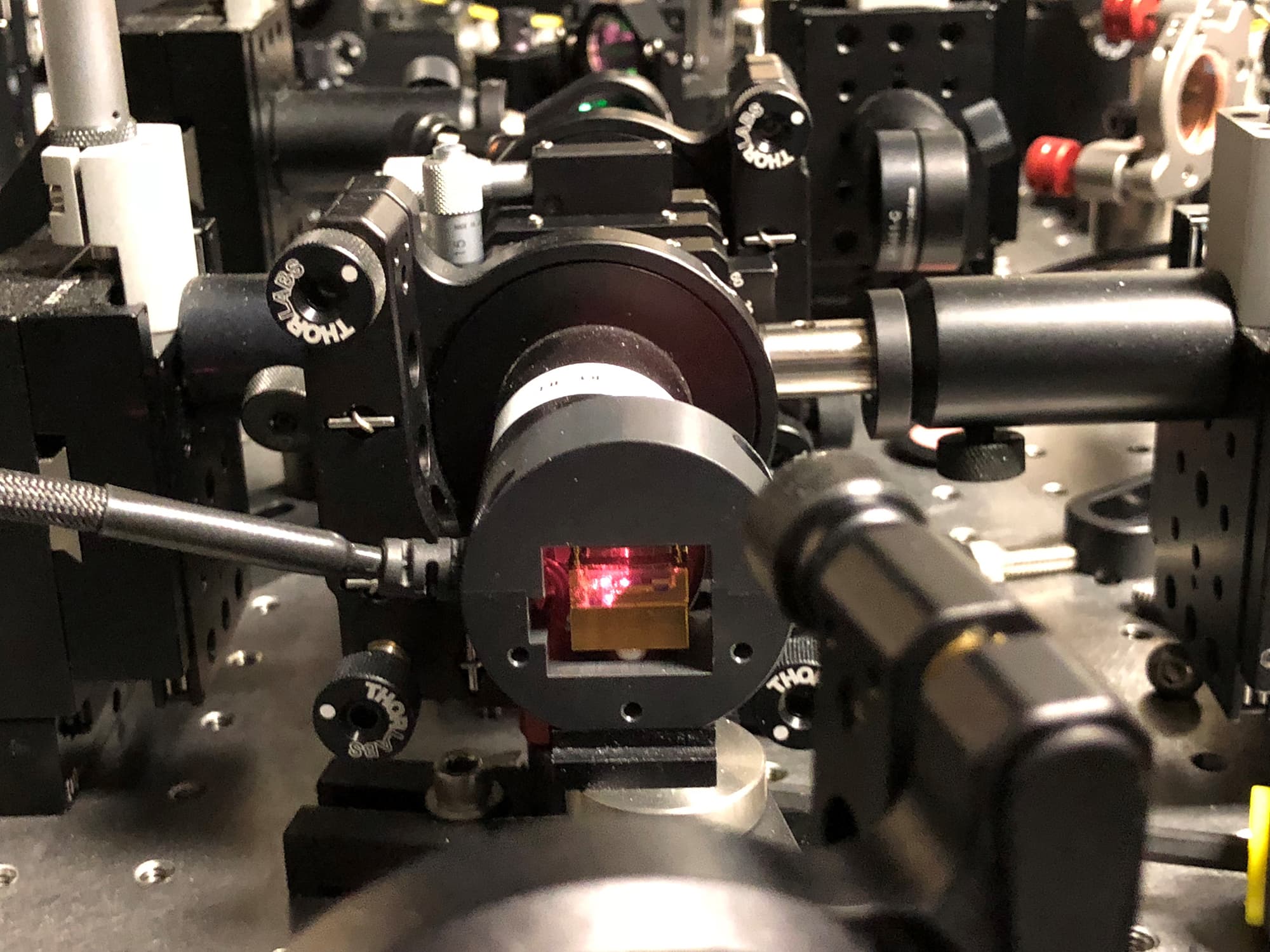
How entanglement is actually made
Shine a violet laser into the right crystal and, very rarely, one photon splits into two; with the right geometry, their polarizations are entangled. Here is the physics, from a lab bench to a satellite.
Why nothing can go faster than light
The cosmic speed limit isn’t really about light. It’s built into how space and time fit together, and breaking it would let an answer arrive before its question.
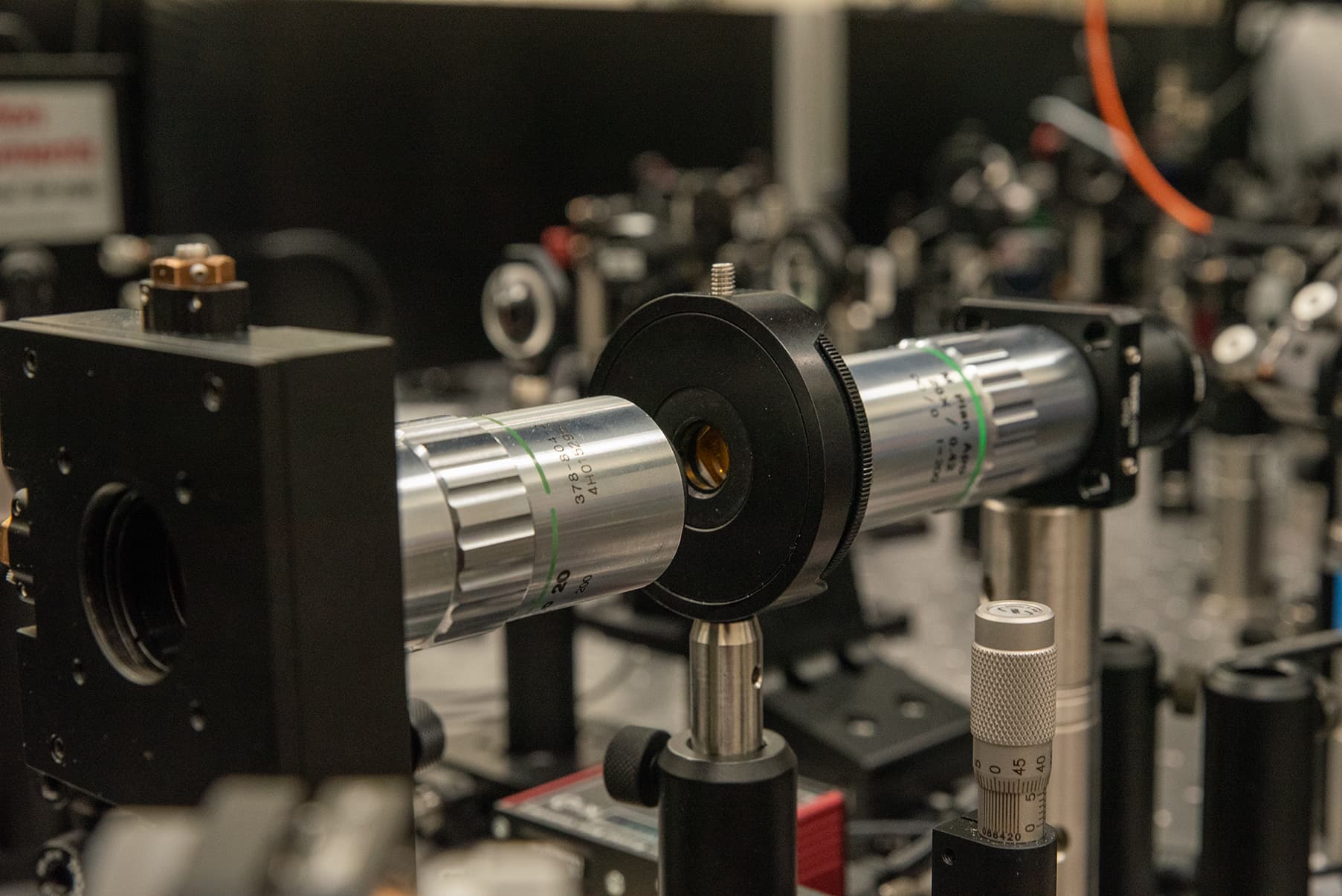
The quantum eraser: single photons, a double slit, and what “erasing” really means
Tag which slit each photon took and the stripes vanish. Erase the tag and they come back, but only in half the light. That half is the whole trick, and nothing travels back in time.