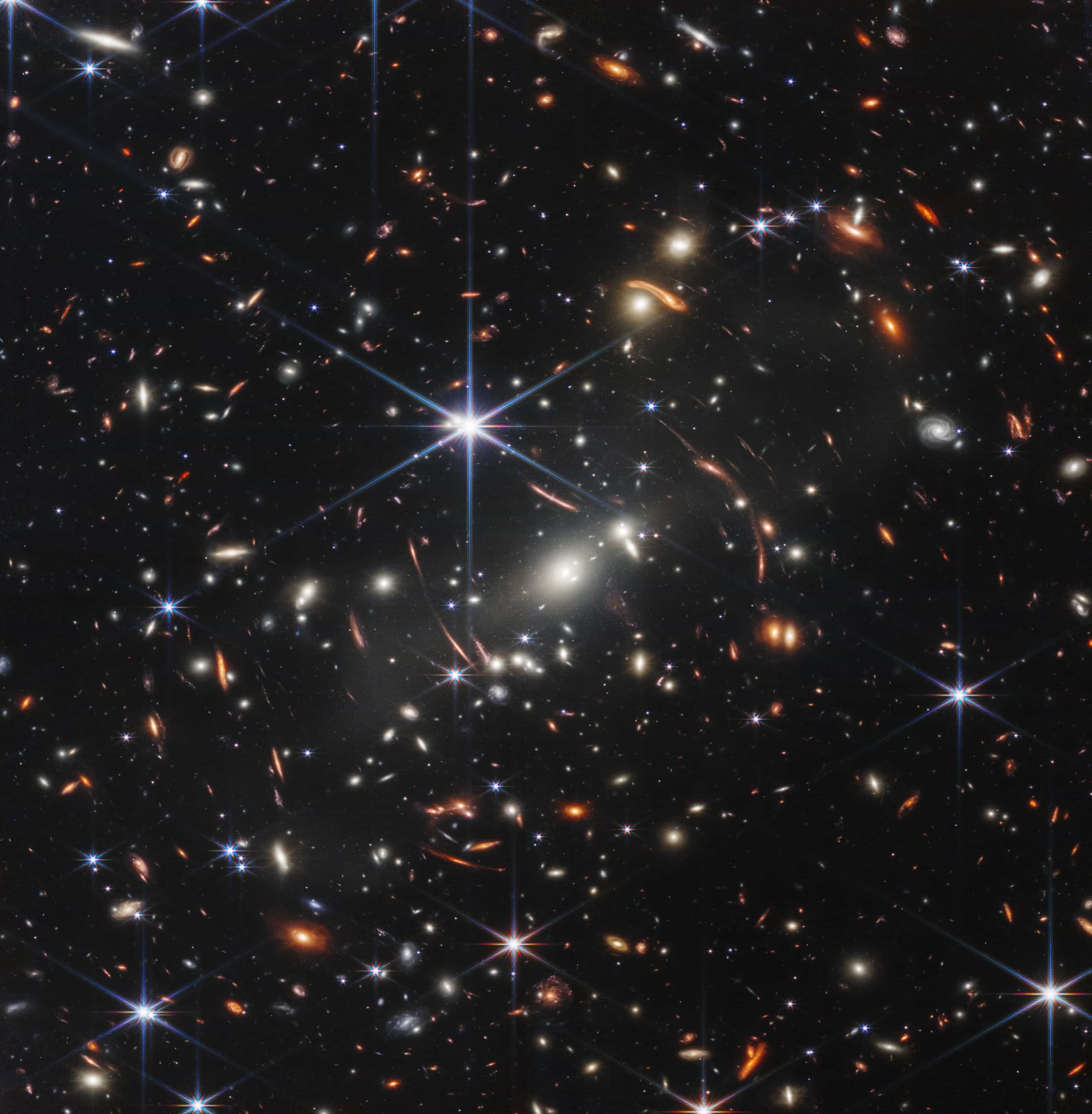
Webb’s First Deep Field (NIRCam Image) · Image credit: NASA, ESA, CSA, and STScI · CC BY 4.0
Relativity22 min read
Why nothing can go faster than light
The cosmic speed limit isn’t really about light. It’s built into how space and time fit together, and breaking it would let an answer arrive before its question.
Look up the speed of light, which physicists write as c, in the official tables of physical constants and you’ll find something odd for a measured quantity: 299,792,458 meters per second, with an uncertainty of exactly zero Reference 1Reference 2.
That zero tells you about our rulers, not about light. The real story is stranger. The cosmic speed limit is not really a fact about light at all, but about space and time themselves, and it rests on an idea physicists are deeply unwilling to give up: that causes come before their effects. This article explains why nothing can outrun light, why expanding space, warp drives and quantum entanglement only seem to break the rule, and how sure we are. Short answer: that nothing with mass can reach light speed is textbook physics. That no signal of any kind can beat it rests on an argument plus the absence of any confirmed exception, so we rate it one level lower on our “How sure are we?” scale at the end.
A speed with no error bar
Since 1983, the meter has been defined using light: it is the distance light travels through a vacuum in 1/299,792,458 of a second Reference 3. Once you define a meter that way, light covers exactly 299,792,458 of them every second. The international system of units, revised in 2018 with effect from May 2019, keeps that arrangement: the speed of light is one of seven constants whose values are simply fixed Reference 2.
So did somebody choose the number? Nobody chose how fast light is. But people did choose the digits. In 1983 the international conference that oversees units kept the value recommended in 1975, so that the new meter matched the old one, defined by the orange light of krypton atoms, within the best precision anyone could measure Reference 3. A slightly longer meter, or a shorter second, would give the same speed different digits.
So when a laboratory “measures the speed of light” today, it is really calibrating its rulers. What experiments can still test is whether that speed is the same in every direction and for everyone. That’s where the real precision lies.
For physicistsHow the SI fixes c1 equation · 1 min
Since 20 May 2019 the SI fixes seven defining constants with zero uncertainty, including and Reference 2, so
The 1983 wording has the same effect; the krypton-86 realization it replaced had a relative uncertainty of about (three standard deviations), hence “no appreciable discontinuity” Reference 3. The cavity tests below compare round trips: they constrain the isotropy of the two-way speed of light Reference 4.
The speed of spacetime, not just of light
In 1905, Albert Einstein built a new theory of motion, now called special relativity, on two assumptions: the laws of physics are the same for everyone moving at a steady speed in a straight line, and light in empty space always travels at the same speed, whatever the motion of its source Reference 5.
Together, these offend every instinct. Chase a beam of light in a rocket at half its speed, and you still measure it pulling away at the full speed of light, exactly as a friend standing still does. Einstein showed that adding speeds below light’s never reaches light’s speed, and adding a slower speed to light’s leaves it unchanged Reference 5. If a rocket at 60% of light speed fires a probe forward at 60%, you don’t see the probe at 120%; you see it at about 88%. Moving clocks run slow, moving rulers shrink, and “at the same time” depends on the observer, in exactly the way needed to keep light’s speed the same for everyone Reference 5.
So the number is better thought of as a property of spacetime: space and time treated as one four-dimensional stage where every event has a place and a moment. The official SI brochure says the speed of light determines the properties of space-time and affects “all particles … equally” Reference 2. Light moves at that speed because its particles, photons, have no mass; anything massless must move at exactly that speed, and anything with mass more slowly Reference 6.
Changes in gravity move at it too. In 2017, ripples in spacetime called gravitational waves, from two colliding neutron stars (the ultra-dense cores left by exploded stars), and a flash of gamma rays (extremely energetic light) from the same collision arrived 1.74 seconds apart, after a trip of roughly 85 million years or more. Nobody knows exactly when each set off, so the team allowed the flash to have left up to 10 seconds after the waves; even then, the two speeds agree within a few parts in 10¹⁵ Reference 7.
Is the photon truly massless? Observations of the solar wind’s magnetic field suggest its mass, if any, is below 10⁻¹⁸ electronvolts Reference 8, a unit of energy that also measures mass through E = mc². Even with that much mass, a typical FM radio wave (100 MHz) would lag the speed limit by only about three parts in 10²⁴, and visible light far less Reference 8. The limit itself would not change: it belongs to spacetime, and light would just travel a whisker below it Reference 6.
How do we know the speed is the same for everyone?
The textbook story starts in 1887. Physicists then thought light rippled through an invisible “luminiferous ether” that Earth must be plowing through Reference 9. Albert Michelson and Edward Morley split a beam of light, sent the halves along perpendicular arms, and rotated the apparatus, watching the bright and dark bands the beams made when recombined (bright where the waves line up, dark where they cancel). Earth’s orbital motion through the ether should have shifted the bands by 0.4 of a band spacing. They shifted by less than a twentieth of that, probably less than a fortieth. Because the shift grows with the square of the speed, the pair concluded that any motion through the ether was probably less than a sixth of Earth’s orbital speed Reference 9.
Did this inspire Einstein? His 1905 paper doesn’t name it; it mentions only “unsuccessful attempts” to detect Earth’s motion relative to the “light medium” Reference 5.
It became one of the classic tests of special relativity Reference 10, and its modern versions are astonishingly precise. Rotating pairs of mirrored chambers, in which light bounces back and forth, limit any dependence of light’s speed on direction to about one part in 10¹⁷ Reference 4, and a later experiment reached about one part in 10¹⁸ Reference 11. Other tests check moving clocks. In 2014, a team in Darmstadt, Germany, sent charged lithium atoms around a storage ring (a circular racetrack for charged particles) at a third of light speed and confirmed Einstein’s clock-slowing formula to within two parts in a billion Reference 10.
The wall at the end of the road
Push on something, and it speeds up. Near light speed, each push buys less and less. Relativity tracks this with one number, the Lorentz factor, written γ (gamma), which says how much a moving clock slows and how much an object’s energy has grown. At everyday speeds γ is 1 to many decimal places. At about 87% of light speed it is 2; at 99%, about 7.1; at light speed it would be infinite Reference 5. Einstein saw the consequence in 1905: the energy needed to speed up an electron becomes infinite as it approaches light speed, so faster-than-light speeds “have no possibility of existence” Reference 5.
For a 1 kg object, ignoring all engineering, half light speed takes about 1.4 × 10¹⁶ joules, the energy of about 3 million tons of TNT Reference 12. Reaching 99% takes about 5.5 × 10¹⁷ joules (130 million tons of TNT), roughly 12 times what Newton’s formula for the energy of motion predicts. At 99.99%, it’s 6.3 × 10¹⁸ joules, 70 times the entire energy locked in the object’s mass by E = mc². The last step never ends Reference 5.
Particle accelerators live at the wall. In its third run, from 2022 until June 2026, CERN’s Large Hadron Collider accelerated protons to 6.8 teraelectronvolts (trillion electronvolts) each Reference 13Reference 14Reference 15, about 7,247 times the energy locked in a proton’s mass Reference 16. That got them to 0.999 999 990 times the speed of light, still about 2.85 m/s short. Each extra 9 would cost about 3.16 times (the square root of 10) more energy. The collider has been off since late June 2026 for an upgrade that will produce more collisions; it is scheduled to restart in 2030 Reference 15Reference 17.
The same γ governs time dilation, the slowing of moving clocks: at 99% of light speed, a clock ticks about 7.1 times slower than yours. The formula behind that number is confirmed to two parts in a billion at a third of light speed Reference 10, and in 1977 unstable particles called positive muons, circling a CERN storage ring at γ = 29.33, lived longer by the factor relativity predicts, to within 0.2% (at 95% confidence) Reference 18. Try it below.
Explorable · try it
Chasing the speed of light
Assumptions and simplifications
- Special relativity only; no gravity or engine details. The energy is the energy of motion given to the object, by Einstein’s formula, with nothing wasted.
- “Years at home per ship year” compares a clock at steady speed with clocks at rest, ignoring speeding up and slowing down.
- Proton mass-energy 938.272 MeV (million electronvolts), from the official 2022 table of constants Reference 16; light’s speed is exact Reference 2.
- Buttons: an LHC Run 3 proton, 6.8 TeV Reference 13; the 0.338c lithium atoms of the 2014 test Reference 10.
You’ll hear that “for light, no time passes”. Take that as a limit, not a description: closer to light speed, a ship’s clock ticks ever more slowly, toward zero. But nobody can ride along with light, because no steady motion brings it to rest; its speed is the same for every observer Reference 5. There is no point of view that belongs to the photon.
For physicistsEnergy, momentum and the LHC numbers3 equations · 2 min
With restored, PDG §49.1 Reference 6:
so gives in every frame. is Einstein’s ( for light speed) Reference 5. For TeV and MeV Reference 16, and
since , a tenfold reduction costs in energy. For 1 kg: at , at (Newtonian ), at ; 1 ton TNT J Reference 12. A photon mass would give at 100 MHz for eV Reference 8.
Why “can’t”, and not just “haven’t”
Could a cleverer engine, or a particle born already faster than light, get around the energy wall? The deepest reason physicists doubt it is causality: the principle that a cause comes before its effect, for everyone. Strictly, it forbids faster-than-light signals; a hypothetical faster-than-light particle that could never carry a message would slip past Reference 19.
It starts with a famous oddity. Picture a flash of light set off in the middle of a moving train car. For a passenger, the light reaches the front and back walls at the same moment. For someone on the platform, the back wall moves toward the light and the front wall away, so the light hits the back first. Both are right: “at the same time” depends on who is asking. That disagreement never swaps two events a light signal could connect, so for anything slower than light it is harmless. For anything faster, it is fatal. Einstein made this argument in 1907, as a historical study still in preprint form recounts Reference 20, and Richard Tolman spelled it out in 1917: if a signal could travel faster than light, then for some observer the effect would come before its cause Reference 21. The sequence below shows why, with real numbers. (A “frame” here just means the point of view of one steadily moving observer.)
Step by step
How a faster-than-light message arrives before it was sent
Figure: Empty spacetime diagram: time in years up the vertical axis, distance in light-years across. Event A, you here and now, sits at the origin. Two dashed lines at 45 degrees through A show the paths of light.
Figure: The region between the 45-degree lines is shaded: the future cone above A and the past cone below. Your worldline is vertical; a ship at half light speed leans over but stays inside the cone, with dots marking each year of ship time; an accelerating ship curves toward the 45-degree line without reaching it.
Figure: Regions labelled FUTURE, PAST and ELSEWHERE. Event B is marked 10 light-years to the right of A and 1 year later, outside the cone, in the elsewhere region.
Figure: An orange line runs from A to B: a signal moving at 10 times light speed, much flatter than the light lines. Readout: signal arrives 1 year after it left.
Figure: The same diagram as seen by an observer moving at one tenth of light speed, computed with the Lorentz transformation. The light lines have not moved. Event B has slid down to the same height as A: the two events are simultaneous for this observer.
Figure: View from an observer moving at half light speed. Event B is now 4.6 years below A: the message is received 4.6 years before it was sent. The light cone is unchanged and the ship's worldline still points upward inside it.
Figure: Still in the half-light-speed view: a relay at B, moving with the half-light-speed ship, sends an orange dashed reply at 10 times light speed back toward your worldline. In this view the reply moves forward in time.
Figure: Back in Earth's view: the orange reply runs from B back to your vertical worldline and lands 3.2 years below A. The reply arrives 3.2 years before the original message was sent.
Tolman was careful: such a state of affairs might not be strictly illogical, he wrote, but its extraordinary nature inclines us to believe no cause can travel faster than light Reference 21. A 1970 paper revisiting the idea for hypothetical faster-than-light particles called it “The Tachyonic Antitelephone” Reference 19.
The loop doesn’t need wildly fast signals. With a friend flying away from you at 60% of light speed and both of you using the same gadget, any signal faster than 3 times light speed is enough, and the faster your friend moves, the closer to light speed that threshold drops. Any faster-than-light signaling, combined with physics being the same for every steady observer, sends messages into your own past. That is why we rate “no signal can beat light” as strong evidence rather than established fact: it rests on this argument, and on relativity’s symmetry being exact, which experiments keep testing.
For physicistsThe Lorentz transformation and causal order3 equations · 2 min
Units ; signature , so . A boost by gives , , so a signal of speed has
Tolman’s Eq. (29) Reference 21: negative whenever , which needs ; for the order is invariant. Scrolly: , , ; at , yr at ; a relay at moving at 0.5 replying with reaches at yr. For the two-observer antitelephone (Bob receding at , both sending at in their own frames) the reply precedes the question when
i.e. at , at . With instantaneous signals, a question sent yr after the two separate gets its reply early: 0.36 yr (131 days) at . These numbers are ours (calc/simultaneity.ts); this exchange follows the spirit of Reference 19, whose A and B stay at rest and use emitters on a moving belt. Einstein’s 1907 version (Jahrbuch der Radioaktivität 4, 411, pp. 423–424) is quoted in Reference 20.
Things that seem to break the rule
Galaxies racing away faster than light
The universe is expanding. Picture raisins in rising dough: every raisin moves away from every other, and the farther apart two are, the faster the gap grows. Far enough out, that rate exceeds the speed of light. The distance where it equals light speed is the Hubble sphere; using data from the Planck satellite, which mapped the afterglow of the Big Bang, it is about 14.5 billion light-years away today Reference 22Reference 23.
Astronomers measure how much a galaxy’s light has been stretched on the way; its “redshift” is that stretch factor minus one. Every galaxy with a redshift above about 1.5 (light stretched by more than about 2.5 times) is receding from us faster than light right now Reference 23. That breaks no rule, because the rule is local: nothing ever overtakes a light beam in its own neighborhood, and every observer measures light passing them at the same speed Reference 23. The faster-than-light figures come from the standard way cosmologists define distance, all along a single cosmic moment. Cosmologists usually describe this as space itself expanding, though some argue the redshift is more naturally read as many small, ordinary Doppler shifts added up Reference 24.
We can even see such galaxies. Think of an ant walking toward you on a rubber band being stretched: at first it is carried backward, but if its part of the band later stretches more slowly, it arrives. Light from beyond the Hubble sphere does the same, because the Hubble sphere grows Reference 23. The galaxy JADES-GS-z14-0, confirmed with the James Webb Space Telescope in 2024 and pinned down in 2025 at a redshift of 14.18 (light stretched about 15 times), is now about 33.7 billion light-years away and receding at about 2.3 times light speed. In the standard cosmological model it has never receded at less than twice light speed, yet its light reaches us Reference 25Reference 26.
That light left 13.5 billion years ago, when the galaxy was much closer, and the distance it had to cross has grown ever since. That is why the observable universe, the region whose light has had time to reach us, has a radius of about 46 billion light-years, though the universe is only 13.8 billion years old Reference 23Reference 22.
There is a real horizon, though. In standard cosmology, light emitted today by galaxies beyond about 16.7 billion light-years will never reach us: the expansion will keep outpacing it. That is the cosmic event horizon, and galaxies with a redshift of about 1.9 are crossing it now Reference 23Reference 22. If dark energy, which makes up about 68% of the universe’s energy content, stays constant forever, the horizon creeps outward to about 17.5 billion light-years and stops Reference 22.
So there are three edges. Beyond 14.5 billion light-years, galaxies recede faster than light today. Beyond 16.7, light they send today will never reach us. Out to 46, we see light sent long ago. The surprising band is between 14.5 and 16.7: galaxies there recede faster than light, yet light they emit today will still reach us.
FIG. 1Some galaxies we see have always receded faster than light
Show the numbers
Flat ΛCDM, Planck 2018 parameters (H₀ = 67.36 km/s/Mpc, Ωm = 0.3153), radiation included. Today: Hubble sphere 14.5 billion light-years; event horizon 16.7 (17.5 in the far future); observable universe 46.1; age 13.8 billion years. Our past light cone is widest, 5.85 billion light-years, about 4 billion years after the Big Bang. The galaxy at redshift 1.48 recedes at exactly light speed today and was never slower than 0.88 times light speed. JADES-GS-z14-0 (redshift 14.18) emitted the light we see 0.29 billion years after the Big Bang from 2.2 billion light-years away; it is now 33.7 billion light-years away, receding at 2.32 times light speed, and never slower than 2.04 times.
COMPUTED: calc/cosmo-horizons.ts · PARAMETERS: Planck 2018, Table 2 · METHOD: Davis & Lineweaver 2004
For physicistsRecession velocity and horizons in ΛCDM2 equations · 2 min
In flat FLRW, and at all distances Reference 23. With ,
and likewise from to 1. Inputs: , Reference 22; radiation from K, , from CODATA Reference 27; flat. Results: Mpc Gly; at ; Gly (no inflation); Gly, tending to Gly; event-horizon crossing at ; CMB matter now at . Superluminal refers to proper distance on constant-cosmic-time slices. Davis & Lineweaver exclude the special-relativistic Doppler formula, inserted into with fixed at today’s value, at about 23σ relative to ΛCDM in their supernova analysis Reference 23; that is not every kinematic reading: Bunn and Hogg interpret the redshift as accumulated Doppler shifts Reference 24.
Warp drives
In 1994, Miguel Alcubierre wrote down a spacetime allowed by general relativity, Einstein’s theory of gravity, and worked out what matter it needs. A bubble of spacetime, squeezed in front and stretched behind, carries a ship at any speed you like as seen from outside, while the ship never outruns light in its own neighborhood Reference 28. The catch is that the bubble needs negative energy density: less energy per amount of space than empty space, which counts as zero. This is called “exotic matter”. Alcubierre also noted a similar idea could probably make a spacetime with loops back in time Reference 28, which revives the paradox above.
Quantum physics allows small negative energies in special situations, such as the Casimir effect between two very close metal plates, but within strict limits Reference 28Reference 29. Applying those limits in 1997, Michael Pfenning and L. H. Ford found the bubble’s walls would be only a few hundred Planck lengths thick (a Planck length is 1.6 × 10⁻³⁵ meters Reference 30). A bubble with a 100-meter radius moving at around light speed would then need negative energy about ten billion times the mass of the visible universe Reference 29. Only by breaking those same quantum limits could the walls be a meter thick, and even then the bubble would need about a quarter of the Sun’s mass in negative energy Reference 29. A 1999 redesign of the bubble’s shape that respects the limits brought the bill down from the ten-billion-universes figure to a few Suns’ worth of negative energy, plus a similar amount of positive energy Reference 31.
In 2020–21, papers claimed warp drives made of positive energy, one even faster than light Reference 32Reference 33. A 2022 check found they had checked the energy only for one family of observers, those carried along by the warp’s flow. For the whole family of designs those papers used, other observers see the negative energy come back: every physically reasonable drive of that kind violates the energy conditions, the assumptions behind many of general relativity’s theorems that every observer measures a non-negative energy density Reference 34. A 2024 design does satisfy them, but it moves slower than light Reference 35; for faster-than-light drives, negative energy appears unavoidable Reference 33.
For physicistsThe Alcubierre metric and its energy bill2 equations · 2 min
With ,
inside the bubble, the distance from its centre, . The ship is geodesic with , and Eulerian observers see
violating the weak, dominant and strong energy conditions Reference 28. Pfenning–Ford: (sampling parameter , independent of size); for radius 100 m, g ; if the quantum inequality could be violated, a 1 m wall would need about Reference 29. Van Den Broeck: a few solar masses of negative mass, satisfying the quantum inequality Reference 31. Santiago, Schuster and Visser: the WEC must hold for all timelike observers, not just Eulerian ones; the arXiv abstract of their final version says all physically reasonable warp drives violate the NEC (the text adds “under plausible subsidiary conditions”), hence WEC, SEC and DEC, within the framework of those papers (Natário-class drives, plus Bobrick–Martire’s models) Reference 34. A subluminal solution outside this class, a regular matter shell with positive ADM mass plus an Alcubierre-like shift, is reported to satisfy all the energy conditions Reference 35.
Wormholes
A wormhole is a hypothetical tunnel between distant places: a shortcut, not a faster trip. In 1988, Michael Morris and Kip Thorne worked out what a traversable one would need: material at its throat stretched by a tension greater than its own energy content, which no known material manages and which violates the same energy conditions Reference 36. With Ulvi Yurtsever, they showed it could in principle become a time machine, reviving the antitelephone paradox Reference 37.
Entanglement
Two particles can share a linked state, called entanglement, so measurements on them are correlated however far apart they are. It can look like an instant influence, but nothing done to one particle changes the statistics of results on the other. Each side sees what looks like random coin tosses; the match appears only when the lists are compared, which takes an ordinary signal. This no-communication theorem means quantum measurements cannot send information faster than light Reference 38.
Patterns that aren’t things
Some things can “move” faster than light because they aren’t things. Tolman’s example: a row of blocks, each with its own timer set to knock it over at just the right instant, so the falling sweeps down the line at any speed you choose. Nothing, no energy and no information, travels from block to block Reference 21.
The neutrinos that seemed to break the rule
On 22 September 2011, the OPERA experiment posted a startling result. Neutrinos, ghostly particles that pass straight through rock, had been sent from CERN, near Geneva, through the Earth’s crust to the underground Gran Sasso Laboratory in Italy, about 730 kilometers away. They seemed to arrive 60.7 nanoseconds (billionths of a second) before light would have, a lead of about 18 meters Reference 39. The team quoted a significance of 6.0σ, a measure of how far the result sat from “no effect” in units of its estimated total uncertainty, and called it large Reference 39.
Admirably, the collaboration declined to interpret the result and said it would keep looking for unknown sources of error Reference 39. They turned up: an optical fiber carrying a timing signal to the master clock was not properly connected, delaying the clock’s reference by about 73 nanoseconds, and the oscillator setting that clock’s ticking rate ran slightly fast Reference 40. Corrected, the neutrinos arrived 6.5 nanoseconds early, give or take about 11 Reference 40. With an uncertainty bigger than the result, zero, meaning exactly light speed, fits comfortably.
The lesson: a single result that contradicts a principle tested in countless ways is, until shown otherwise, most likely an error. A large sigma says a result is far outside its estimated uncertainty; it can’t warn you about an error nobody has found yet.
For physicistsOPERA by the numbers1 min
v1 Reference 39: ns, , 6.0σ (60.7 ns over the 10.1 ns quadrature sum), over an effective 730.085 km baseline from the mean parent-meson decay point. Final Reference 40: ns (total about 11 ns), . Sec. 6.1: fiber delay 73.2 ns, confirmed with cosmic-ray muons crossing OPERA and LVD; master-clock oscillator 0.124 ppm fast, an opposite-sign effect of up to 74 ns. Code: calc/opera.ts.
Open questions
The speed limit itself isn’t in doubt. What physicists still probe is the fine print.
- Is the photon exactly massless? The limit the Particle Data Group adopts leans on modeling the solar wind; fast-radio-burst limits are weaker but rest on different assumptions Reference 8. A mass would not change the speed limit, only light’s relation to it.
- Are the laws exactly the same for every steady observer, even at the tiniest scales? Many attempts to unify quantum physics and gravity allow tiny violations, which is why laboratory tests of light’s isotropy have pushed to about one part in 10¹⁸ Reference 11.
- Where exactly are the cosmic horizons? They depend on the expansion rate, and measurements disagree: supernovae calibrated with pulsating stars give 73.04 ± 1.04 kilometers per second for every megaparsec of distance (a megaparsec is about 3.26 million light-years) Reference 41, Planck gives 67.36 ± 0.54 Reference 22, and a team using other stars gets 70.4 (±1.9, our combination of its three quoted errors) Reference 42. The highest gives a 13.4-billion-light-year Hubble sphere. The event horizon also depends on whether dark energy changes. The Dark Energy Spectroscopic Instrument (DESI), a survey mapping millions of galaxies, reported in 2025 that its data prefer evolving dark energy, by an amount that depends on which other data are combined Reference 43; a 2026 recalibration of the supernova sample behind the strongest preference weakened it Reference 44. More DESI data with recalibrated supernovae would help settle it.
- Could another theory of gravity allow warp drives? Modified gravity faces strong constraints too Reference 34.
How sure are we?
EVIDENCE LEVELS ARE EDITORIAL JUDGEMENTS OF THE WHOLE BODY OF EVIDENCE — NOT σ VALUES · What these mean
Light’s speed is the same in every direction and for every steadily moving observer.
Evidence level: EstablishedDirection-dependence of the round-trip speed is limited to about one part in 10¹⁷–10¹⁸, and the clock-slowing formula is confirmed to 2 parts in a billion, among many tests Reference 4Reference 11Reference 10.
Nothing with mass can reach the speed of light.
Evidence level: EstablishedThe energy required grows without limit; even the LHC’s 6.8 TeV protons fell about 2.85 m/s short Reference 5Reference 13.
Distant galaxies recede faster than light without breaking relativity.
Evidence level: EstablishedStandard cosmology, fitted to precise data; nothing overtakes light locally. “Space expanding” is the usual interpretation, not the only one Reference 23Reference 22Reference 24.
Entanglement cannot be used to send messages.
Evidence level: EstablishedA theorem of quantum theory: local statistics don’t depend on distant operations Reference 38.
No signal can travel faster than light.
Evidence level: Strong evidenceIt would let effects precede causes, and OPERA’s claimed sighting was equipment faults. Open detail: it assumes relativity’s symmetry is exact, which experiments keep testing Reference 21Reference 40Reference 11.
Dark energy may be changing over time, which would move the cosmic event horizon.
Evidence level: Hint / tensionA galaxy survey prefers evolving dark energy, but how strongly depends on which supernova data are added, and a recalibration weakened the strongest case. What would settle it: more DESI data combined with recalibrated supernova samples Reference 43Reference 44. Reported: DESI DR2: 3.1σ preference for evolving dark energy (w₀wₐ model) over the standard cosmological model (DESI + cosmic microwave background); 2.8–4.2σ with supernovae, depending on the sample. Recalibrated DES supernovae with DESI DR2 + CMB (Planck, ACT, SPT): 3.2σ, down from 4.2σ
Warp drives or traversable wormholes could allow faster-than-light travel.
Evidence level: SpeculativeAllowed on paper, but they need negative energy of a kind, or in amounts, no known physics can supply Reference 29Reference 34Reference 36.
What the video simplified
In the video: Nobody chose the number 299,792,458.
More precisely: Nobody chose how fast light is, but the digits were chosen in 1983 to keep the new meter matching the old one Reference 3.In the video: The speed of light is the speed of causality.
More precisely: Fair, and causality is the deep reason for the limit. But the limit belongs to spacetime; light reaches it because photons are massless, and the limit would exist even if they weren’t Reference 2Reference 6.In the video: The Michelson–Morley experiment showed that light’s speed is constant.
More precisely: It found no sign of Earth moving through the ether. Einstein’s 1905 paper doesn’t cite it, and the same kind of test is now far more precise Reference 9Reference 5Reference 4.In the video: LHC protons reach 0.999999991 times the speed of light.
More precisely: A small difference: that figure corresponds to 7 TeV per beam. At Run 3’s 6.8 TeV it is 0.99999999048, and the LHC has been off since June 2026 Reference 13Reference 15.In the video: For light, no time passes.
More precisely: A limit: no observer can travel with light Reference 5.In the video: OPERA’s faster-than-light neutrinos were caused by a loose cable.
More precisely: Mostly: a badly connected optical fiber added about 73 ns, and a clock oscillator offset pushed the other way. OPERA never claimed new physics Reference 39Reference 40.
Further reading
Start here Accessible
CERN, CERN bids farewell to the LHC and enters Long Shutdown 3 (2026). https://home.cern/cern-bids-farewell-to-the-lhc-and-enters-long-shutdown-3/ (accessed 12 October 2026)Free
The LHC’s switch-off.Conférence Générale des Poids et Mesures, Definition of the metre, Proceedings of the 17th CGPM (1983), Bureau International des Poids et Mesures (1983). https://doi.org/10.59161/CGPM1983RES1EFree
The meter, tied to light.Bureau International des Poids et Mesures, The International System of Units (SI) (2019). https://doi.org/10.59161/AUEZ1291Free
Section 2: defining constants.
Go deeper Intermediate
T. M. Davis and C. H. Lineweaver, Expanding Confusion: Common Misconceptions of Cosmological Horizons and the Superluminal Expansion of the Universe, Publ. Astron. Soc. Aust. 21, 97–109 (2004). https://doi.org/10.1071/AS03040 · Free version: arXiv:astro-ph/0310808 [astro-ph]Free on arXiv
Superluminal recession and horizons, clarified.M. S. Morris and K. S. Thorne, Wormholes in spacetime and their use for interstellar travel: A tool for teaching general relativity, Am. J. Phys. 56, 395–412 (1988). https://doi.org/10.1119/1.15620Paywall
Wormholes for teaching relativity.R. C. Tolman, The Theory of the Relativity of Motion (University of California Press, Berkeley, 1917). https://archive.org/details/theoryofrelativi00tolmuoft (accessed 12 October 2026)Free
Section 52: the causality argument.M. Alcubierre, The warp drive: hyper-fast travel within general relativity, Class. Quantum Grav. 11, L73-L77 (1994). https://doi.org/10.1088/0264-9381/11/5/001 · Free version: arXiv:gr-qc/0009013 [gr-qc]Free on arXiv
The original warp drive.
Technical Primary literature
D. Mattingly, Modern Tests of Lorentz Invariance, Living Rev. Relativ. 8, 5 (2005). https://doi.org/10.12942/lrr-2005-5 · Free version: arXiv:gr-qc/0502097 [gr-qc]Free
Lorentz-invariance tests reviewed.A. Peres and D. R. Terno, Quantum information and relativity theory, Rev. Mod. Phys. 76, 93–123 (2004). https://doi.org/10.1103/RevModPhys.76.93 · Free version: arXiv:quant-ph/0212023 [quant-ph]Free on arXiv
Includes the no-communication theorem.J. Santiago, S. Schuster, and M. Visser, Generic warp drives violate the null energy condition, Phys. Rev. D 105, 064038 (2022). https://doi.org/10.1103/PhysRevD.105.064038 · Free version: arXiv:2105.03079 [gr-qc]Free on arXiv
Warp drives and energy conditions.M. J. Pfenning and L. H. Ford, The unphysical nature of `warp drive', Class. Quantum Grav. 14, 1743–1751 (1997). https://doi.org/10.1088/0264-9381/14/7/011 · Free version: arXiv:gr-qc/9702026 [gr-qc]Free on arXiv
Quantum limits on warp bubbles.T. Adam et al. (OPERA Collaboration), Measurement of the neutrino velocity with the OPERA detector in the CNGS beam, J. High Energy Phys. 2012, 93 (2012). https://doi.org/10.1007/JHEP10(2012)093 · Free version: arXiv:1109.4897 [hep-ex]Free
The corrected measurement.
References
Numbered in order of first citation. Journal articles link to their DOI; where a free version exists on arXiv we link it too. Preprints are marked as not peer reviewed.
- Reference 1: National Institute of Standards and Technology, CODATA Value: speed of light in vacuum (2024). https://physics.nist.gov/cgi-bin/cuu/Value?c (accessed 12 October 2026)Back to citation 1 of reference 1
- Reference 2: Bureau International des Poids et Mesures, The International System of Units (SI) (2019). https://doi.org/10.59161/AUEZ1291Back to citation 1 of reference 2Back to citation 2 of reference 2Back to citation 3 of reference 2Back to citation 4 of reference 2Back to citation 5 of reference 2Back to citation 6 of reference 2
- Reference 3: Conférence Générale des Poids et Mesures, Definition of the metre, Proceedings of the 17th CGPM (1983), Bureau International des Poids et Mesures (1983). https://doi.org/10.59161/CGPM1983RES1EBack to citation 1 of reference 3Back to citation 2 of reference 3Back to citation 3 of reference 3Back to citation 4 of reference 3
- Reference 4: S. Herrmann, A. Senger, K. Möhle, M. Nagel, E. V. Kovalchuk, and A. Peters, Rotating optical cavity experiment testing Lorentz invariance at the 10⁻¹⁷ level, Phys. Rev. D 80, 105011 (2009). https://doi.org/10.1103/PhysRevD.80.105011 · Free version: arXiv:1002.1284 [physics.class-ph]Back to citation 1 of reference 4Back to citation 2 of reference 4Back to citation 3 of reference 4Back to citation 4 of reference 4
- Reference 5: A. Einstein, Zur Elektrodynamik bewegter Körper, Ann. Phys. (Berlin) 322, 891–921 (1905). https://doi.org/10.1002/andp.19053221004Back to citation 1 of reference 5Back to citation 2 of reference 5Back to citation 3 of reference 5Back to citation 4 of reference 5Back to citation 5 of reference 5Back to citation 6 of reference 5Back to citation 7 of reference 5Back to citation 8 of reference 5Back to citation 9 of reference 5Back to citation 10 of reference 5Back to citation 11 of reference 5Back to citation 12 of reference 5
- Reference 6: D. Miller, D. R. Tovey, and J. D. Jackson, 49. Kinematics, in Review of Particle Physics (2026), p. 2630011. https://pdg.lbl.gov/2026/reviews/rpp2026-rev-kinematics.pdf (accessed 12 October 2026)Back to citation 1 of reference 6Back to citation 2 of reference 6Back to citation 3 of reference 6Back to citation 4 of reference 6
- Reference 7: LIGO Scientific Collaboration, Virgo Collaboration, Fermi Gamma-ray Burst Monitor, and INTEGRAL, Gravitational Waves and Gamma-Rays from a Binary Neutron Star Merger: GW170817 and GRB 170817A, Astrophys. J. Lett. 848, L13 (2017). https://doi.org/10.3847/2041-8213/aa920c · Free version: arXiv:1710.05834 [astro-ph.HE]Back to citation 1 of reference 7
- Reference 8: Particle Data Group, γ (photon) — Particle Listings, in Review of Particle Physics (2026), p. 2630011. https://pdg.lbl.gov/2026/listings/rpp2026-list-photon.pdf (accessed 12 October 2026)Back to citation 1 of reference 8Back to citation 2 of reference 8Back to citation 3 of reference 8Back to citation 4 of reference 8
- Reference 9: A. A. Michelson and E. W. Morley, On the relative motion of the Earth and the luminiferous ether, Am. J. Sci. s3-34, 333–345 (1887). https://doi.org/10.2475/ajs.s3-34.203.333Back to citation 1 of reference 9Back to citation 2 of reference 9Back to citation 3 of reference 9
- Reference 10: B. Botermann et al., Test of Time Dilation Using Stored Li+ Ions as Clocks at Relativistic Speed, Phys. Rev. Lett. 113, 120405 (2014). https://doi.org/10.1103/PhysRevLett.113.120405 · Free version: arXiv:1409.7951 [physics.atom-ph]Back to citation 1 of reference 10Back to citation 2 of reference 10Back to citation 3 of reference 10Back to citation 4 of reference 10Back to citation 5 of reference 10
- Reference 11: M. Nagel, S. R. Parker, E. V. Kovalchuk, P. L. Stanwix, J. G. Hartnett, E. N. Ivanov, A. Peters, and M. E. Tobar, Direct terrestrial test of Lorentz symmetry in electrodynamics to 10⁻¹⁸, Nat. Commun. 6, 8174 (2015). https://doi.org/10.1038/ncomms9174Back to citation 1 of reference 11Back to citation 2 of reference 11Back to citation 3 of reference 11Back to citation 4 of reference 11
- Reference 12: National Institute of Standards and Technology, NIST Guide to the SI, Appendix B.9: Factors for units listed by kind of quantity or field of science (2008). https://www.nist.gov/pml/special-publication-811/nist-guide-si-appendix-b-conversion-factors/nist-guide-si-appendix-b9 (accessed 13 October 2026)Back to citation 1 of reference 12Back to citation 2 of reference 12
- Reference 13: A. Schaeffer, And they’re off! The 2025 LHC physics season gets underway, CERN (2025). https://home.cern/and-theyre-2025-lhc-physics-season-gets-underway/ (accessed 12 October 2026)Back to citation 1 of reference 13Back to citation 2 of reference 13Back to citation 3 of reference 13Back to citation 4 of reference 13
- Reference 14: CERN, Run 3: an opportunity to expand the LHC physics programme (2022). https://home.cern/press/media-kits/run-3/ (accessed 12 October 2026)Back to citation 1 of reference 14
- Reference 15: CERN, CERN bids farewell to the LHC and enters Long Shutdown 3 (2026). https://home.cern/cern-bids-farewell-to-the-lhc-and-enters-long-shutdown-3/ (accessed 12 October 2026)Back to citation 1 of reference 15Back to citation 2 of reference 15Back to citation 3 of reference 15
- Reference 16: National Institute of Standards and Technology, CODATA Value: proton mass energy equivalent in MeV (2024). https://physics.nist.gov/cgi-bin/cuu/Value?mpc2mev (accessed 12 October 2026)Back to citation 1 of reference 16Back to citation 2 of reference 16Back to citation 3 of reference 16
- Reference 17: CERN, Long Shutdown 3 (2026). https://home.cern/science/long-shutdown-3/ (accessed 12 October 2026)Back to citation 1 of reference 17
- Reference 18: J. Bailey et al., Measurements of relativistic time dilatation for positive and negative muons in a circular orbit, Nature 268, 301–305 (1977). https://doi.org/10.1038/268301a0Back to citation 1 of reference 18
- Reference 19: G. A. Benford, D. L. Book, and W. A. Newcomb, The Tachyonic Antitelephone, Phys. Rev. D 2, 263–265 (1970). https://doi.org/10.1103/PhysRevD.2.263Back to citation 1 of reference 19Back to citation 2 of reference 19Back to citation 3 of reference 19
- Reference 20: G. Weinstein, Einstein on the Impossibility of Superluminal Velocities, arXiv:1203.4954 [physics.hist-ph] (2012).Preprint · not peer reviewedBack to citation 1 of reference 20Back to citation 2 of reference 20
- Reference 21: R. C. Tolman, The Theory of the Relativity of Motion (University of California Press, Berkeley, 1917). https://archive.org/details/theoryofrelativi00tolmuoft (accessed 12 October 2026)Back to citation 1 of reference 21Back to citation 2 of reference 21Back to citation 3 of reference 21Back to citation 4 of reference 21Back to citation 5 of reference 21
- Reference 22: N. Aghanim et al. (Planck Collaboration), Planck 2018 results. VI. Cosmological parameters, Astron. Astrophys. 641, A6 (2020). https://doi.org/10.1051/0004-6361/201833910 · Free version: arXiv:1807.06209 [astro-ph.CO]Back to citation 1 of reference 22Back to citation 2 of reference 22Back to citation 3 of reference 22Back to citation 4 of reference 22Back to citation 5 of reference 22Back to citation 6 of reference 22Back to citation 7 of reference 22Back to citation 8 of reference 22
- Reference 23: T. M. Davis and C. H. Lineweaver, Expanding Confusion: Common Misconceptions of Cosmological Horizons and the Superluminal Expansion of the Universe, Publ. Astron. Soc. Aust. 21, 97–109 (2004). https://doi.org/10.1071/AS03040 · Free version: arXiv:astro-ph/0310808 [astro-ph]Back to citation 1 of reference 23Back to citation 2 of reference 23Back to citation 3 of reference 23Back to citation 4 of reference 23Back to citation 5 of reference 23Back to citation 6 of reference 23Back to citation 7 of reference 23Back to citation 8 of reference 23Back to citation 9 of reference 23Back to citation 10 of reference 23
- Reference 24: E. F. Bunn and D. W. Hogg, The kinematic origin of the cosmological redshift, Am. J. Phys. 77, 688–694 (2009). https://doi.org/10.1119/1.3129103 · Free version: arXiv:0808.1081 [physics.pop-ph]Back to citation 1 of reference 24Back to citation 2 of reference 24Back to citation 3 of reference 24
- Reference 25: S. Carniani et al., Spectroscopic confirmation of two luminous galaxies at a redshift of 14, Nature 633, 318–322 (2024). https://doi.org/10.1038/s41586-024-07860-9 · Free version: arXiv:2405.18485 [astro-ph.GA]Back to citation 1 of reference 25
- Reference 26: S. Schouws et al., Detection of [O III] 88 μm in JADES-GS-z14-0 at z = 14.1793, Astrophys. J. 988, 19 (2025). https://doi.org/10.3847/1538-4357/adbf1b · Free version: arXiv:2409.20549 [astro-ph.GA]Back to citation 1 of reference 26Back to citation 2 of reference 26
- Reference 27: National Institute of Standards and Technology, CODATA Value: Newtonian constant of gravitation (2024). https://physics.nist.gov/cgi-bin/cuu/Value?bg (accessed 12 October 2026)Back to citation 1 of reference 27
- Reference 28: M. Alcubierre, The warp drive: hyper-fast travel within general relativity, Class. Quantum Grav. 11, L73-L77 (1994). https://doi.org/10.1088/0264-9381/11/5/001 · Free version: arXiv:gr-qc/0009013 [gr-qc]Back to citation 1 of reference 28Back to citation 2 of reference 28Back to citation 3 of reference 28Back to citation 4 of reference 28
- Reference 29: M. J. Pfenning and L. H. Ford, The unphysical nature of `warp drive', Class. Quantum Grav. 14, 1743–1751 (1997). https://doi.org/10.1088/0264-9381/14/7/011 · Free version: arXiv:gr-qc/9702026 [gr-qc]Back to citation 1 of reference 29Back to citation 2 of reference 29Back to citation 3 of reference 29Back to citation 4 of reference 29Back to citation 5 of reference 29
- Reference 30: National Institute of Standards and Technology, CODATA Value: Planck length (2024). https://physics.nist.gov/cgi-bin/cuu/Value?plkl (accessed 13 October 2026)Back to citation 1 of reference 30
- Reference 31: C. Van Den Broeck, A ‘warp drive’ with more reasonable total energy requirements, Class. Quantum Grav. 16, 3973–3979 (1999). https://doi.org/10.1088/0264-9381/16/12/314 · Free version: arXiv:gr-qc/9905084 [gr-qc]Back to citation 1 of reference 31Back to citation 2 of reference 31
- Reference 32: E. W. Lentz, Breaking the warp barrier: hyper-fast solitons in Einstein–Maxwell-plasma theory, Class. Quantum Grav. 38, 075015 (2021). https://doi.org/10.1088/1361-6382/abe692 · Free version: arXiv:2006.07125 [gr-qc]Back to citation 1 of reference 32
- Reference 33: A. Bobrick and G. Martire, Introducing physical warp drives, Class. Quantum Grav. 38, 105009 (2021). https://doi.org/10.1088/1361-6382/abdf6e · Free version: arXiv:2102.06824 [gr-qc]Back to citation 1 of reference 33Back to citation 2 of reference 33
- Reference 34: J. Santiago, S. Schuster, and M. Visser, Generic warp drives violate the null energy condition, Phys. Rev. D 105, 064038 (2022). https://doi.org/10.1103/PhysRevD.105.064038 · Free version: arXiv:2105.03079 [gr-qc]Back to citation 1 of reference 34Back to citation 2 of reference 34Back to citation 3 of reference 34Back to citation 4 of reference 34
- Reference 35: J. Fuchs, C. Helmerich, A. Bobrick, L. Sellers, B. Melcher, and G. Martire, Constant velocity physical warp drive solution, Class. Quantum Grav. 41, 095013 (2024). https://doi.org/10.1088/1361-6382/ad26aa · Free version: arXiv:2405.02709 [gr-qc]Back to citation 1 of reference 35Back to citation 2 of reference 35
- Reference 36: M. S. Morris and K. S. Thorne, Wormholes in spacetime and their use for interstellar travel: A tool for teaching general relativity, Am. J. Phys. 56, 395–412 (1988). https://doi.org/10.1119/1.15620Back to citation 1 of reference 36Back to citation 2 of reference 36
- Reference 37: M. S. Morris, K. S. Thorne, and U. Yurtsever, Wormholes, Time Machines, and the Weak Energy Condition, Phys. Rev. Lett. 61, 1446–1449 (1988). https://doi.org/10.1103/PhysRevLett.61.1446Back to citation 1 of reference 37
- Reference 38: A. Peres and D. R. Terno, Quantum information and relativity theory, Rev. Mod. Phys. 76, 93–123 (2004). https://doi.org/10.1103/RevModPhys.76.93 · Free version: arXiv:quant-ph/0212023 [quant-ph]Back to citation 1 of reference 38Back to citation 2 of reference 38
- Reference 39: T. Adam et al. (OPERA Collaboration), Measurement of the neutrino velocity with the OPERA detector in the CNGS beam, arXiv:1109.4897v1 [hep-ex] (2011).Preprint · not peer reviewedBack to citation 1 of reference 39Back to citation 2 of reference 39Back to citation 3 of reference 39Back to citation 4 of reference 39Back to citation 5 of reference 39
- Reference 40: T. Adam et al. (OPERA Collaboration), Measurement of the neutrino velocity with the OPERA detector in the CNGS beam, J. High Energy Phys. 2012, 93 (2012). https://doi.org/10.1007/JHEP10(2012)093 · Free version: arXiv:1109.4897 [hep-ex]Back to citation 1 of reference 40Back to citation 2 of reference 40Back to citation 3 of reference 40Back to citation 4 of reference 40Back to citation 5 of reference 40
- Reference 41: A. G. Riess et al., A Comprehensive Measurement of the Local Value of the Hubble Constant with 1 km s⁻¹ Mpc⁻¹ Uncertainty from the Hubble Space Telescope and the SH0ES Team, Astrophys. J. Lett. 934, L7 (2022). https://doi.org/10.3847/2041-8213/ac5c5b · Free version: arXiv:2112.04510 [astro-ph.CO]Back to citation 1 of reference 41
- Reference 42: W. L. Freedman, B. F. Madore, T. J. Hoyt, I. S. Jang, A. J. Lee, and K. A. Owens, Status Report on the Chicago-Carnegie Hubble Program (CCHP): Measurement of the Hubble Constant Using the Hubble and James Webb Space Telescopes, Astrophys. J. 985, 203 (2025). https://doi.org/10.3847/1538-4357/adce78 · Free version: arXiv:2408.06153 [astro-ph.CO]Back to citation 1 of reference 42
- Reference 43: M. Abdul Karim et al. (DESI Collaboration), DESI DR2 results. II. Measurements of baryon acoustic oscillations and cosmological constraints, Phys. Rev. D 112, 083515 (2025). https://doi.org/10.1103/tr6y-kpc6 · Free version: arXiv:2503.14738 [astro-ph.CO]Back to citation 1 of reference 43Back to citation 2 of reference 43
- Reference 44: B. Popovic et al., The Dark Energy Survey supernova program: a reanalysis of cosmology results and evidence for evolving dark energy with an updated Type Ia supernova calibration, Mon. Not. R. Astron. Soc. 548, stag632 (2026). https://doi.org/10.1093/mnras/stag632 · Free version: arXiv:2511.07517 [astro-ph.CO]Back to citation 1 of reference 44Back to citation 2 of reference 44
Cite this article
Five Sigma, “Why nothing can go faster than light,” Five Sigma (12 October 2026), https://thefivesigma.com/articles/nothing-faster-than-light. Version of 12 October 2026.
Spotted an error?
We correct mistakes openly and log every change on our corrections page. Report an error in this article.
Was this article clear?
The video
60-second video · coming soonWhy nothing can go faster than light
Terms in this article
Keep reading
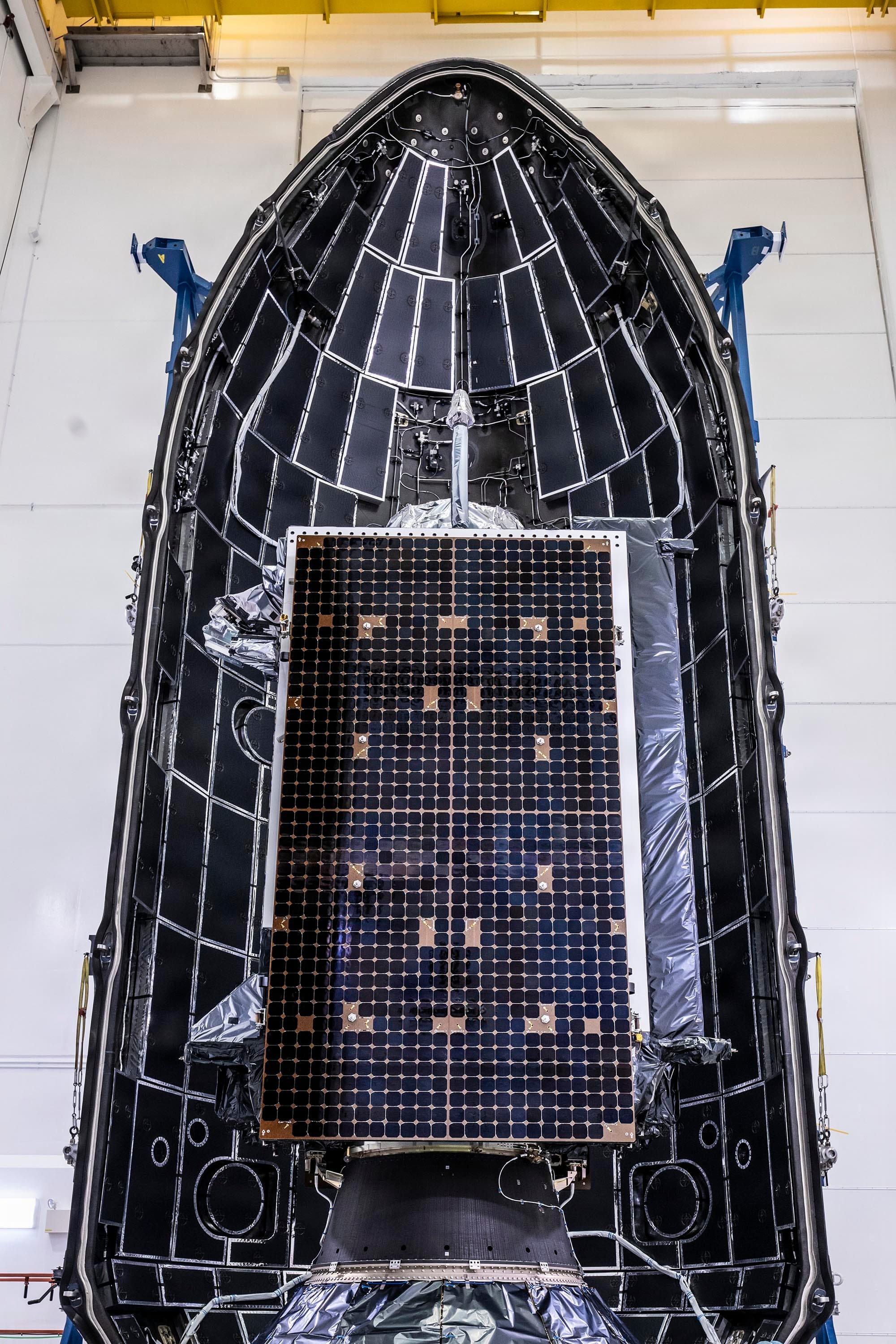
Time runs faster above your head: relativity in GPS
Clocks on GPS satellites would gain about 38.6 microseconds a day on clocks on the ground. Where that number comes from, how engineers deal with it, and what would really go wrong if they didn’t.
Quantum entanglement: what it is (and isn’t)
Distant particles give results that no instructions they carry can explain, unless something passes between them or the experiments are rigged. Fifty years of tests agree. None of it lets you send a message faster than light.