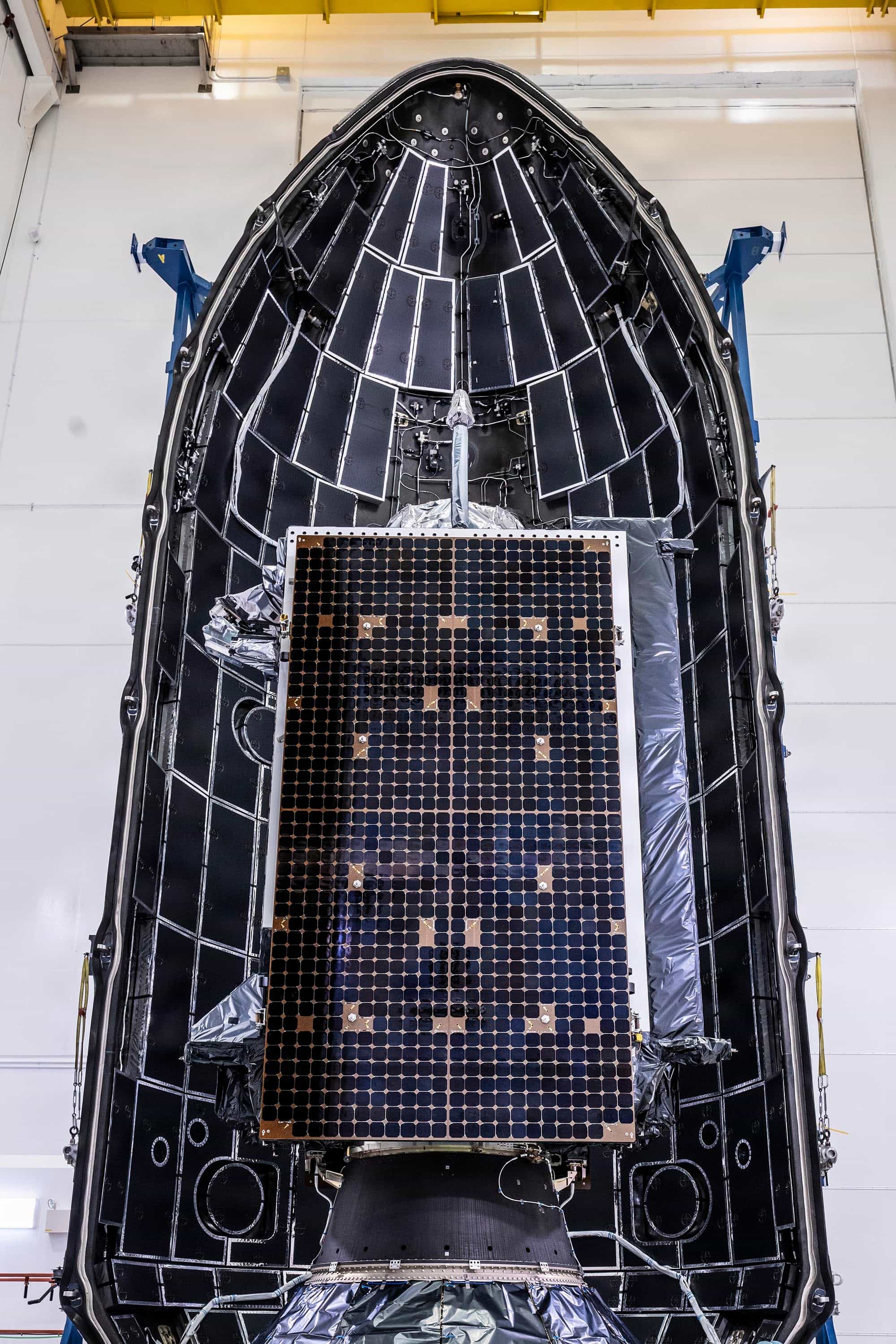
A GPS III satellite before launch, April 2026 · Image credit: U.S. Space Force photo by Maj. Brittany Curry · Public domain (US government work, U.S. Space Force)The appearance of U.S. Department of War (DoW) visual information does not imply or constitute DoW endorsement.
Relativity22 min read
Time runs faster above your head: relativity in GPS
Clocks on GPS satellites would gain about 38.6 microseconds a day on clocks on the ground. Where that number comes from, how engineers deal with it, and what would really go wrong if they didn’t.
Companion video: Time runs faster above your head ↓
Contents
- A position, measured with clocks
- Two ways to change how fast a clock ticks
- The ground is not a neutral referee
- Slowing the clock down on purpose
- What would actually go wrong
- Oval orbits and a spinning Earth
- Where the two effects cancel
- Your head is older than your feet
- Open questions
- How sure are we?
- What the video simplified
- Further reading
- References
On 23 June 1977 a test satellite called NTS-2 went into orbit carrying what physicist Neil Ashby describes as the first cesium atomic clock (an ultra-precise clock that keeps time using cesium atoms) placed in orbit. Einstein’s theories predicted that the clock would tick at a different rate up there. But no clock like it had flown before, there was uncertainty about how big the effect would be and even which way it would go, and some people doubted it would matter at all. So the engineers built in a switch: a device that could change how fast the clock ticked, to be turned on once the clock’s behavior in orbit had been measured Reference 1.
They let the clock run for about 20 days. It ran fast compared with clocks on the ground by 442.5 parts in a million million (10¹²): for every million million ticks of a ground clock, it made 442.5 extra ones. That is a gain of about 38.2 microseconds a day (a microsecond, written μs, is a millionth of a second). Einstein’s theories predicted 446.5 parts, or 38.6 μs a day, and the small gap was well within the accuracy of the clock itself Reference 1. The switch was flipped.
A clock 20,000 kilometers up does not keep the same time as a clock in your pocket, and a positioning system built from clocks has to know exactly how much they disagree. This article explains where the disagreement comes from (two effects that pull in opposite directions), why the net result is about 38.6 microseconds a day, what engineers do about it, and what would actually go wrong if they didn’t. That last part is less dramatic than the usual telling, but still fatal: timing would drift by a microsecond within about 40 minutes, and ignoring relativity entirely would put errors of up to about 14 m (oval orbits) and 40 m (Earth’s spin) into the distances to the satellites, some immediately, the rest within hours. The physics itself is as settled as physics gets.
A position, measured with clocks
Satellite navigation works by timing. Each GPS (Global Positioning System) satellite carries an atomic clock, a clock that counts the extremely regular vibrations of atoms, and broadcasts a signal that says, in effect, “this message left me at exactly this time, from exactly this place.” Your phone notes when each message arrives. Radio waves travel at the speed of light, so the delay tells the phone how far away each satellite is Reference 1.
The margins are brutal. Light travels about 30 centimeters in a nanosecond, a billionth of a second, so a timing error of one nanosecond becomes a distance error of roughly 30 cm.
There is a catch in your pocket, too. Your phone does not have an atomic clock. Its clock is a cheap vibrating crystal, like the one in a wristwatch, and it can be off by a lot Reference 1. GPS gets around this by treating the phone’s clock error as one more unknown. Three unknowns pin down where you are (east–west, north–south, up–down), and the fourth is how wrong your own clock is. That is why a receiver needs signals from at least four satellites Reference 1. Keep this in mind; it matters later. Under open sky, a smartphone typically finds you to within about 4.9 m Reference 6.
The satellites fly about 20,200 km above the ground and circle the Earth twice a day Reference 7. Add Earth’s own radius and the planned orbit is 26,559.8 km from Earth’s center Reference 8.
Two ways to change how fast a clock ticks
The first comes from special relativity, Einstein’s theory of space, time and motion. It says a moving clock ticks more slowly than a clock at rest, an effect called time dilation. Moving compared with what? For GPS, speeds are measured from a point of view, or frame, that does not spin with the Earth, as if you hovered far above the North Pole watching the planet turn. From there both the satellite and a ground clock are moving. Ashby’s classroom explanation sends a light signal from one end of a rod to the other while the rod moves sideways: seen by someone the rod is moving past, the light travels a longer, slanted path, and since light always moves at the same speed, it takes longer. If each trip of the light is one tick of a clock, the moving clock ticks slower Reference 2. The satellite moves at about 3.87 km/s (our calculation), fast for an object but tiny compared with light, so the slowdown is small: less than one part in ten billion (10¹⁰) Reference 2.
The second comes from general relativity, Einstein’s theory of gravity, and it is the one in the headline. It says a clock deeper in a gravitational field ticks more slowly than a clock higher up. This is gravitational time dilation. What matters is not how strongly gravity pulls on the clock but how far down in Earth’s “gravity well” it sits: how much energy it would take to climb all the way out. The two are different. To take our own illustration of Ashby’s rule that rate follows depth Reference 2: at the very center of the Earth the pulls from all sides cancel, so you would feel no gravity at all, yet that is the bottom of the well, and a clock there would tick slower than one on the surface.
Ashby explains the slowdown with a thought experiment. In a rocket accelerating upward, a signal sent from the floor takes a moment to reach the ceiling, and by then the ceiling has sped up and is running away from the signal. Like an ambulance siren heard from a car driving away, the signal arrives at a lower frequency (the Doppler effect), so the ceiling receives the floor clock’s ticks more slowly than its own. Einstein’s equivalence principle says that standing in gravity is indistinguishable from riding in such a rocket, so on Earth, too, a clock lower down is seen to tick slower Reference 2. A GPS satellite is lifted a long way out of the well, so its clock speeds up by about five parts in 10¹⁰ Reference 9Reference 2.
For physicistsThe weak-field clock rate3 equations · conventions · ~3 min
Conventions: SI units, weak field, order , Earth-centered inertial (ECI) frame, coordinate time ticking at the geoid rate (Ashby’s Eqs. 12–24 Reference 1):
A clock at ECI radius and speed runs, relative to geoid clocks, at (Eq. 27)
keeping only the monopole at the satellite (Earth's there contributes about , neglected as in Ashby §5).
The geoid's effective potential (monopole, and centrifugal terms) is (Eq. 18). Since IAU 2000 the rate of Terrestrial Time is fixed by the defining constant rather than by the geoid itself (Table 1.1 of Reference 10). With Reference 10Reference 11 and km Reference 8, our calc/rates.ts gives, for an equatorial geoid clock as reference,
summing to (IS-GPS-200N and Ashby: 4.4647, for a slightly larger orbit), with the equatorial radius.
Step by step
Two clocks, one day
Figure: Two identical clock faces stand side by side on a curved ground line. The panel below reads: same design, same rate, zero microseconds per day apart.
Figure: The second clock is lifted to about 20,200 km. An orange bar labelled height, general relativity, extends to plus 45.7 microseconds per day.
Figure: An arrow shows the orbiting clock moving at 3.87 km/s; the ground clock moves at 0.47 km/s with Earth’s spin. An orange bar labelled speed, special relativity, extends to minus 7.1 microseconds per day.
Figure: A third bar, net, in orange, reaches plus 38.6 microseconds per day; the orbiting clock is labelled plus 38.6 microseconds per day.
Figure: An orange line rises steadily over 30 days, with a dot at day 1 and labels at 7 days (270 microseconds) and 30 days (1,157 microseconds); the orbiting clock is labelled plus 38.6 microseconds per day.
Figure: Four bars on a log scale of meters. One day of relativistic drift: 11.6 km of light travel, removed by the built-in offset. Ordinary clock offsets in the GPS week 2440 almanac: about 95 km, corrected from the ground. Oval orbits, in orange: swings of 6.9 to 14 m that receivers must compute. Earth’s spin during the signal: up to 40 m that receivers must allow for.
The ground is not a neutral referee
“The satellite clock gains on the ground clock” hides a subtlety. The ground clock is not a perfect timekeeper either. It sits deep in Earth’s gravity well, which slows it, and it rides around on the spinning planet, which slows it a little more. Compared with a clock at rest far from Earth (ignoring the Sun’s gravity), clocks at sea level run slow by about seven parts in 10¹⁰ Reference 1.
Here is the remarkable part. All clocks at rest on the geoid, the idealized sea-level surface of the Earth, tick at the same rate, to the precision GPS needs Reference 1Reference 9. A clock near a pole is closer to Earth’s center (the planet is slightly squashed), so it sits deeper in the gravity well, but it barely moves. A clock on the equator is higher but moves faster. The balance is no coincidence. Seen from the turning Earth, the spin shows up as a gentle outward fling, strongest at the equator. Water flows until no spot is “downhill” from any other, counting both gravity and that fling, so the sea surface balances depth against spin. A clock’s rate depends on the same two things, its depth and its speed from Earth’s spin, so sea-level clocks agree Reference 1. World time, the official time kept by laboratories around the world, is based on clocks on this surface Reference 1. So is GPS time, the system’s own master timescale: it is kept by GPS’s control center and steered to stay close to the U.S. Naval Observatory’s version of world time (apart from leap seconds), and the satellite clocks must keep it Reference 3Reference 1.
It also means the split into a “height part” and a “speed part” depends on which ground clock you compare with. Against a clock at a pole, deeper in the well but not moving, the satellite’s height gain is bigger and so is its speed loss; against a clock on the equator, both are smaller. The total is the same, because those two ground clocks agree (our calculation). Treating the Earth as a non-spinning ball of average radius would give 38.5 instead (our calculation).
+38.6 μs/day
Net gain of an uncorrected GPS clock · vs sea level
Slowing the clock down on purpose
The fix sounds almost too simple: make the clock run slow before it gets to orbit.
Each satellite’s timing signals are built from a reference that is supposed to run at 10.23 million cycles a second (10.23 megahertz, MHz) Reference 3. The official GPS rulebook, the interface specification that says how satellites and receivers must behave, requires the satellite clocks to be offset by −4.4647 parts in 10¹⁰. Measured on the ground before launch, the reference runs at 10.2299999954326 MHz, about 0.0046 cycles per second slow. Up in orbit it gains, on average, almost exactly that much, so compared with ground clocks it keeps the 10.23 MHz rate Reference 3Reference 1. For the early cesium clocks this adjustment was made at the factory, before launch Reference 1.
Rubidium clocks, another kind of atomic clock, can jump in frequency during launch. Ashby reported in 2003 and 2006 that their rate was often measured in orbit instead, with the correction sent to receivers in the navigation message, the data each satellite broadcasts with its time signal Reference 1Reference 2.
The history includes a cautionary tale. The original factory offset was slightly wrong: one stage of the calculation had left out the effect of Earth’s rotation on the ground clocks. Ashby found the omission, and GPS managers knew about it by the early 1980s, but eight years passed from then before the specifications were changed. The required change was 1.2 parts in a million million Reference 1Reference 9, worth about 100 nanoseconds a day, or 31 m of light travel. Meanwhile, by our inference, the ground stations’ constant re-measuring of each clock could absorb the error.
What would actually go wrong
A popular claim, made in our video too, is that without relativity GPS would drift by about 10 kilometers a day. The most authoritative version of that claim comes from Ashby, a University of Colorado physicist who, as of 2002, had consulted for the U.S. National Institute of Standards and Technology (NIST) on relativistic effects on clocks since 1974 Reference 9. In Physics Today magazine he wrote: “If these relativistic effects were not corrected for, satellite clock errors building up in just one day would cause navigational errors of more than 11 km, quickly rendering the system useless” Reference 9.
The arithmetic is simple: in 38.6 microseconds light travels 11.6 km. But what does “not corrected” mean? Two things about a satellite clock matter: its offset, how far it is set off from GPS time at a given moment, and its drift rate, how fast that offset grows. Ground stations measure both for every satellite and broadcast them in the navigation message, so receivers can correct each clock Reference 9Reference 3. The rest of this section is Five Sigma’s own reading of the published equations and of the almanac for GPS week 2440 (October 2026), a weekly summary of every satellite’s orbit and clock Reference 12.
In that almanac the satellite clocks are set off from GPS time by a median of 317 microseconds, about 95 km of light travel, and drift at a median rate worth roughly 190 m of light travel per day. Relativity alone would add 11.6 km per day: roughly 60 times the median drift rate (the almanac lists drift only coarsely), and 20 times the largest in the almanac Reference 12.
Could the ground correct relativity’s drift too? Yes: for rubidium clocks it once did, as Ashby reported Reference 1. Today none of the broadcast drift rates comes close to 38.6 microseconds a day, so the offset must already be applied in the satellites, as the rulebook specifies (our inference) Reference 12Reference 3. If the drift were corrected neither in the satellites nor from the ground (a thought experiment: in reality the ground measures each clock’s total drift), the satellite clocks would run away from GPS time, and so from world time, by 38.6 microseconds more each day. GPS time would drift by a microsecond within about 40 minutes, too much for users who need precise time, such as power companies locating faults on their lines Reference 9.
If the drift were corrected neither in the satellites nor from the ground, positions would also degrade. Your receiver always solves for its own clock error Reference 1, so the part of the drift shared by every satellite would look like your phone’s own clock being off, just as a race timed with stopwatches all started 5 seconds late still has the right winner. Two things leak through. Orbits differ slightly in size, so each satellite’s relativistic gain differs slightly too: by our calculation typically 10–15 cm of distance per day, up to about 30 cm, for most satellites and nearly 2 m a day for one whose orbit is about 7 km smaller than average, adding up to meters within a month for most and tens of meters for that one Reference 12Reference 1. And the phone works out where each satellite is from its time stamps, so a clock running ahead misplaces its satellite: by up to 15 cm after a day and 4.5 m after a month (our calculation).
Relativity also requires two corrections that the built-in offset cannot make, and GPS leaves both to receivers. Receivers must correct for slightly oval orbits themselves, because the broadcast corrections deliberately leave that part out (a historical choice, explained below): up to about 7 m for an orbit whose distance from Earth’s center varies by ±1% (eccentricity 0.01), and 14 m for the almanac’s most eccentric orbit, 0.021 Reference 3Reference 12. And signal travel must be worked out in a frame that does not spin with the Earth, or errors of up to about 40 m appear (next section).
The verdict: switching relativity off would not send your blue dot 11 km away in a day. Correcting the steady gain neither in the satellites nor from the ground would make GPS time drift by a microsecond within about 40 minutes and spoil positions by meters within weeks (tens with the outlier satellite). The ground could take over the job instead, as it once did for rubidium clocks Reference 1. Ignoring relativity entirely, including the receivers’ corrections, would add range errors of up to about 14 m (oval orbits) and 40 m (Earth’s spin), some immediately, the rest within hours, larger than a phone’s 4.9 m position accuracy.
For physicistsWhy a common clock drift cancels, and what doesn’t1 equation · our analysis · ~2 min
Pseudorange to satellite (Eqs. 41–43 of Reference 1):
A common bias is degenerate with (our inference). What remains: the ephemeris time-tag error, at most ≈ 0.15 m after a day (line-of-sight part only enters); orbit-size rate differences, per meter (Eq. 55), small next to ordinary drifts (median ≈ 188 m/day in the week-2440 almanac Reference 12) but larger than the time-tag error: the median satellite (0.48 km from the mean) gives 0.12 m/day, PRN 12 (7.31 km below the mean) 1.8 m/day; and , excluded from the broadcast polynomial Reference 3: 6.9 m at , 14.4 m at .
Oval orbits and a spinning Earth
Orbits are not perfect circles. A GPS orbit is allowed to be slightly oval. Its eccentricity, a measure of how stretched the ellipse is, is normally kept between 0 and 0.02 and required to stay below 0.03, so the almanac’s largest, 0.021, is inside the requirement Reference 8Reference 12. On an oval orbit the satellite swoops lower and faster near one end and climbs higher and slower near the other, so its clock gets ahead and then falls behind in a rhythm that repeats every orbit. For an eccentricity of 0.01, the clock runs up to about 23 nanoseconds ahead or behind, worth about 7 m of distance Reference 1. The satellites do not correct for this themselves. The specification tells every receiver to compute it from the orbit data in the navigation message Reference 3. According to Ashby, that was a historical choice, made because early satellites had little computing power Reference 1Reference 9.
The effect has been watched directly. In October 1995, the GPS receiver on TOPEX/POSEIDON, a satellite built to measure the height of the sea, tracked GPS satellites from orbit. For the most oval of the satellites tracked (eccentricity 0.01486) the clock swung up to 10.2 m (in distance terms) ahead and behind, and the preliminary results agreed with theory to within about 2.5% Reference 1.
For physicistsWhere 4.4647 × 10⁻¹⁰ comes from, and the eccentricity term3 equations · ~3 min
Using (Eq. 33 of Reference 1), coordinate time on the satellite clock is (Eq. 34)
The constant terms give (Eq. 35), the offset IS-GPS-200N §3.3.1.1 specifies Reference 3. With the last term integrates to (Eqs. 38–40)
IS-GPS-200N §20.3.3.3.3.1 writes , ; with it is the negative of Ashby's, but it is added to and then subtracted, so the net correction has the same sign as Eq. 39 Reference 3.
The Earth spins under the signal. A signal takes about 0.07–0.09 seconds to come down from a satellite. In that time a receiver on the equator is carried tens of meters east by Earth’s spin, so if the satellite is to the east the signal has a little less distance to cover, and if it is to the west a little more Reference 9. Seen from a viewpoint that does not spin with the Earth, this is just geometry: light goes straight, at constant speed, to wherever the receiver has moved. Seen from the spinning ground, it looks like a strange, direction-dependent timing offset, called the Sagnac effect. For a single GPS signal our calculation gives up to about 133 nanoseconds, or 40 m. GPS therefore works out signal travel in a frame that does not spin with the Earth, which amounts to each receiver allowing for its own motion during the signal’s flight Reference 1Reference 9Reference 3. It is a first-order effect of the receiver’s motion, but Ashby counts it as relativity because it is about when events count as simultaneous: clocks set one after another by light signals sent eastward around the equator would end up with the last one 207.4 nanoseconds behind the first, so no single “now” works for every clock on the spinning ground Reference 1.
Where the two effects cancel
The tug-of-war between height and speed depends on the orbit. Close to the Earth a satellite must move very fast to stay up, so the speed effect wins and its clock runs slow Reference 1. By our calculation, a clock in a 400 km circular orbit would lose about 24.6 microseconds a day. Far out, satellites move more slowly and sit much higher, so height wins. For circular orbits the two effects cancel at a radius of about 9,545 km from Earth’s center Reference 1Reference 9, roughly 3,170 km above the surface (our calculation). A clock in geostationary orbit, where a satellite circles once a day and seems to hover over one spot, 42,164 km from Earth’s center Reference 1, would gain about 46.6 microseconds a day (our calculation).
That crossover is a property of orbiting clocks. A clock held up on a tower or a mountain isn’t racing around the planet, so almost nothing offsets its gravitational speed-up. Raise it on any tower or mountain and it runs faster.
Explorable · try it
How much does your clock drift at this altitude?
A clock in a circular orbit at 20 182 km runs fast by 38.6 μs a day compared with a clock at sea level.
Assumptions and simplifications
- Rates are compared with a clock at sea level; all sea-level clocks tick at the same rate.
- “Orbiting” means a circular orbit at that height; “at rest” means held fixed above the equator, turning with the Earth.
- Includes Earth’s slight bulge at the equator; ignores the tiny pull of the Sun and Moon.
- Very low orbits are hypothetical: air drag would bring a real satellite down.
Your head is older than your feet
The same physics works at human scale, just much more weakly. Near the ground, a clock one meter higher runs faster by about 1.1 parts in 10¹⁶ (ten million billion) Reference 4. If you stood upright for 80 years, your head, about 1.7 m above your feet, would age roughly half a microsecond more.
The landmark measurement on Earth came in 1960. R. V. Pound and G. A. Rebka at Harvard University sent gamma rays (very high-energy light) up and down a 74-foot (22.6 m) tower. The rays falling down the tower arrived with slightly higher frequency than those going up, by the amount general relativity predicts, within 10% Reference 13. A light wave’s vibrations are themselves a kind of clock, so this is the bottom of the tower seeing the top’s “clock” run fast.
In October 1971, J. C. Hafele and Richard Keating flew four cesium clocks around the world on commercial airliners, once eastward and once westward. Compared with clocks at the U.S. Naval Observatory, the flying clocks lost 59 ± 10 nanoseconds going east and gained 273 ± 7 going west (“±” gives one standard deviation of uncertainty: the true value probably lies within that range, with roughly two chances in three). The predictions were −40 ± 23 and +275 ± 21, so both trips agreed within the uncertainties Reference 14Reference 15. Why does direction matter? Picture the Earth from above the North Pole, from the non-spinning frame. A plane flying east adds its speed to the ground’s spin, so its clock moves fastest and loses time; a plane flying west cancels part of the spin, so its clock moves slower than the ground clocks and gains Reference 9.
In 1976, Gravity Probe A launched a hydrogen maser, a very stable atomic clock based on hydrogen, nearly straight up to 10,000 km on a rocket. The measured frequency shift agreed with the prediction to about 7 parts in 100,000 Reference 16Reference 17. Later tests compare themselves with a more cautious limit derived from the same flight: any departure from general relativity is smaller than about 14 parts in 100,000 Reference 17.
In 2010, physicists at NIST compared two optical clocks, an even more precise kind of atomic clock that uses light instead of the microwaves of cesium clocks Reference 18, each built around a single aluminum ion (an aluminum atom with an electron removed), connected by 75 m of optical fiber Reference 4. They raised one of the two clocks by 33 cm Reference 4Reference 19. The raised clock ran faster by (4.1 ± 1.6) parts in 10¹⁷. From the clocks alone, without a ruler, you would conclude it had been raised by 37 ± 15 cm; the true value was 33 Reference 4. NIST put it in human terms: standing 33 cm higher for a 79-year lifetime adds up to about 90 billionths of a second Reference 18.
Then came a happy accident. In August 2014, a problem with a rocket’s upper stage left two satellites of Europe’s Galileo navigation system, numbers 5 and 6, in the wrong, stretched orbits. Even after the orbits were adjusted, they stayed oval (eccentricity 0.162), so on each 13-hour lap a satellite climbs and falls by thousands of kilometers Reference 17Reference 20. The mishap turned them into a gravity experiment Reference 20: over each lap, their clocks run ahead and then behind by up to about 370 nanoseconds Reference 20. Two independent teams analyzed about three years of data. Both found agreement with general relativity. For the height effect alone, one team’s uncertainty was about 2.5 parts in 100,000, about 5.6 times tighter than the Gravity Probe A limit Reference 17; the other’s was about four times tighter, and it also tested the height and speed effects together Reference 20.
In 2022 a team at JILA, a physics institute run by the University of Colorado and NIST, went further still. Within a single millimeter-sized cloud of ultracold strontium atoms, they measured the clock rate rising from the bottom of the cloud to the top by 9.8 ± 2.3 parts in 10²⁰ per millimeter, against 10.9 predicted by general relativity Reference 5. In 2023 an independent team at the University of Wisconsin measured the same steady change of clock rate with height across a row of five tiny clocks spanning 1 cm, again consistent with general relativity Reference 21.
For physicistsTesting the redshift: the α parameter1 equation · results · ~2 min
Departures from local position invariance are parametrized as Reference 17. GSAT0201/0202 (, h): Delva et al. (1σ) Reference 17; Herrmann et al. (redshift plus Doppler) from their most reliable clock; redshift-only Reference 20. Gravity Probe A: Reference 17, agreement "at the level" Reference 16. Pound–Rebka: two-way shift vs predicted (their signs) Reference 13. JILA's gradient is negative only because its axis points along gravity Reference 5; Wisconsin's analysis was blinded Reference 21.
Open questions
The basic effect is not in doubt. The open questions are about precision and new uses.
- How exactly does gravity change time? The best satellite tests agree with general relativity to a few parts in 100,000 Reference 17Reference 20. The European Space Agency’s ACES (Atomic Clock Ensemble in Space), installed on the International Space Station in April 2025 for a planned 30 months, carries an ultra-precise cesium clock and a hydrogen maser to compare clocks in space and on the ground Reference 22Reference 23. In a preprint (not peer reviewed) written before launch, the team projected an uncertainty of 0.2–0.3 parts in 100,000: about 50 to 70 times better than the Gravity Probe A limit and roughly ten times better than Galileo Reference 23. As of 13 October 2026 we found no published result.
- Clocks as height sensors. Because clock rates depend on height, clocks can measure heights relative to sea level directly, with uses in geophysics, the study of the Earth’s shape and interior Reference 4. In 2018 NIST clocks reached an accuracy of 1.4 parts in 10¹⁸, close to the one part in 10¹⁸ needed to resolve 1 cm of height Reference 24, and in 2020 a pair of transportable clocks measured the 450 m height difference of Tokyo Skytree, a broadcasting tower, agreeing with general relativity to within about 9 parts in 100,000 Reference 25. The open question is turning such demonstrations into routine networks.
How sure are we?
EVIDENCE LEVELS ARE EDITORIAL JUDGEMENTS OF THE WHOLE BODY OF EVIDENCE — NOT σ VALUES · What these mean
Clocks higher in a gravitational field tick faster, and moving clocks tick slower.
Evidence level: EstablishedMeasured with gamma rays, aircraft, rockets, satellites and laboratory clocks, from millimeters to thousands of kilometers Reference 13Reference 15Reference 16Reference 17Reference 4Reference 5Reference 21.An uncorrected GPS satellite clock would gain about 38.6 microseconds a day on clocks at sea level.
Evidence level: EstablishedStandard general relativity for Earth’s gentle gravity. NTS-2 confirmed the combined effect to about 1% in 1977 Reference 1.GPS has to account for relativity to work: an on-board clock offset plus receiver-side corrections.
Evidence level: EstablishedWritten into the official interface specification Reference 3 and explained in detail by Ashby Reference 1.If the steady gain were corrected neither in the satellites nor from the ground, GPS time would drift by a microsecond within about 40 minutes and positions would degrade by meters within weeks; ignoring relativity entirely would add range errors of up to about 14 m (oval orbits) and 40 m (Earth’s spin), some immediately, the rest within hours. Neither means a jump of 11 km a day.
Evidence level: Strong evidenceOur analysis of standard physics (Ashby’s equations) and the GPS week 2440 almanac; the conclusion itself is not stated in the sources Reference 1Reference 12.The gravitational slowdown has been measured across distances of a millimeter to a centimeter.
Evidence level: Strong evidenceTwo independent experiments, both consistent with general relativity Reference 5Reference 21.
What the video simplified
In the video: Satellite clocks run faster because gravity is weaker up there.
More precisely: What matters is how deep a clock sits in Earth’s gravity well (the gravitational potential), not how hard gravity pulls on it. The direction comes out the same, but the reason is depth, not strength Reference 1.In the video: General relativity adds about 45 microseconds a day, special relativity takes away about 7, net 38.
More precisely: Close. With the real sea-level reference it is +45.7, −7.1 and net +38.6 microseconds a day. The split depends on which ground clock you compare with; the net does not Reference 2Reference 1.In the video: Without relativity, GPS positions would drift by about 10 km a day.
More precisely: Ashby wrote “more than 11 km”: that is how far light travels in one day’s drift. By our analysis, if the drift were corrected neither in the satellites nor from the ground, the shared part would mostly show up as wrong time and differences between satellites would spoil positions over weeks; skipping the oval-orbit and Earth’s-spin corrections too would add range errors of up to about 14 m (oval orbits) and 40 m (Earth’s spin) Reference 9Reference 12Reference 3.In the video: The satellite clocks are set to 10.22999999543 MHz before launch.
More precisely: That is the specified value, rounded Reference 3. Cesium clocks were adjusted before launch; Ashby reported that rubidium clocks were often measured in orbit instead Reference 1.In the video: The satellites correct for relativity.
More precisely: Partly. The clock offset handles the steady gain, but every receiver must add the oval-orbit correction itself and allow for Earth’s spin Reference 3Reference 1.
Further reading
Start here Accessible
National Institute of Standards and Technology, NIST Pair of Aluminum Atomic Clocks Reveal Einstein's Relativity at a Personal Scale (2010). https://www.nist.gov/news-events/news/2010/09/nist-pair-aluminum-atomic-clocks-reveal-einsteins-relativity-personal-scale (accessed 12 October 2026)Free
NIST’s own account of seeing time run faster 33 cm higher.B. G. Levi, Relativistic effects seen at everyday distances and speeds, Phys. Today 63, 16–17 (2010). https://doi.org/10.1063/1.3518266Paywall
A short news story explaining how the aluminum-ion clocks were compared.European Space Agency, ACES finds its home in orbit (2025). https://www.esa.int/Science_Exploration/Human_and_Robotic_Exploration/ACES_finds_its_home_in_orbit (accessed 12 October 2026)Free
ESA on the atomic clocks now flying on the International Space Station.
Go deeper Intermediate
N. Ashby, Relativity and the Global Positioning System, Phys. Today 55, 41–47 (2002). https://doi.org/10.1063/1.1485583Paywall
The classic magazine-length explanation of relativity in GPS, by the physicist who worked on it.N. Ashby, Relativistic Effects in the Global Positioning System (2006). https://www.aapt.org/doorway/tgru/articles/ashbyarticle.pdf (accessed 12 October 2026)Free
Ashby’s undergraduate-level notes, with thought experiments on moving light signals and an accelerating rocket.GPS.gov, Space Segment. https://www.gps.gov/space-segment (accessed 12 October 2026)Free
The official overview of the GPS satellite constellation.
Technical Primary literature
N. Ashby, Relativity in the Global Positioning System, Living Rev. Relativ. 6, 1 (2003). https://doi.org/10.12942/lrr-2003-1Free
The definitive open-access review: coordinate time, the geoid, the eccentricity effect, orbit-change tests.U.S. Space Force, Space Systems Command, NAVSTAR GPS Space Segment/Navigation User Segment Interfaces (IS-GPS-200, Revision N), Report No. IS-GPS-200N (2022). https://www.navcen.uscg.gov/sites/default/files/pdf/gps/IS-GPS-200N.pdf (accessed 12 October 2026)Free
The GPS interface specification itself; see sections 3.3.1.1 and 20.3.3.3.3.1.P. Delva et al., Gravitational Redshift Test Using Eccentric Galileo Satellites, Phys. Rev. Lett. 121, 231101 (2018). https://doi.org/10.1103/PhysRevLett.121.231101 · Free version: arXiv:1812.03711 [gr-qc]Free on arXiv
The Galileo 5 and 6 gravity-clock test, with a careful error analysis.S. Herrmann et al., Test of the Gravitational Redshift with Galileo Satellites in an Eccentric Orbit, Phys. Rev. Lett. 121, 231102 (2018). https://doi.org/10.1103/PhysRevLett.121.231102 · Free version: arXiv:1812.09161 [gr-qc]Free on arXiv
The independent analysis of the same satellites.T. Bothwell, C. J. Kennedy, A. Aeppli, D. Kedar, J. M. Robinson, E. Oelker, A. Staron, and J. Ye, Resolving the gravitational redshift across a millimetre-scale atomic sample, Nature 602, 420–424 (2022). https://doi.org/10.1038/s41586-021-04349-7 · Free version: arXiv:2109.12238 [physics.atom-ph]Free on arXiv
The millimeter-scale redshift measurement.X. Zheng, J. Dolde, M. C. Cambria, H. M. Lim, and S. Kolkowitz, A lab-based test of the gravitational redshift with a miniature clock network, Nat. Commun. 14, 4886 (2023). https://doi.org/10.1038/s41467-023-40629-8 · Free version: arXiv:2207.07145 [physics.atom-ph]Free
The independent centimeter-scale test with a miniature clock network.
References
Numbered in order of first citation. Journal articles link to their DOI; where a free version exists on arXiv we link it too. Preprints are marked as not peer reviewed.
- Reference 1: N. Ashby, Relativity in the Global Positioning System, Living Rev. Relativ. 6, 1 (2003). https://doi.org/10.12942/lrr-2003-1Back to citation 1 of reference 1Back to citation 2 of reference 1Back to citation 3 of reference 1Back to citation 4 of reference 1Back to citation 5 of reference 1Back to citation 6 of reference 1Back to citation 7 of reference 1Back to citation 8 of reference 1Back to citation 9 of reference 1Back to citation 10 of reference 1Back to citation 11 of reference 1Back to citation 12 of reference 1Back to citation 13 of reference 1Back to citation 14 of reference 1Back to citation 15 of reference 1Back to citation 16 of reference 1Back to citation 17 of reference 1Back to citation 18 of reference 1Back to citation 19 of reference 1Back to citation 20 of reference 1Back to citation 21 of reference 1Back to citation 22 of reference 1Back to citation 23 of reference 1Back to citation 24 of reference 1Back to citation 25 of reference 1Back to citation 26 of reference 1Back to citation 27 of reference 1Back to citation 28 of reference 1Back to citation 29 of reference 1Back to citation 30 of reference 1Back to citation 31 of reference 1Back to citation 32 of reference 1Back to citation 33 of reference 1Back to citation 34 of reference 1Back to citation 35 of reference 1Back to citation 36 of reference 1Back to citation 37 of reference 1Back to citation 38 of reference 1Back to citation 39 of reference 1
- Reference 2: N. Ashby, Relativistic Effects in the Global Positioning System (2006). https://www.aapt.org/doorway/tgru/articles/ashbyarticle.pdf (accessed 12 October 2026)Back to citation 1 of reference 2Back to citation 2 of reference 2Back to citation 3 of reference 2Back to citation 4 of reference 2Back to citation 5 of reference 2Back to citation 6 of reference 2Back to citation 7 of reference 2Back to citation 8 of reference 2Back to citation 9 of reference 2Back to citation 10 of reference 2
- Reference 3: U.S. Space Force, Space Systems Command, NAVSTAR GPS Space Segment/Navigation User Segment Interfaces (IS-GPS-200, Revision N), Report No. IS-GPS-200N (2022). https://www.navcen.uscg.gov/sites/default/files/pdf/gps/IS-GPS-200N.pdf (accessed 12 October 2026)Back to citation 1 of reference 3Back to citation 2 of reference 3Back to citation 3 of reference 3Back to citation 4 of reference 3Back to citation 5 of reference 3Back to citation 6 of reference 3Back to citation 7 of reference 3Back to citation 8 of reference 3Back to citation 9 of reference 3Back to citation 10 of reference 3Back to citation 11 of reference 3Back to citation 12 of reference 3Back to citation 13 of reference 3Back to citation 14 of reference 3Back to citation 15 of reference 3Back to citation 16 of reference 3Back to citation 17 of reference 3
- Reference 4: C. W. Chou, D. B. Hume, T. Rosenband, and D. J. Wineland, Optical Clocks and Relativity, Science 329, 1630–1633 (2010). https://doi.org/10.1126/science.1192720Back to citation 1 of reference 4Back to citation 2 of reference 4Back to citation 3 of reference 4Back to citation 4 of reference 4Back to citation 5 of reference 4Back to citation 6 of reference 4Back to citation 7 of reference 4
- Reference 5: T. Bothwell, C. J. Kennedy, A. Aeppli, D. Kedar, J. M. Robinson, E. Oelker, A. Staron, and J. Ye, Resolving the gravitational redshift across a millimetre-scale atomic sample, Nature 602, 420–424 (2022). https://doi.org/10.1038/s41586-021-04349-7 · Free version: arXiv:2109.12238 [physics.atom-ph]Back to citation 1 of reference 5Back to citation 2 of reference 5Back to citation 3 of reference 5Back to citation 4 of reference 5Back to citation 5 of reference 5
- Reference 6: GPS.gov, GPS Accuracy. https://www.gps.gov/gps-accuracy (accessed 13 October 2026)Back to citation 1 of reference 6
- Reference 7: GPS.gov, Space Segment. https://www.gps.gov/space-segment (accessed 12 October 2026)Back to citation 1 of reference 7
- Reference 8: U.S. Department of Defense, Global Positioning System Standard Positioning Service Performance Standard, 5th Edition (2020). https://www.navcen.uscg.gov/sites/default/files/pdf/gps/geninfo/2020SPSPerformanceStandardFINAL.pdf (accessed 12 October 2026)Back to citation 1 of reference 8Back to citation 2 of reference 8Back to citation 3 of reference 8
- Reference 9: N. Ashby, Relativity and the Global Positioning System, Phys. Today 55, 41–47 (2002). https://doi.org/10.1063/1.1485583Back to citation 1 of reference 9Back to citation 2 of reference 9Back to citation 3 of reference 9Back to citation 4 of reference 9Back to citation 5 of reference 9Back to citation 6 of reference 9Back to citation 7 of reference 9Back to citation 8 of reference 9Back to citation 9 of reference 9Back to citation 10 of reference 9Back to citation 11 of reference 9Back to citation 12 of reference 9Back to citation 13 of reference 9
- Reference 10: Verlag des Bundesamts für Kartographie und Geodäsie, IERS Conventions (2010), Report No. 36 (2010). https://iers-conventions.obspm.fr/content/tn36.pdf (accessed 12 October 2026)Back to citation 1 of reference 10Back to citation 2 of reference 10
- Reference 11: National Geospatial-Intelligence Agency, World Geodetic System 1984, United Nations Office for Outer Space Affairs (International Committee on GNSS reference-frame template) (2012). https://www.unoosa.org/pdf/icg/2012/template/WGS_84.pdf (accessed 12 October 2026)Back to citation 1 of reference 11
- Reference 12: U.S. Coast Guard Navigation Center, GPS YUMA almanac, week 392 (GPS week 2440) (2026). https://www.navcen.uscg.gov/sites/default/files/gps/almanac/current_yuma.alm (accessed 13 October 2026)Back to citation 1 of reference 12Back to citation 2 of reference 12Back to citation 3 of reference 12Back to citation 4 of reference 12Back to citation 5 of reference 12Back to citation 6 of reference 12Back to citation 7 of reference 12Back to citation 8 of reference 12Back to citation 9 of reference 12
- Reference 13: R. V. Pound and G. A. Rebka, Apparent Weight of Photons, Phys. Rev. Lett. 4, 337–341 (1960). https://doi.org/10.1103/PhysRevLett.4.337Back to citation 1 of reference 13Back to citation 2 of reference 13Back to citation 3 of reference 13
- Reference 14: J. C. Hafele and R. E. Keating, Around-the-World Atomic Clocks: Predicted Relativistic Time Gains, Science 177, 166–168 (1972). https://doi.org/10.1126/science.177.4044.166Back to citation 1 of reference 14
- Reference 15: J. C. Hafele and R. E. Keating, Around-the-World Atomic Clocks: Observed Relativistic Time Gains, Science 177, 168–170 (1972). https://doi.org/10.1126/science.177.4044.168Back to citation 1 of reference 15Back to citation 2 of reference 15
- Reference 16: R. F. C. Vessot et al., Test of Relativistic Gravitation with a Space-Borne Hydrogen Maser, Phys. Rev. Lett. 45, 2081–2084 (1980). https://doi.org/10.1103/PhysRevLett.45.2081Back to citation 1 of reference 16Back to citation 2 of reference 16Back to citation 3 of reference 16
- Reference 17: P. Delva et al., Gravitational Redshift Test Using Eccentric Galileo Satellites, Phys. Rev. Lett. 121, 231101 (2018). https://doi.org/10.1103/PhysRevLett.121.231101 · Free version: arXiv:1812.03711 [gr-qc]Back to citation 1 of reference 17Back to citation 2 of reference 17Back to citation 3 of reference 17Back to citation 4 of reference 17Back to citation 5 of reference 17Back to citation 6 of reference 17Back to citation 7 of reference 17Back to citation 8 of reference 17Back to citation 9 of reference 17
- Reference 18: National Institute of Standards and Technology, NIST Pair of Aluminum Atomic Clocks Reveal Einstein's Relativity at a Personal Scale (2010). https://www.nist.gov/news-events/news/2010/09/nist-pair-aluminum-atomic-clocks-reveal-einsteins-relativity-personal-scale (accessed 12 October 2026)Back to citation 1 of reference 18Back to citation 2 of reference 18
- Reference 19: B. G. Levi, Relativistic effects seen at everyday distances and speeds, Phys. Today 63, 16–17 (2010). https://doi.org/10.1063/1.3518266Back to citation 1 of reference 19
- Reference 20: S. Herrmann et al., Test of the Gravitational Redshift with Galileo Satellites in an Eccentric Orbit, Phys. Rev. Lett. 121, 231102 (2018). https://doi.org/10.1103/PhysRevLett.121.231102 · Free version: arXiv:1812.09161 [gr-qc]Back to citation 1 of reference 20Back to citation 2 of reference 20Back to citation 3 of reference 20Back to citation 4 of reference 20Back to citation 5 of reference 20Back to citation 6 of reference 20
- Reference 21: X. Zheng, J. Dolde, M. C. Cambria, H. M. Lim, and S. Kolkowitz, A lab-based test of the gravitational redshift with a miniature clock network, Nat. Commun. 14, 4886 (2023). https://doi.org/10.1038/s41467-023-40629-8 · Free version: arXiv:2207.07145 [physics.atom-ph]Back to citation 1 of reference 21Back to citation 2 of reference 21Back to citation 3 of reference 21Back to citation 4 of reference 21
- Reference 22: European Space Agency, ACES finds its home in orbit (2025). https://www.esa.int/Science_Exploration/Human_and_Robotic_Exploration/ACES_finds_its_home_in_orbit (accessed 12 October 2026)Back to citation 1 of reference 22
- Reference 23: L. Cacciapuoti et al., Atomic Clock Ensemble in Space, arXiv:2411.02912 [gr-qc] (2024).Preprint · not peer reviewedBack to citation 1 of reference 23Back to citation 2 of reference 23
- Reference 24: W. F. McGrew et al., Atomic clock performance enabling geodesy below the centimetre level, Nature 564, 87–90 (2018). https://doi.org/10.1038/s41586-018-0738-2Back to citation 1 of reference 24
- Reference 25: M. Takamoto, I. Ushijima, N. Ohmae, T. Yahagi, K. Kokado, H. Shinkai, and H. Katori, Test of general relativity by a pair of transportable optical lattice clocks, Nat. Photonics 14, 411–415 (2020). https://doi.org/10.1038/s41566-020-0619-8Back to citation 1 of reference 25
Cite this article
Five Sigma, “Time runs faster above your head: relativity in GPS,” Five Sigma (12 October 2026), https://thefivesigma.com/articles/gps-relativity. Version of 12 October 2026.
Spotted an error?
We correct mistakes openly and log every change on our corrections page. Report an error in this article.
Was this article clear?
The video
60-second video · coming soonTime runs faster above your head
Terms in this article
Keep reading
Why nothing can go faster than light
The cosmic speed limit isn’t really about light. It’s built into how space and time fit together, and breaking it would let an answer arrive before its question.