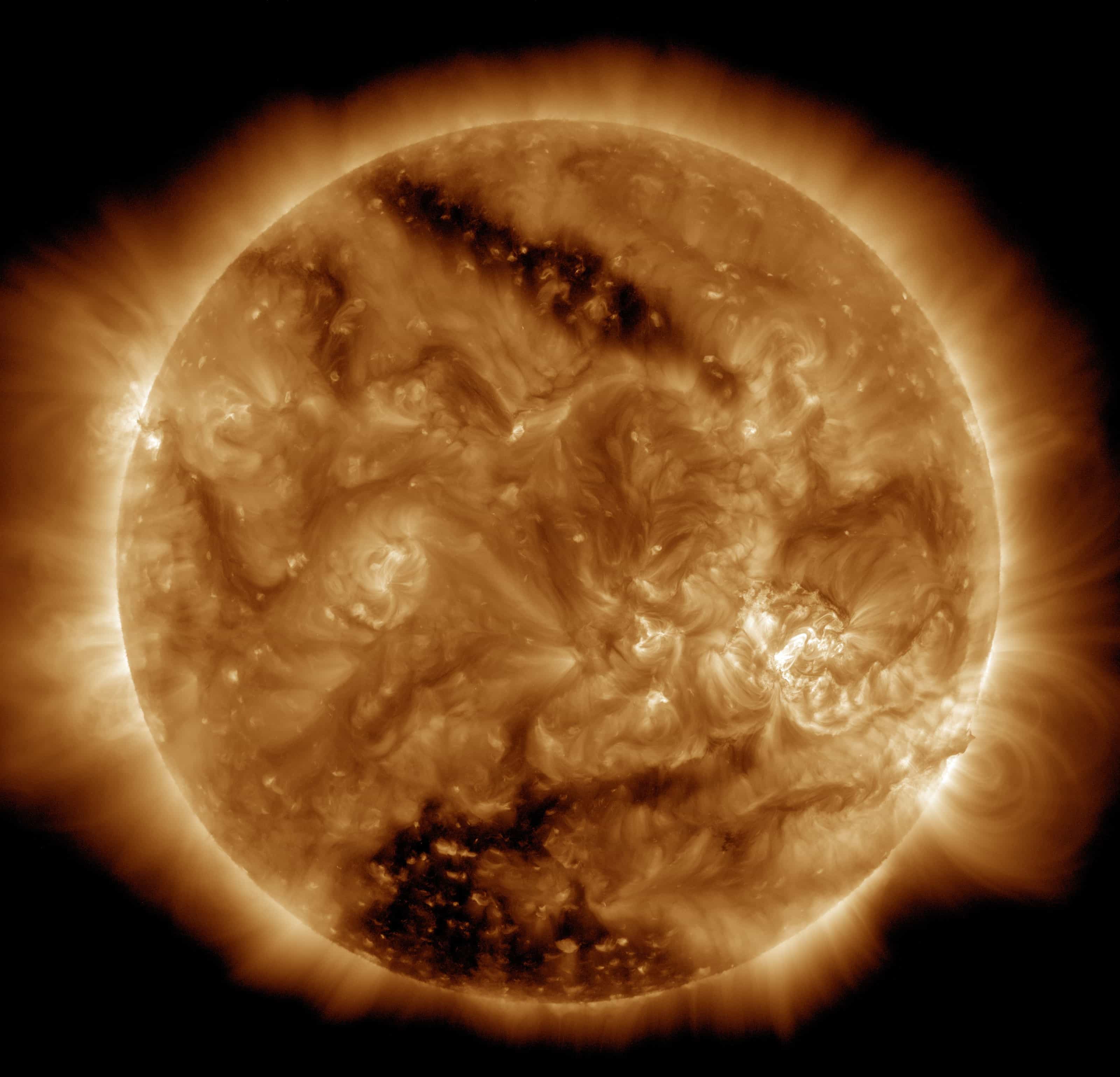
Two Coronal Holes on the Sun Viewed by SDO · Image credit: NASA/Goddard/SDO · Public domain (NASA)
Particles & neutrinos22 min read
Ghost particles: the neutrinos passing through you right now
Every second, tens of billions of neutrinos from the Sun cross each square centimeter of you, by day and by night. Here is how we know, and why it took a thirty-year puzzle to understand them.
Companion video: Ghost particles passing through you right now ↓
Hold up your thumb. In the second it took to read that, about 65 billion particles from the Sun went straight through every square centimeter of you, an area about the size of your thumbnail Reference 1. They were made a little over eight minutes ago, in the Sun’s core. Tonight, with the Sun below the horizon, they will keep coming, up through the floor, after crossing thousands of kilometers of rock. You will feel nothing. These particles are neutrinos: tiny particles with no electric charge that almost never touch anything Reference 2Reference 3.
Almost never is not never: by our own estimate, from a real detector’s counting rate, about once a week one of those solar neutrinos bumps into an electron somewhere inside your body. This article is about how we know, and why, for more than thirty years, up to two-thirds of the expected ones seemed to be missing Reference 4Reference 3.
Made in the core
The Sun shines because of nuclear fusion: light atomic nuclei joining to make heavier ones and releasing energy as they do. Its core is at about 15 million °C Reference 5. That is so hot that hydrogen atoms have lost their electrons, leaving bare protons in a super-hot, electrically charged gas called a plasma Reference 5.
The first step is the hard one. Two protons repel each other and cannot form a nucleus on their own. Even when the heat slams them together, they only stick if one of them turns into a neutron at that instant. Only one force in nature can do that: the weak interaction, the force that can change one kind of particle into another. When it succeeds, the pair becomes a deuteron, a heavy-hydrogen nucleus made of one proton and one neutron. Two new particles fly out: a positron, the antimatter twin of the electron, and a neutrino Reference 6. Neutrinos come in three types, named after the electron and its two heavier, short-lived cousins, the muon and the tau. This one is an electron neutrino; the Sun makes only electron neutrinos Reference 2.
The weak force lives up to its name: a given proton in the solar core waits, on average, about ten billion years before it takes part in this reaction Reference 6. The Sun is only about 4.6 billion years old, so most protons in its core are still waiting Reference 5.
After a few more steps, four protons end up as one helium nucleus; two protons must become neutrons, so in the main branch the first step happens twice. That releases 26.73 million electronvolts. An electronvolt (eV) is the energy an electron picks up crossing one volt; a million of them is written MeV. Physicists also give masses in these units, using E = mc²: an electron weighs 511,000 eV. Between them, the two neutrinos carry off about 0.63 MeV on average and leave the Sun for good. The rest heats the Sun and eventually leaves as sunlight. By our calculation from the reaction energies and the solar model, neutrinos take away about 2.4% of the Sun’s total power (0.63 of every 26.73 MeV) Reference 6Reference 1.
That bookkeeping is enough to count them. Each helium nucleus leaves about 26 MeV behind as heat and comes with two neutrinos, so each neutrino is like a receipt for about 13 MeV of sunshine. The Sun radiates 3.828 × 10²⁶ watts of light Reference 7. Divide that power into 13-MeV packets and you find the Sun must make about 1.8 × 10³⁸ neutrinos per second. Spread them over a sphere the size of the Earth’s orbit, and roughly 65 billion cross each square centimeter every second Reference 7Reference 6.
65 billion
SOLAR NEUTRINOS PER cm² PER SECOND AT EARTH
6.5 × 10¹⁰ per cm² per second, from the Sun’s energy budget.
The standard solar model, physicists’ best computer model of the Sun’s interior, agrees on the total, as it must, since the model is tuned to match the Sun’s brightness. What it adds is the breakdown: which steps make which neutrinos Reference 1. About 91% come from that first proton–proton step; physicists call the whole sequence it starts the proton–proton chain. About 7.5% come from a later step involving beryllium-7 (the number counts the protons and neutrons in the nucleus). Fewer than one in ten thousand come from boron-8, an unstable nucleus that breaks apart. Those are among the most energetic, and they will matter later in this story Reference 1.
The genuinely independent check is a count. Deep underground in Italy, the Borexino detector counted the collisions of proton–proton neutrinos; allowing for the known rate at which neutrinos change type (more on that later), that corresponds to about 6.1 × 10¹⁰ per square centimeter per second, give or take roughly 10%, against a predicted 6.0 × 10¹⁰ for this proton–proton part of the 6.5 × 10¹⁰ total Reference 8. Borexino’s measurements also confirm that about 99% of the Sun’s energy comes from the proton–proton chain Reference 9Reference 10. The remaining 1% or so comes from a second route, the CNO cycle, in which carbon, nitrogen and oxygen nuclei act as helpers Reference 11.
For physicistsCounting neutrinos from sunlight2 equations · the luminosity constraint · ~3 min
Hydrogen burning is plus heat. If fusion of light elements powers the Sun, neutrino fluxes must reproduce the photon flux at Earth Reference 6:
where , the heat delivered per neutrino of branch , is fixed by nuclear masses, independent of the solar model to one part in . Table I gives MeV and MeV, so MeV. With B16-GS98 fluxes Reference 1, MeV and
using W (IAU nominal, radiative only) and the exact au Reference 7. The SSM sum is (GS98) or (AGSS09met); since SSMs are calibrated to , this is a consistency check, not an independent determination. Borexino pp: , a full-spectrum rate from a spectral fit (most pp recoils lie under the ¹⁴C background) Reference 8. CNO: 5.1σ in 2020 Reference 11; final Reference 12. Code: calc/solar-neutrino-production.ts.
Step by step
From the Sun’s core to your floor
It starts here: two protons, one turning into a neutron, and an electron neutrino flying out. For every helium nucleus the Sun builds, 26.73 MeV is released and about 0.6 MeV leaves with the neutrinos.
Figure: Two protons fuse into a deuteron, a proton plus a neutron. A positron flies off, and an electron neutrino, drawn in orange, shoots away. Readouts: 26.73 MeV per helium nucleus, 0.63 MeV of it carried by the neutrinos.
Two ways out. The neutrino flies straight through and leaves in 2.3 seconds. Light staggers out in a random walk, absorbed and re-emitted over and over, for roughly 10,000 to 170,000 years; the heat itself, mostly stored in the gas, takes millions of years.
Figure: A cross-section of the Sun. A jagged random-walk path wanders around the center. A straight orange line runs from the center out through the surface, labeled 2.3 seconds. The light's random walk is labeled roughly 10,000 to 170,000 years, and the heat around ten million years.
Once out, light and neutrinos race side by side across 150 million kilometers. Both reach Earth 8 minutes and 17 seconds later.
Figure: The Sun on the left, the Earth as a dot on the right, joined by a dashed orange arrow labeled 8 minutes 17 seconds from the surface; the Earth–Sun distance is 149,597,870,700 meters.
At night the Sun is under your feet, and the neutrinos simply come through the planet. Even straight through the middle, only about 3 in 100 billion of the most common kind scatter on the way, and they keep going.
Figure: The Earth with a day side and a night side. Horizontal lines from the Sun pass straight through the planet; the middle one, in orange, reaches a person standing on the night side. About 3 in 100 billion scatter on the way, and practically none is stopped.
To catch some, you need a huge, quiet target. A neutrino crossing Borexino has roughly a one in ten-billion-billion chance of bouncing off an electron. So many pass that about 190 a day collide in every 100 tonnes.
Figure: Many lines cross a spherical detector labeled Borexino, 280 tonnes of liquid that glows when hit. Inside, one orange flash marks a single collision. Each neutrino has about a 1 in 10 to the 19 chance of hitting an electron; still about 190 hits per day per 100 tonnes.
Then came a puzzle, told below: too few electron neutrinos. In 2002 SNO counted boron-8 neutrinos two ways: only a third arrived as electron neutrinos, but all types together matched the solar model.
Figure: Bar chart of boron-8 neutrino fluxes measured by SNO in 2002, in millions per square centimeter per second: electron type only 1.76; all three types 5.09, with the non-electron part in orange; the 2017 solar model's prediction, 5.5 give or take 0.7.
The answer: neutrinos change type in flight. Low-energy ones arrive as electron neutrinos a bit over half the time; for boron-8, the Sun’s own matter pushes that down to about a third.
Figure: Graph of the chance that a solar neutrino arrives as an electron neutrino versus energy, each step ten times the energy. Theory's simple limits, 0.57 at low energy and 0.31 at high energy, shown dashed; Borexino's proton–proton value 0.57 give or take 0.09, and SNO's boron-8 value 0.32 give or take 0.02 in orange.
Two ways out of the Sun
Inside the Sun, light cannot travel far. A ray of light goes only a tiny distance before it is absorbed and sent off again in a random direction Reference 13. Physicists call that distance the mean free path: the average distance something travels before it hits something. For light in the Sun it is about a tenth of a millimeter near the center, and stays below a few millimeters until close to the surface Reference 14Reference 13.
So the light does not march outward. It wanders. This is a random walk, and random walks are slow: to get ten steps away from where you started, you need about a hundred steps; to get a hundred steps away, about ten thousand Reference 13. Crossing a star about seven hundred thousand kilometers in radius in steps of a millimeter or so takes a staggering number of them Reference 7.
How long, then? It depends on what you time. Follow the light first. The answer depends on the step length: make the steps ten times shorter and you need a hundred times as many of them, each taking a tenth of the time, so the walk takes ten times longer. Estimates based on realistic models of the Sun mostly fall between about 10,000 and 170,000 years to reach the outer layer, where boiling motion, called convection, takes over Reference 13Reference 14. The most quoted figure, 170,000 years, comes from a 1992 calculation that NASA’s pages use Reference 14Reference 5Reference 13; our own check suggests its formula overstates the time about sixfold, which would bring it nearer 30,000 years (details in the panel below).
No single particle of light makes the whole trip. Deep in the Sun the light is mostly X-rays, far too energetic for our eyes (our calculation from the core temperature), and it is absorbed and new light emitted over and over Reference 15Reference 13. Now follow the heat instead. Think of the hot gas as a huge tank of heat and the light as a thin trickle carrying it out. By our calculation, at the center the light holds only about a thousandth as much energy as the gas. Each bit of light gets out in tens of thousands of years, but it carries so little that draining the tank takes a few hundred times longer: around ten million years, by our calculation. A published estimate of how long energy stays in the Sun, based on a rough estimate of the Sun’s stored energy, gives about 8 million years Reference 16. So the sunlight on your face left the Sun’s surface about 8 minutes ago, but the heat behind it left the core millions of years ago.
Neutrinos skip all that, crossing the Sun’s radius in 2.3 seconds and the gap to Earth in another 8 minutes and 17 seconds Reference 7. Those going through you now were made a little over eight minutes ago.
For physicistsThe random walk, and why estimates scatter1 formula · a factor of 6 · ~3 min
For radiative diffusion with , the mean first-passage time from the centre is , i.e. for constant . Mitalas and Sills start from (their Eq. 2), and their Eq. 9 equals : six times the first-passage time for the same opacity profile Reference 14. Their effective step, cm from the local of a solar model, gives yr in their formula and yr as a first passage. The factor of 6 is our analysis. They give no error bar on their own value. All of this times the radiation, not the heat. With central K and g cm⁻³ Reference 15 and – (assumed), –. The thermal diffusivity , so heat diffuses 340–480 times more slowly than radiation: about yr from the first-passage time, the same order as the Kelvin–Helmholtz time yr. This local estimate is ours. A published estimate of the residence time of energy, with , gives about yr, which its authors identify with the Kelvin–Helmholtz scale (it is an energy-content ratio, not a transport calculation) Reference 16. The core radiation is thermal: keV, Wien peak 3.8 keV.
Why neutrinos are ghosts
Light is stopped by matter because it interacts with electric charge, and atoms are full of charge. A neutrino has no electric charge, so light and electricity have nothing to grab. Apart from gravity, the only force it feels is the weak interaction Reference 4Reference 2.
Physicists measure how likely a collision is with a number called a cross section: the effective target size one particle presents to another. For a proton–proton neutrino hitting an electron, it is about 1.2 × 10⁻⁴⁵ square centimeters Reference 17, a number with forty-four zeros after the decimal point.
Turn that into a mean free path and the numbers get absurd. In solid lead, 11.3 grams per cubic centimeter Reference 5, the average distance before one of these neutrinos hits an electron is hundreds of light-years: about 340 for electron-type ones, and about 500 averaged over the mix that actually reaches Earth (more on that below) Reference 17. A light-year, the distance light travels in a year, is nearly ten trillion kilometers. Neutrinos can also nudge whole atomic nuclei, which happens more often (counting those, the distance shrinks to several light-years), but each nudge gives a lead nucleus only a few electronvolts of energy Reference 18Reference 19.
The Earth, by comparison, is thin. Along a path straight through the middle of the planet, about 3 in 100 billion proton–proton neutrinos scatter, most of them by nudging iron nuclei in the core; only about 2 in a trillion bounce off an electron Reference 20Reference 21Reference 17. None is stopped: a scattered neutrino keeps going. Counting every kind of solar neutrino, fewer than one in ten billion scatter on the way through, so the planet’s rock removes essentially none of them. As we will see, there are signs that the Earth leaves one tiny fingerprint on them.
For physicistsCross sections and mean free paths3 formulas · tree level vs. Table VIII · ~4 min
Neutrino–electron elastic scattering at tree level (Eq. A1 of Reference 17 without radiative corrections), :
Spectrum-averaged values with radiative corrections ( cm²): pp 11.6 (), 3.3 (); ⁷Be (862 keV) 57.9, 12.8 Reference 17. With and cm⁻³: ly (pp), 100 ly (⁷Be), 4000 ly in water. Coherent elastic neutrino–nucleus scattering (CEνNS), , Reference 18, first observed in 2017 at 6.7σ Reference 19, gives ly (pp) and 0.7 ly (⁷Be) in ²⁰⁸Pb; recoils of a few eV sit below lattice binding energies, so the free-nucleus figure is only indicative. Earth: PREM gives a diameter column of g cm⁻², 56% above a uniform-density Earth Reference 20Reference 21Reference 22. Assuming an iron core and an Mg₂SiO₄ mantle: pp , ; ⁷Be CEνNS ; flux-weighted over all solar neutrinos , though a single ⁸B neutrino reaches about . Code: calc/earth.ts, calc/mean-free-path.ts.
How often does one hit you?
A popular line says one neutrino might interact in your body in your whole lifetime. We found no source for it. It may mean rarer reactions that change a nucleus; for neutrinos simply bouncing off electrons, our arithmetic says otherwise.
Here is the reasoning. Borexino’s liquid gives a flash when a particle hits it, and from the pattern of flashes the experiment works out that solar neutrinos bounce off electrons about 190 times a day in every 100 tonnes Reference 8Reference 12. That liquid Reference 11 has almost the same number of electrons per gram as water, and so do you (our calculation). A 70-kilogram person is 1/1,429 of 100 tonnes, so expect about 191 ÷ 1,429 ≈ 0.13 collisions a day: about 49 a year, roughly one a week, or about 4,000 in an 80-year life. A second calculation, from the solar model’s fluxes and textbook cross sections, gives 49–51 a year Reference 1Reference 17.
This is our calculation, not a published result; details are in the panel. Each collision hands one electron a tiny amount of energy, almost always under 1.5 MeV Reference 17.
The number merely passing through is enormous: if you present a target of about a tenth of a square meter with the Sun overhead, about 65 trillion solar neutrinos cross you each second; side-on, with the Sun low, a few hundred trillion. Over a lifetime: about 2 × 10²³ to 10²⁴ Reference 1. The Nobel committee’s “thousands of billions” every second is a safe understatement Reference 3.
Explorable · try it
Neutrinos through you
In one second, about 6.5 trillion solar neutrinos pass through a hand, 100 square centimeters. Over the same time, about 1.6 × 10⁻⁶ of them bounce off an electron somewhere in a 70-kilogram body.
FLUX · 6.5 × 10¹⁰ per cm² per s · COMPUTED: calc/through-you.ts, calc/body-interactions.ts
Assumptions and simplifications
- Flux 6.5 × 10¹⁰ per cm² per second, the annual average; about 3.4% higher when the Earth is closest to the Sun and 3.3% lower when farthest Reference 22.
- Assumed areas: thumbnail 1 cm², hand 100 cm², phone 105 cm², a person 0.1 m² from above and 0.6 m² from the side.
- The Earth removes essentially none, so the count is the same at night.
- Collisions: neutrinos bouncing off electrons, scaled from Borexino’s rates; the body is treated as water (3.34 × 10²³ electrons per gram).
- Nudges of whole nuclei, roughly three times as many and mostly under 100 eV, are not counted.
For physicistsOur estimate: about 49 neutrino–electron scatterings per year in a body2 methods · assumptions · ~3 min
Method A. Borexino Phase-II full-spectrum rates (counts per day per 100 t): pp 134, ⁷Be 48.3, pep 2.43 Reference 8; CNO 6.7 Reference 12. With electrons per 100 t Reference 11, per electron. A 70 kg water-equivalent body () gives : 49 per year, 0.95 per week, per 80 years. ⁸B (about of the flux Reference 1) is omitted.
Method B. B16-GS98 fluxes times Table VIII cross sections Reference 17, with a theoretical – below 1 MeV, give 49–51 per year.
Caveats. Coherent scattering on ¹⁶O adds about 150 per year, mostly under 100 eV (⁸B can reach about 30 keV). Code: calc/body-interactions.ts.
Catching ghosts
How do you detect them? With an enormous target, deep underground where rock blocks the rain of particles from space (cosmic rays), and patience Reference 2.
The first to catch neutrinos from the Sun was Ray Davis, a chemist by training Reference 23. In the Homestake gold mine in South Dakota, 1,500 meters down, he filled a tank with 615 tonnes of perchloroethylene, a dry-cleaning fluid rich in chlorine Reference 24. Very rarely, a solar neutrino turns a chlorine-37 atom into radioactive argon-37. Solar neutrinos made about one argon atom every other day. But argon-37 itself decays, half of it within 35 days, so when Davis flushed the tank every couple of months he recovered only about 17 atoms, fished out from among some 2 × 10³⁰ chlorine-37 atoms Reference 24Reference 4.
Later detectors watched for light instead. When a neutrino knocks an electron hard enough, the electron can travel through water faster than light itself travels in water, which is about 75% of its speed in vacuum. It then gives off a faint cone of blue light called Cherenkov radiation, the optical cousin of a sonic boom Reference 2. At boron-8 energies the electron flies off within a few tens of degrees of the neutrino’s path, so the light points back toward where the neutrino came from Reference 18. Japan’s Kamiokande, built by a team led by Masatoshi Koshiba, used this to show that the neutrinos really come from the direction of the Sun Reference 24. Davis and Koshiba shared half of the 2002 Nobel Prize in Physics “for the detection of cosmic neutrinos”, which included the Sun’s Reference 23. Kamiokande’s successor, Super-Kamiokande, is a tank 40 meters tall and as wide, holding 50,000 tonnes of ultra-pure water watched by more than 11,000 light sensors Reference 2.
Canada’s Sudbury Neutrino Observatory, SNO, used 1,000 tonnes of heavy water, in which each hydrogen atom carries an extra neutron, two kilometers underground Reference 25Reference 2. Water detectors could only see neutrinos above a few MeV; Kamiokande’s threshold, the lowest energy it could see, was about 8 MeV Reference 24. So they, and largely Davis’s tank too, were counting the rare, energetic boron-8 neutrinos Reference 4. In Italy, Borexino used about 280 tonnes of a liquid that glows when a charged particle passes through it, which let it reach the proton–proton neutrinos, all below 0.42 MeV Reference 11Reference 17.
The missing two-thirds
Davis’s first result, in 1968, was already a surprise. He saw so few that he could only say the rate was no more than 3 “solar neutrino units” (SNU; think of it as a score where bigger means more neutrinos caught) Reference 24Reference 26. The solar model published alongside it predicted about two and a half times as much Reference 27. Davis’s experiment then ran for a quarter century. Its final answer was 2.56 SNU, with an uncertainty of about 9%, roughly 30% of the 8.5 SNU that later solar models predict Reference 28Reference 4. The prediction had shifted over the years as the model and nuclear measurements improved, but it never came near the measurement Reference 27. Kamiokande confirmed a shortfall too: it saw about half the expected number Reference 24, rather than a third; why it saw more than Davis became clear only later (its method also picks up other neutrino types, about six times more weakly) Reference 4.
This was the solar neutrino problem, and it lasted more than thirty years Reference 4. By 1978 alone, over 400 papers had proposed solutions Reference 24. Two explanations stood out. Perhaps the solar model was wrong and the core slightly cooler than calculated, which would make far fewer boron-8 neutrinos, the ones these detectors mostly saw. Or perhaps the neutrinos were made as predicted but changed into another type on the way Reference 4. The Sun makes only electron neutrinos. If some turned into muon or tau neutrinos, detectors built to catch electron neutrinos would miss them Reference 2.
SNO was built to settle it, and heavy water was the key. It let SNO count boron-8 neutrinos two ways: one reaction happens only for electron neutrinos, another equally for all three types Reference 29Reference 4. In 2002 the answer came in. The number of electron-type neutrinos arriving (the flux) was 1.76 million per square centimeter per second. The flux of all types was 5.09 million, consistent with the solar model. The non-electron part, 3.41 million (from a joint fit), was 5.3σ above zero Reference 29.
That “σ” (sigma) is how physicists say how sure they are: the bigger the number, the less likely the result is a fluke of chance. Particle physicists usually want a significance of at least 5σ before calling something a discovery Reference 30, and Super-Kamiokande and LZ, for example, call their 3.2σ and 4.5σ results “evidence” Reference 31Reference 32. Smaller numbers are cheap: by chance alone, a bump of 2σ or more turns up about once in every 44 tries.
The neutrinos had never been missing. About two-thirds of the boron-8 electron neutrinos had simply arrived as another type Reference 4Reference 33. The Sun was fine.
For physicistsThe SNO numbers3 reactions · fluxes with errors · ~2 min
On deuterium Reference 29: CC (only ), NC (all active flavors), ES (all flavors, about six times weaker for Reference 4). In cm⁻² s⁻¹ (2002, 5 MeV kinetic threshold): , from the joint fit (5.3σ), Reference 29. Our ratio treats errors as uncorrelated. SNO’s combined three-phase analysis: Reference 33. Homestake: SNU versus , ratio 0.30 Reference 28Reference 4. Code: calc/oscillation.ts.
Neutrinos that change identity
Changing type in flight is called neutrino oscillation, and it only works if neutrinos have mass Reference 3. Each type of neutrino is really a mixture of slightly different masses. Each ingredient behaves like a wave, and ingredients of different mass wiggle at slightly different rates, so as the neutrino travels they drift in and out of step, a bit like two notes played together that beat louder and softer; the type you would catch swings back and forth with distance Reference 2. That only happens if the masses differ, so at least some of them cannot be zero. That came as a shock, because the Standard Model, physicists’ long-tested theory of the basic particles of matter, had treated neutrinos as massless Reference 3.
Super-Kamiokande had already seen the same behavior elsewhere. Cosmic rays hitting the upper atmosphere make muon neutrinos all around the planet. Those arriving from straight above have traveled about 15 kilometers; those from below have crossed the Earth, about 13,000 kilometers. In 1998 Super-K reported that muon neutrinos coming up through the Earth were missing in a way that depended on the distance traveled: the longer the trip, the more time to change Reference 34. Takaaki Kajita of Super-Kamiokande and Arthur B. McDonald of SNO shared the 2015 Nobel Prize in Physics “for the discovery of neutrino oscillations, which shows that neutrinos have mass” Reference 3.
For the Sun, there is a twist. For the energetic boron-8 neutrinos, most of the change happens inside the Sun itself, and not through collisions. The Sun is full of electrons but has no muons or taus, so electron neutrinos, and only they, feel a tiny, steady extra push from the whole crowd of electrons. Nothing collides and nothing slows down, but the push shifts the timing between the mass ingredients and changes how they mix, steering the neutrino smoothly into another type as it climbs out. The push matters more the more energetic the neutrino: by our calculation it dominates for boron-8 neutrinos in the core but is only a small correction for proton–proton ones. This is the MSW effect, after Mikheyev, Smirnov and Wolfenstein Reference 4. So “two-thirds missing” describes the boron-8 neutrinos. Theory predicts that low-energy neutrinos arrive as electron neutrinos about 55–60% of the time, and high-energy ones about 30% Reference 31. Borexino, taking the solar model’s fluxes as given, found 0.57, give or take 0.09, for proton–proton neutrinos Reference 35Reference 10, and SNO about 0.32 for boron-8 Reference 33.
And the night-time fingerprint? Crossing the Earth stops none of them, but its matter can turn a few back into electron neutrinos, again without any collision Reference 4. Super-Kamiokande sees electron neutrinos more easily than the other types, so it counts about 3% more solar neutrinos at night than by day Reference 36. In its 1996–2018 data this difference stands 3.2σ from zero, which the collaboration calls evidence for the Earth’s matter effect Reference 31. Borexino works at lower energies, where theory predicts a negligibly small effect, and sees none Reference 37.
How heavy are neutrinos? Not very. The KATRIN experiment has set an upper limit of 0.45 eV on the electron neutrino’s effective mass (a kind of average over its mass ingredients), less than a millionth of the electron’s mass Reference 38. Anything with mass travels slightly slower than light, but a typical solar neutrino trails a beam of sunlight by less than a billionth of a second over the whole trip to Earth.
For physicistsSurvival probability: vacuum and matter limits2 limits · day/night · ~3 min
Two-flavor, θ₁₃ neglected: averaging vacuum oscillations over the Sun–Earth distance gives . MSW is coherent forward scattering: gain a (repulsive) potential that shifts their phase, not their speed, and for the effective angle Reference 4; an adiabatic transition then delivers , so (a smooth conversion, not an oscillation). With Reference 39 the limits are 0.57 and 0.31 (figures use these two-flavor values); three flavors multiply by ( Reference 4). Measured: Borexino (assuming SSM fluxes) pp , ⁷Be Reference 35; SNO (total flux fitted from NC, no SSM input) day-time at 10 MeV Reference 33. Day/night (all SK phases): at eV² (3.2σ; expected ), and at eV² (3.1σ; expected ) Reference 31. Borexino ⁷Be: Reference 37. KATRIN bounds eV (90% CL) Reference 38. Code: calc/oscillation.ts, calc/travel-times.ts.
Open questions
What is the Sun made of? Astronomers call every element heavier than helium a “metal”. Reading the Sun’s surface light one way gives fewer heavy elements, but then models disagree with helioseismology, the study of how the Sun vibrates Reference 40Reference 41; a 2022 reanalysis found 26% more, and its authors argue this removes the clash Reference 42; others find it does not, once the models are made to match other solar data Reference 43. Neutrinos can referee, because the CNO cycle’s output depends on the carbon and nitrogen in the core Reference 11. Borexino’s final result favors the higher values Reference 12: a hint, not a verdict.
Do neutrinos from the Sun and from nuclear reactors, which also give them off, behave the same way? Almost. Solar data alone prefer a slightly smaller mass difference between two mass ingredients than reactor experiments do, a 1.5σ gap that could be chance Reference 31. China’s JUNO detector, running since August 2025, has already measured the reactor value more precisely than all earlier experiments combined, and agrees with them, so the gap remains (our comparison) Reference 39.
A new way to see the Sun. Giant xenon detectors built to search for undiscovered particles also catch boron-8 neutrinos nudging xenon nuclei. After first indications in 2024 (2.73σ and 2.64σ) Reference 44Reference 45, LZ reported 4.5σ and XENONnT 3.3σ, both published in 2026, still short of 5σ Reference 32Reference 46.
Next. Hyper-Kamiokande in Japan, with a usable volume eight times Super-K’s, is under construction and planned to start operating in 2028 Reference 47. In our judgement, that size is what the day/night question needs.
How sure are we?
EVIDENCE LEVELS ARE EDITORIAL JUDGEMENTS OF THE WHOLE BODY OF EVIDENCE — NOT σ VALUES · What these mean
The Sun is powered by hydrogen fusion, about 99% through the proton–proton chain.
Evidence level: EstablishedNeutrinos from most steps of the chain measured, consistent with the energy budget Reference 9Reference 10.
About 65 billion solar neutrinos cross each square centimeter at Earth every second.
Evidence level: EstablishedFixed by the Sun’s energy budget; Borexino’s count of the main part agrees, allowing for the known type-changing Reference 6Reference 8.
Solar neutrinos change type on the way to Earth, so neutrinos have mass.
Evidence level: EstablishedSNO’s solar measurements and later experiments; Super-K saw the same in atmospheric neutrinos Reference 29Reference 34Reference 3. Reported: 5.3σ non-electron flux (SNO, 2002)
Light random-walks out of the Sun’s interior in roughly 10,000 to 170,000 years, while its stored heat leaks out over millions of years.
Evidence level: Strong evidenceLight: model estimates. Heat: our rough calculation, in line with how long the Sun’s stored heat would last and with a published rough estimate of about 8 million years Reference 14Reference 13Reference 16.
Crossing the Earth at night appears to slightly increase the share of electron-type solar neutrinos.
Evidence level: Hint / tensionThe experiment calls this evidence; we rate it a hint: one experiment only, and a difference a bit bigger than predicted for the reactor value of the mass difference Reference 31. Reported: 3.2σ from zero assuming the solar-only mass-difference value (3.1σ at the reactor value); Super-K 1996–2018 data
Solar neutrinos favor the higher estimates of the Sun’s heavy-element content.
Evidence level: Hint / tensionA modest preference from one experiment, while astronomers who read the Sun’s light still disagree; the 3.2σ figure holds only if the high-heavy-element model is assumed true Reference 12Reference 41. Reported: C+N abundance in 2σ tension with low-heavy-element abundance measurements; low-heavy-element model disfavored at 3.2σ assuming the high-heavy-element model is true
What the video simplified
In the video: Light takes tens of thousands of years to escape the Sun.
More precisely: It depends on what you follow. A random walk of light takes about 10,000–170,000 years in models (our check suggests the top figure is high), but the heat, stored mostly in the gas, takes millions of years, by our calculation Reference 13Reference 14.In the video: About 2 × 10³⁸ neutrinos a second and 65 billion per square centimeter.
More precisely: Right. Our recomputation gives 1.8 × 10³⁸ per second and, at Earth, 6.5 × 10¹⁰ per cm² per second on average; that flux varies by about ±3.4% over the year Reference 7Reference 22.In the video: Neutrinos would go through light-years of lead.
More precisely: True for bouncing off electrons (hundreds of light-years); gentler nudges of nuclei shorten that to several Reference 17Reference 18.In the video: Maybe one interaction in your whole lifetime.
More precisely: For bouncing off electrons, our calculation from Borexino’s rates gives about 49 a year Reference 8.In the video: Davis found only about a third of the expected neutrinos.
More precisely: Right (about 30%), but his 1968 result was only a limit; pinning it down took 25 years Reference 28Reference 24.In the video: Two-thirds of the neutrinos were missing until oscillations solved it.
More precisely: The two-thirds applies to the energetic boron-8 neutrinos, and for them the change happens mostly inside the Sun (the MSW effect). Low-energy neutrinos survive as electron type more than half the time Reference 4Reference 35.In the video: The Earth is completely transparent to them.
More precisely: To about one part in ten billion. Yet Super-Kamiokande sees evidence, not yet confirmed elsewhere, of about 3% more electron-type neutrinos at night Reference 31.
Further reading
Start here Accessible
The Royal Swedish Academy of Sciences, Popular Science Background: The chameleons of space (2015). https://www.nobelprize.org/uploads/2018/06/popular-physicsprize2015.pdf (accessed 12 October 2026)Free
The Nobel committee’s illustrated story of the 2015 prize.NASA Sun-Earth Day, NASA - Sun-Earth Day - Technology Through Time - #50 Ancient Sunlight, NASA Goddard Space Flight Center (SPDF archive) (2007). https://spdf.gsfc.nasa.gov/pub/documents/old/websites/sunearthday.nasa.gov/2007/locations/ttt_sunlight.php (accessed 12 October 2026)Free
NASA on why textbooks disagree about how old sunlight is.NASA Science, Sun: Facts, NASA. https://science.nasa.gov/sun/facts/ (accessed 12 October 2026)Free
NASA’s overview of the Sun’s structure.
Go deeper Intermediate
Class for Physics of the Royal Swedish Academy of Sciences, Scientific Background on the Nobel Prize in Physics 2015: Neutrino oscillations, The Royal Swedish Academy of Sciences (2015). https://www.nobelprize.org/uploads/2017/09/advanced-physicsprize2015.pdf (accessed 12 October 2026)Free
The scientific background to the 2015 prize.The Royal Swedish Academy of Sciences, Advanced information on the Nobel Prize in Physics 2002: Neutrino astronomy (2002). https://www.nobelprize.org/uploads/2018/06/advanced-physicsprize2002.pdf (accessed 12 October 2026)Free
Davis’s chlorine tank and Kamiokande, in readable detail.J. N. Bahcall, Solar models: An historical overview, Nuclear Physics B - Proceedings Supplements 118, 77–86 (2003). https://doi.org/10.1016/s0920-5632(03)01306-9 · Free version: arXiv:astro-ph/0209080 [astro-ph]Free on arXiv
Bahcall’s own history of the solar neutrino puzzle.
Technical Primary literature
J. N. Bahcall, The luminosity constraint on solar neutrino fluxes, Phys. Rev. C 65, 025801 (2002). https://doi.org/10.1103/physrevc.65.025801 · Free version: arXiv:hep-ph/0108148 [hep-ph]Free on arXiv
How sunlight fixes the total neutrino flux.N. Vinyoles, A. M. Serenelli, F. L. Villante, S. Basu, J. Bergström, M. C. Gonzalez-Garcia, M. Maltoni, C. Peña-Garay, and N. Song, A New Generation of Standard Solar Models, Astrophys. J. 835, 202 (2017). https://doi.org/10.3847/1538-4357/835/2/202 · Free version: arXiv:1611.09867 [astro-ph.SR]Free on arXiv
The standard solar model’s neutrino predictions.J. A. Formaggio and G. P. Zeller, From eV to EeV: Neutrino cross sections across energy scales, Rev. Mod. Phys. 84, 1307–1341 (2012). https://doi.org/10.1103/revmodphys.84.1307 · Free version: arXiv:1305.7513 [hep-ex]Free on arXiv
Neutrino cross sections, from eV to EeV.SNO Collaboration, Direct Evidence for Neutrino Flavor Transformation from Neutral-Current Interactions in the Sudbury Neutrino Observatory, Phys. Rev. Lett. 89, 011301 (2002). https://doi.org/10.1103/physrevlett.89.011301 · Free version: arXiv:nucl-ex/0204008 [nucl-ex]Free on arXiv
SNO’s neutral-current result.
References
Numbered in order of first citation. Journal articles link to their DOI; where a free version exists on arXiv we link it too. Preprints are marked as not peer reviewed.
- Reference 1: N. Vinyoles, A. M. Serenelli, F. L. Villante, S. Basu, J. Bergström, M. C. Gonzalez-Garcia, M. Maltoni, C. Peña-Garay, and N. Song, A New Generation of Standard Solar Models, Astrophys. J. 835, 202 (2017). https://doi.org/10.3847/1538-4357/835/2/202 · Free version: arXiv:1611.09867 [astro-ph.SR]Back to citation 1 of reference 1Back to citation 2 of reference 1Back to citation 3 of reference 1Back to citation 4 of reference 1Back to citation 5 of reference 1Back to citation 6 of reference 1Back to citation 7 of reference 1Back to citation 8 of reference 1
- Reference 2: The Royal Swedish Academy of Sciences, Popular Science Background: The chameleons of space (2015). https://www.nobelprize.org/uploads/2018/06/popular-physicsprize2015.pdf (accessed 12 October 2026)Back to citation 1 of reference 2Back to citation 2 of reference 2Back to citation 3 of reference 2Back to citation 4 of reference 2Back to citation 5 of reference 2Back to citation 6 of reference 2Back to citation 7 of reference 2Back to citation 8 of reference 2Back to citation 9 of reference 2
- Reference 3: The Royal Swedish Academy of Sciences, The 2015 Nobel Prize in Physics - Press release, Nobel Prize Outreach (2015). https://www.nobelprize.org/prizes/physics/2015/press-release/ (accessed 12 October 2026)Back to citation 1 of reference 3Back to citation 2 of reference 3Back to citation 3 of reference 3Back to citation 4 of reference 3Back to citation 5 of reference 3Back to citation 6 of reference 3Back to citation 7 of reference 3
- Reference 4: Class for Physics of the Royal Swedish Academy of Sciences, Scientific Background on the Nobel Prize in Physics 2015: Neutrino oscillations, The Royal Swedish Academy of Sciences (2015). https://www.nobelprize.org/uploads/2017/09/advanced-physicsprize2015.pdf (accessed 12 October 2026)Back to citation 1 of reference 4Back to citation 2 of reference 4Back to citation 3 of reference 4Back to citation 4 of reference 4Back to citation 5 of reference 4Back to citation 6 of reference 4Back to citation 7 of reference 4Back to citation 8 of reference 4Back to citation 9 of reference 4Back to citation 10 of reference 4Back to citation 11 of reference 4Back to citation 12 of reference 4Back to citation 13 of reference 4Back to citation 14 of reference 4Back to citation 15 of reference 4Back to citation 16 of reference 4Back to citation 17 of reference 4
- Reference 5: NASA Science, Sun: Facts, NASA. https://science.nasa.gov/sun/facts/ (accessed 12 October 2026)Back to citation 1 of reference 5Back to citation 2 of reference 5Back to citation 3 of reference 5Back to citation 4 of reference 5Back to citation 5 of reference 5
- Reference 6: J. N. Bahcall, The luminosity constraint on solar neutrino fluxes, Phys. Rev. C 65, 025801 (2002). https://doi.org/10.1103/physrevc.65.025801 · Free version: arXiv:hep-ph/0108148 [hep-ph]Back to citation 1 of reference 6Back to citation 2 of reference 6Back to citation 3 of reference 6Back to citation 4 of reference 6Back to citation 5 of reference 6Back to citation 6 of reference 6
- Reference 7: A. Prša, P. Harmanec, and G. Torres, Nominal Values for Selected Solar and Planetary Quantities: IAU 2015 Resolution B3, The Astronomical Journal 152, 41 (2016). https://doi.org/10.3847/0004-6256/152/2/41 · Free version: arXiv:1605.09788 [astro-ph.SR]Back to citation 1 of reference 7Back to citation 2 of reference 7Back to citation 3 of reference 7Back to citation 4 of reference 7Back to citation 5 of reference 7Back to citation 6 of reference 7
- Reference 8: Borexino Collaboration, Simultaneous precision spectroscopy of pp, ⁷Be, and pep solar neutrinos with Borexino Phase-II, Phys. Rev. D 100, 082004 (2019). https://doi.org/10.1103/physrevd.100.082004 · Free version: arXiv:1707.09279 [hep-ex]Back to citation 1 of reference 8Back to citation 2 of reference 8Back to citation 3 of reference 8Back to citation 4 of reference 8Back to citation 5 of reference 8Back to citation 6 of reference 8
- Reference 9: Borexino Collaboration, Neutrinos from the primary proton–proton fusion process in the Sun, Nature 512, 383–386 (2014). https://doi.org/10.1038/nature13702Back to citation 1 of reference 9Back to citation 2 of reference 9
- Reference 10: Borexino Collaboration, Comprehensive measurement of pp-chain solar neutrinos, Nature 562, 505–510 (2018). https://doi.org/10.1038/s41586-018-0624-yBack to citation 1 of reference 10Back to citation 2 of reference 10Back to citation 3 of reference 10
- Reference 11: Borexino Collaboration, Experimental evidence of neutrinos produced in the CNO fusion cycle in the Sun, Nature 587, 577–582 (2020). https://doi.org/10.1038/s41586-020-2934-0 · Free version: arXiv:2006.15115 [hep-ex]Back to citation 1 of reference 11Back to citation 2 of reference 11Back to citation 3 of reference 11Back to citation 4 of reference 11Back to citation 5 of reference 11Back to citation 6 of reference 11
- Reference 12: Borexino Collaboration, Final results of Borexino on CNO solar neutrinos, Phys. Rev. D 108, 102005 (2023). https://doi.org/10.1103/physrevd.108.102005 · Free version: arXiv:2307.14636 [hep-ex]Back to citation 1 of reference 12Back to citation 2 of reference 12Back to citation 3 of reference 12Back to citation 4 of reference 12Back to citation 5 of reference 12
- Reference 13: NASA Sun-Earth Day, NASA - Sun-Earth Day - Technology Through Time - #50 Ancient Sunlight, NASA Goddard Space Flight Center (SPDF archive) (2007). https://spdf.gsfc.nasa.gov/pub/documents/old/websites/sunearthday.nasa.gov/2007/locations/ttt_sunlight.php (accessed 12 October 2026)Back to citation 1 of reference 13Back to citation 2 of reference 13Back to citation 3 of reference 13Back to citation 4 of reference 13Back to citation 5 of reference 13Back to citation 6 of reference 13Back to citation 7 of reference 13Back to citation 8 of reference 13
- Reference 14: R. Mitalas and K. R. Sills, On the photon diffusion time scale for the sun, Astrophys. J. 401, 759 (1992). https://doi.org/10.1086/172103Back to citation 1 of reference 14Back to citation 2 of reference 14Back to citation 3 of reference 14Back to citation 4 of reference 14Back to citation 5 of reference 14Back to citation 6 of reference 14
- Reference 15: NASA Space Science Data Coordinated Archive, Sun Fact Sheet, NASA Goddard Space Flight Center (2024). https://nssdc.gsfc.nasa.gov/planetary/factsheet/sunfact.html (accessed 13 October 2026)Back to citation 1 of reference 15Back to citation 2 of reference 15
- Reference 16: C. Osácar, M. Membrado, and A. Fernández-Pacheco, Brief communication: Residence time of energy in the atmosphere, Nonlinear Processes in Geophysics 27, 235–237 (2020). https://doi.org/10.5194/npg-27-235-2020 · Free version: arXiv:1906.01932 [physics.ao-ph]Back to citation 1 of reference 16Back to citation 2 of reference 16Back to citation 3 of reference 16
- Reference 17: J. N. Bahcall, M. Kamionkowski, and A. Sirlin, Solar neutrinos: Radiative corrections in neutrino-electron scattering experiments, Phys. Rev. D 51, 6146–6158 (1995). https://doi.org/10.1103/physrevd.51.6146 · Free version: arXiv:astro-ph/9502003 [astro-ph]Back to citation 1 of reference 17Back to citation 2 of reference 17Back to citation 3 of reference 17Back to citation 4 of reference 17Back to citation 5 of reference 17Back to citation 6 of reference 17Back to citation 7 of reference 17Back to citation 8 of reference 17Back to citation 9 of reference 17Back to citation 10 of reference 17
- Reference 18: J. A. Formaggio and G. P. Zeller, From eV to EeV: Neutrino cross sections across energy scales, Rev. Mod. Phys. 84, 1307–1341 (2012). https://doi.org/10.1103/revmodphys.84.1307 · Free version: arXiv:1305.7513 [hep-ex]Back to citation 1 of reference 18Back to citation 2 of reference 18Back to citation 3 of reference 18Back to citation 4 of reference 18
- Reference 19: COHERENT Collaboration, Observation of coherent elastic neutrino-nucleus scattering, Science 357, 1123–1126 (2017). https://doi.org/10.1126/science.aao0990 · Free version: arXiv:1708.01294 [nucl-ex]Back to citation 1 of reference 19Back to citation 2 of reference 19
- Reference 20: A. M. Dziewonski and D. L. Anderson, Preliminary reference Earth model, Physics of the Earth and Planetary Interiors 25, 297–356 (1981). https://doi.org/10.1016/0031-9201(81)90046-7Back to citation 1 of reference 20Back to citation 2 of reference 20
- Reference 21: P. M. Shearer, Appendix A: The PREM Model, in Introduction to Seismology (2nd ed.) (Cambridge University Press, 2009). https://igpppublic.ucsd.edu/~shearer/ED2/appendices.pdf (accessed 13 October 2026)Back to citation 1 of reference 21Back to citation 2 of reference 21
- Reference 22: NASA Space Science Data Coordinated Archive, Earth Fact Sheet, NASA Goddard Space Flight Center (2024). https://nssdc.gsfc.nasa.gov/planetary/factsheet/earthfact.html (accessed 12 October 2026)Back to citation 1 of reference 22Back to citation 2 of reference 22Back to citation 3 of reference 22
- Reference 23: The Royal Swedish Academy of Sciences, Press release: The Nobel Prize in Physics 2002, Nobel Prize Outreach (2002). https://www.nobelprize.org/prizes/physics/2002/press-release/ (accessed 12 October 2026)Back to citation 1 of reference 23Back to citation 2 of reference 23
- Reference 24: The Royal Swedish Academy of Sciences, Advanced information on the Nobel Prize in Physics 2002: Neutrino astronomy (2002). https://www.nobelprize.org/uploads/2018/06/advanced-physicsprize2002.pdf (accessed 12 October 2026)Back to citation 1 of reference 24Back to citation 2 of reference 24Back to citation 3 of reference 24Back to citation 4 of reference 24Back to citation 5 of reference 24Back to citation 6 of reference 24Back to citation 7 of reference 24Back to citation 8 of reference 24
- Reference 25: SNO Collaboration, Measurement of the Rate of νe + d → p + p + e− Interactions Produced by 8B Solar Neutrinos at the Sudbury Neutrino Observatory, Phys. Rev. Lett. 87, 071301 (2001). https://doi.org/10.1103/physrevlett.87.071301 · Free version: arXiv:nucl-ex/0106015 [nucl-ex]Back to citation 1 of reference 25
- Reference 26: R. Davis, D. S. Harmer, and K. C. Hoffman, Search for Neutrinos from the Sun, Phys. Rev. Lett. 20, 1205–1209 (1968). https://doi.org/10.1103/physrevlett.20.1205Back to citation 1 of reference 26
- Reference 27: J. N. Bahcall, Solar models: An historical overview, Nuclear Physics B - Proceedings Supplements 118, 77–86 (2003). https://doi.org/10.1016/s0920-5632(03)01306-9 · Free version: arXiv:astro-ph/0209080 [astro-ph]Back to citation 1 of reference 27Back to citation 2 of reference 27
- Reference 28: B. T. Cleveland, T. Daily, R. Jr. Davis, J. R. Distel, K. Lande, C. K. Lee, P. S. Wildenhain, and J. Ullman, Measurement of the Solar Electron Neutrino Flux with the Homestake Chlorine Detector, Astrophys. J. 496, 505–526 (1998). https://doi.org/10.1086/305343Back to citation 1 of reference 28Back to citation 2 of reference 28Back to citation 3 of reference 28
- Reference 29: SNO Collaboration, Direct Evidence for Neutrino Flavor Transformation from Neutral-Current Interactions in the Sudbury Neutrino Observatory, Phys. Rev. Lett. 89, 011301 (2002). https://doi.org/10.1103/physrevlett.89.011301 · Free version: arXiv:nucl-ex/0204008 [nucl-ex]Back to citation 1 of reference 29Back to citation 2 of reference 29Back to citation 3 of reference 29Back to citation 4 of reference 29Back to citation 5 of reference 29
- Reference 30: G. Cowan, K. Cranmer, E. Gross, and O. Vitells, Asymptotic formulae for likelihood-based tests of new physics, Eur. Phys. J. C 71, 1554 (2011). https://doi.org/10.1140/epjc/s10052-011-1554-0 · Free version: arXiv:1007.1727 [physics.data-an]Back to citation 1 of reference 30
- Reference 31: Super-Kamiokande Collaboration, Solar neutrino measurements using the full data period of Super-Kamiokande-IV, Phys. Rev. D 109, 092001 (2024). https://doi.org/10.1103/physrevd.109.092001 · Free version: arXiv:2312.12907 [hep-ex]Back to citation 1 of reference 31Back to citation 2 of reference 31Back to citation 3 of reference 31Back to citation 4 of reference 31Back to citation 5 of reference 31Back to citation 6 of reference 31Back to citation 7 of reference 31
- Reference 32: LZ Collaboration, Searches for Light Dark Matter and Evidence of Coherent Elastic Neutrino-Nucleus Scattering of Solar Neutrinos with the LUX-ZEPLIN (LZ) Experiment, Phys. Rev. Lett. 137, 091806 (2026). https://doi.org/10.1103/jvqf-njpj · Free version: arXiv:2512.08065 [hep-ex]Back to citation 1 of reference 32Back to citation 2 of reference 32
- Reference 33: SNO Collaboration, Combined analysis of all three phases of solar neutrino data from the Sudbury Neutrino Observatory, Phys. Rev. C 88, 025501 (2013). https://doi.org/10.1103/physrevc.88.025501 · Free version: arXiv:1109.0763 [nucl-ex]Back to citation 1 of reference 33Back to citation 2 of reference 33Back to citation 3 of reference 33Back to citation 4 of reference 33
- Reference 34: Super-Kamiokande Collaboration, Evidence for Oscillation of Atmospheric Neutrinos, Phys. Rev. Lett. 81, 1562–1567 (1998). https://doi.org/10.1103/physrevlett.81.1562 · Free version: arXiv:hep-ex/9807003 [hep-ex]Back to citation 1 of reference 34Back to citation 2 of reference 34
- Reference 35: S. Kumaran, L. Ludhova, Ö. Penek, and G. Settanta, Borexino Results on Neutrinos from the Sun and Earth, Universe 7, 231 (2021). https://doi.org/10.3390/universe7070231 · Free version: arXiv:2105.13858 [hep-ex]Back to citation 1 of reference 35Back to citation 2 of reference 35Back to citation 3 of reference 35
- Reference 36: Super-Kamiokande Collaboration, First Indication of Terrestrial Matter Effects on Solar Neutrino Oscillation, Phys. Rev. Lett. 112, 091805 (2014). https://doi.org/10.1103/physrevlett.112.091805 · Free version: arXiv:1312.5176 [hep-ex]Back to citation 1 of reference 36
- Reference 37: Borexino Collaboration, Absence of a day–night asymmetry in the 7Be solar neutrino rate in Borexino, Phys. Lett. B 707, 22–26 (2012). https://doi.org/10.1016/j.physletb.2011.11.025 · Free version: arXiv:1104.2150 [hep-ex]Back to citation 1 of reference 37Back to citation 2 of reference 37
- Reference 38: KATRIN Collaboration, Direct neutrino-mass measurement based on 259 days of KATRIN data, Science 388, 180–185 (2025). https://doi.org/10.1126/science.adq9592 · Free version: arXiv:2406.13516 [nucl-ex]Back to citation 1 of reference 38Back to citation 2 of reference 38
- Reference 39: JUNO Collaboration, Measurement of reactor neutrino oscillation with the first JUNO data, Nature 654, 343–348 (2026). https://doi.org/10.1038/s41586-026-10538-z · Free version: arXiv:2511.14593 [hep-ex]Back to citation 1 of reference 39Back to citation 2 of reference 39
- Reference 40: J. N. Bahcall, A. M. Serenelli, and S. Basu, New Solar Opacities, Abundances, Helioseismology, and Neutrino Fluxes, Astrophys. J. 621, L85-L88 (2005). https://doi.org/10.1086/428929 · Free version: arXiv:astro-ph/0412440 [astro-ph]Back to citation 1 of reference 40
- Reference 41: M. Asplund, A. M. Amarsi, and N. Grevesse, The chemical make-up of the Sun: A 2020 vision, Astron. Astrophys. 653, A141 (2021). https://doi.org/10.1051/0004-6361/202140445 · Free version: arXiv:2105.01661 [astro-ph.SR]Back to citation 1 of reference 41Back to citation 2 of reference 41
- Reference 42: E. Magg, M. Bergemann, and A. Serenelli, Observational constraints on the origin of the elements: IV. Standard composition of the Sun, Astron. Astrophys. 661, A140 (2022). https://doi.org/10.1051/0004-6361/202142971 · Free version: arXiv:2203.02255 [astro-ph.SR]Back to citation 1 of reference 42
- Reference 43: G. Buldgen, P. Eggenberger, A. Noels, R. Scuflaire, A. M. Amarsi, N. Grevesse, and S. Salmon, Higher metal abundances do not solve the solar problem, Astron. Astrophys. 669, L9 (2023). https://doi.org/10.1051/0004-6361/202245448 · Free version: arXiv:2212.06473 [astro-ph.SR]Back to citation 1 of reference 43
- Reference 44: XENON Collaboration, First Indication of Solar 8B Neutrinos via Coherent Elastic Neutrino-Nucleus Scattering with XENONnT, Phys. Rev. Lett. 133, 191002 (2024). https://doi.org/10.1103/physrevlett.133.191002 · Free version: arXiv:2408.02877 [hep-ex]Back to citation 1 of reference 44
- Reference 45: PandaX Collaboration, First Indication of Solar 8B Neutrinos through Coherent Elastic Neutrino-Nucleus Scattering in PandaX-4T, Phys. Rev. Lett. 133, 191001 (2024). https://doi.org/10.1103/physrevlett.133.191001 · Free version: arXiv:2407.10892 [hep-ex]Back to citation 1 of reference 45
- Reference 46: XENON Collaboration, Probing the Solar 8B Neutrino Fog with XENONnT, Phys. Rev. Lett. 137, 091807 (2026). https://doi.org/10.1103/xvpn-w3q9 · Free version: arXiv:2604.06002 [hep-ex]Back to citation 1 of reference 46
- Reference 47: Institute for Cosmic Ray Research, The University of Tokyo, Charles University, Palacky University Olomouc, KEK and UTokyo Sign MoU to Promote Hyper-Kamiokande Project, The University of Tokyo (2026). https://www.u-tokyo.ac.jp/focus/en/articles/z0208_00239.html (accessed 12 October 2026)Back to citation 1 of reference 47
Cite this article
Five Sigma, “Ghost particles: the neutrinos passing through you right now,” Five Sigma (12 October 2026), https://thefivesigma.com/articles/ghost-particles. Version of 12 October 2026.
Spotted an error?
We correct mistakes openly and log every change on our corrections page. Report an error in this article.
Was this article clear?
The video
60-second video · coming soonGhost particles passing through you right now
Terms in this article
Keep reading
The neutrino mass mystery: a floor, a ceiling and three suspects
Experiments on Earth say neutrinos must weigh at least a certain amount. The newest map of the universe, combined with its oldest light, allows barely that much, or less. Nobody needs to be lying, but some assumption has to give.
What “five sigma” really means — and what it doesn’t
Particle physicists reserve “discovery” for five sigma: a bump chance alone would make about once in 3.5 million tries. What that measures, why it isn’t “99.99997% sure,” and how five-sigma results still went wrong.