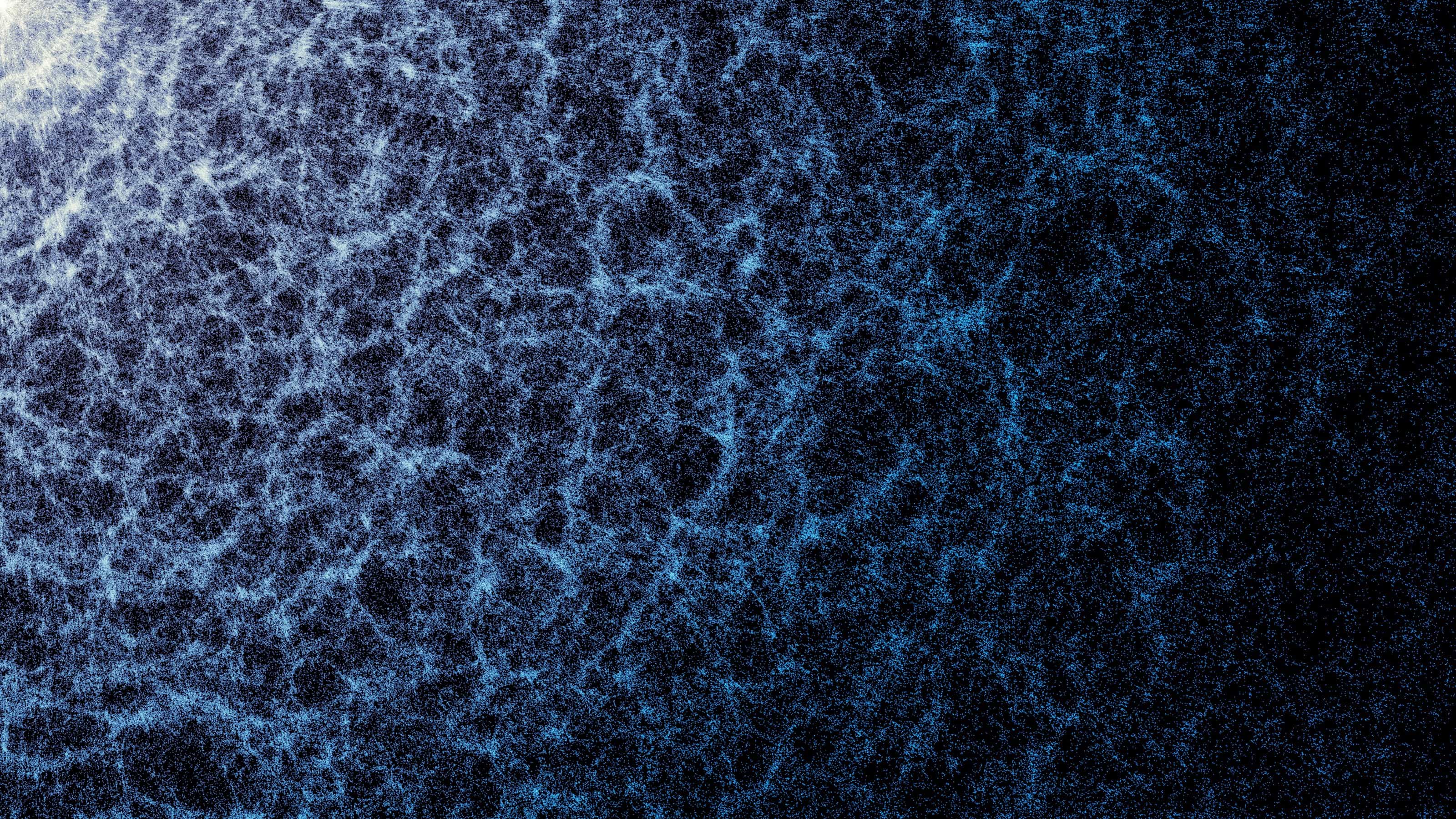
Zoomed-in portion of DESI’s year-five map · Image credit: DESI Collaboration and DESI Member Institutions/DOE/KPNO/NOIRLab/NSF/AURA/R. Proctor. Image Processing: M. Zamani (NSF NOIRLab) · CC BY 4.0
Particles & neutrinos22 min read
The neutrino mass mystery: a floor, a ceiling and three suspects
Experiments on Earth say neutrinos must weigh at least a certain amount. The newest map of the universe, combined with its oldest light, allows barely that much, or less. Nobody needs to be lying, but some assumption has to give.
Fast-moving topic New results arrive often. This article reflects the literature as of 13 October 2026; we re-check it when new data are published.
Companion video: The neutrino mass mystery — who’s lying? ↓
Contents
- Three ways to weigh a ghost
- The floor
- The ceiling
- Where the floor meets the ceiling
- What a “negative mass” really means
- Suspect 1: a fluke or a hidden error
- Suspect 2: dark energy that changes
- Suspect 3: neutrinos that vanish
- Pick your universe
- What happens next
- Open questions
- How sure are we?
- What the video simplified
- Further reading
- References
Experiments on Earth set a minimum weight for the neutrino, a ghostly particle that passes through almost everything. Maps of the universe set a maximum. The minimum comes from detectors, many underground, that watch neutrinos change identity as they travel Reference 1. The maximum combines two pictures of the cosmos: a map of more than 14 million galaxies and quasars (the blazing cores of distant galaxies), made by the Dark Energy Spectroscopic Instrument (DESI), which splits each galaxy’s light to gauge its distance, and the oldest light in the universe, the cosmic microwave background Reference 2Reference 3.
For years the maximum sat comfortably above the minimum, then crept down toward it Reference 3. As of October 2026 the two are pressed against each other, though the newest measurements disagree on exactly how hard. The oscillation experiments say the masses of the three neutrinos, added together, must be at least 0.059 electronvolts (eV), an energy unit that, thanks to E = mc², physicists also use for mass Reference 3. That is about 1.05 × 10⁻³⁷ kilograms, nearly nine million times lighter than a single electron Reference 4Reference 5. The galaxy map combined with the microwave background, read in the standard way, says the total is less than 0.064 eV. A second, equally respectable statistical reading of the same data says less than 0.053 eV, below the minimum Reference 3.
So is somebody lying? Almost certainly not. Each measurement rests on different assumptions, and the real question is which assumption is wrong. Physicists have three main suspects. When the math is allowed to go below zero, the data’s preferred value sits about three standard deviations (σ) below the minimum. Standard deviations count how far a result sits from what was expected, in units of its typical random wobble; physicists usually want five before claiming a discovery Reference 6. This one rests on a single data combination, and its size ranges from about two to four depending on the statistical method, so we rate it a hint.
Three ways to weigh a ghost
Neutrinos are electrically neutral cousins of the electron. They come in three types, or “flavors,” named after the electron and its two heavier, short-lived cousins, the muon and the tau Reference 1Reference 7. They are the most abundant particles with mass in the universe, and at least a million times lighter than any other particle of matter Reference 7. The Standard Model of particle physics, the theory that describes all the known particles, originally treated them as massless Reference 1.
That changed with neutrino oscillation: a neutrino created as one flavor can be detected later as another. Each flavor is a different mix of the same three ingredients, called “mass states,” each with one definite mass, and the mix drifts as the states travel slightly out of step, like two tuning forks at slightly different pitches beating against each other. If the masses were equal, there would be no drift; and because both measured gaps (below) are non-zero, at most one of the three can be massless Reference 1. The three masses in this story are those of the ingredients; an electron neutrino has no single mass of its own. Oscillations have been seen with neutrinos from the Sun, the atmosphere, nuclear reactors and accelerators, and the discovery won the 2015 Nobel Prize in Physics Reference 1Reference 8Reference 9.
Oscillations measure gaps, not weights. The rate of flavor change depends on the differences between the squares of the masses. It is like knowing the spacing between three rungs of a ladder without knowing how high the bottom rung is Reference 10. Two gaps between the squared masses are measured, one about 34 times bigger than the other Reference 10.
A laboratory scale measures one blurred mass. The KATRIN experiment in Karlsruhe, Germany, watches tritium, a radioactive form of hydrogen, turn into helium while giving off an electron and an antineutrino (the antimatter twin of a neutrino). These two share a fixed energy budget, and the antineutrino’s mass slightly distorts the electron energies near the top end Reference 7. KATRIN found that an effective, weighted mass is below 0.45 eV, at 90% confidence: data like KATRIN’s would rarely arise if the true value were higher Reference 7. If the lightest neutrino were that heavy, the gaps would hardly matter and the three masses would be nearly equal, totaling about 1.35 eV, more than 20 times the minimum set by oscillations. KATRIN’s result assumes nothing about the universe.
Cosmology weighs the sum, through gravity. The Big Bang left about 340 relic neutrinos and antineutrinos in every cubic centimeter of space Reference 11. Their mass adds to the matter in the universe and changes how fast it expands and how matter clumps Reference 11. Cosmology measures only the total mass, and only inside a model of the universe, which is where the trouble starts.
For physicistsWhat each method actually measures4 equations · ~3 min
Conventions: natural units for masses (eV), .
NuFIT 6.0 (the fit DESI uses, with the Super-Kamiokande atmospheric table) gives, with fitted for NO and for IO Reference 10,
Tritium β-decay near the 18.6 keV endpoint probes the incoherent sum Reference 7
KATRIN’s 259-day result has best fit , a downward fluctuation into the unphysical region. For quasi-degenerate masses eV (our conversion, calc/oscillation-floor.ts).
The floor
Even without knowing the lightest neutrino’s weight, the two gaps set a minimum: make the lightest weigh nothing at all, and the other two must still be heavy enough to produce the gaps.
There are two ways the masses could be arranged, and nobody yet knows which one nature chose. This is called the neutrino mass ordering. In the “normal” ordering, two mass states are light and close together and the third is much heavier. In the “inverted” ordering, two are heavy and close together and the third is much lighter Reference 1.
With the lightest set to zero, the normal ordering gives masses of about 0, 0.0087 and 0.050 eV, adding up to 0.0588 eV. The inverted ordering gives about 0, 0.049 and 0.050 eV, adding up to 0.0989 eV Reference 10Reference 3.
The floor is solid. It rests on decades of measurements by many experiments, combined in a “global fit,” one joint analysis of all their data Reference 10. A new reactor experiment in China, JUNO, started taking data after its completion in August 2025 and within months measured the small gap 1.6 times more precisely than all previous experiments combined Reference 12. A 2026 global fit that includes JUNO’s first data leaves the floor unchanged at the precision quoted here Reference 13.
0.059 eV
Minimum sum of the three masses (normal ordering)
The ordering is still open. Before JUNO, the global fit favored the normal ordering only mildly, and only with data from one large Japanese detector, Super-Kamiokande Reference 10. An exploratory 2026 global fit adding JUNO’s first data favors it with or without those data Reference 13, and JUNO’s own September 2026 preprint, not yet peer reviewed, finds a one-sided preference of at least 2.1 standard deviations when combined with accelerator experiments Reference 14.
For physicistsThe floor, exactly2 equations · ~2 min
For the normal ordering () and the inverted ordering (, NuFIT convention with ):
With NuFIT 6.0 (with SK-atm) and : eV (NO) and eV (IO), first-order propagation of the splitting errors; DESI quotes and eV Reference 3. NuFIT 6.1 with first JUNO solar data (with SK): 0.05879 and 0.09892 eV Reference 13. JUNO’s 207-day reactor-only splittings (it quotes for IO) give 0.05869 and 0.10038 eV Reference 14; the IO difference reflects the reactor-only IO fit, and global fits keep the IO floor at 0.0989 eV. All in calc/oscillation-floor.ts.
On the ordering: NuFIT 6.0 prefers NO by with SK-atm, while without it NO is disfavored by Reference 10; NuFIT 6.1 with JUNO gives (9.4) without (with) SK and IceCube atmospheric data, “taken at face value” Reference 13. JUNO’s preprint quotes a Bayes factor of 10.18 for NO Reference 14.
The ceiling
At the floor, neutrinos make up only about half a percent of all the matter in the universe Reference 11. That is small, but it leaves two fingerprints.
The first is in how the universe expands. Mass adds gravity and changes the expansion history, which changes the distances to faraway galaxies. DESI measures those distances with a natural ruler called baryon acoustic oscillations. In the young universe, before atoms formed, ordinary matter and light made a hot, dense soup in which pressure waves rippled outward. When atoms formed and light broke free, the waves froze, leaving a slight preference for galaxies to sit about 150 megaparsecs apart, nearly 500 million light-years Reference 2Reference 15. How big that ruler looks at different distances tells you how the universe has expanded.
The second fingerprint is in how matter clumps. Neutrinos move so fast that they don’t settle into clumps, so their share of the matter doesn’t help pull galaxies and clusters together, and growth is slightly slower Reference 16Reference 11. That shows up in the faint bending of the cosmic microwave background (CMB), the oldest light in the universe, whose pattern of slightly hotter and colder spots gets distorted by all the matter it passes on its way to us, an effect called CMB lensing Reference 3Reference 17. Heavier neutrinos mean a smoother universe, and a smoother universe bends the CMB light less.
The CMB is mapped by the Planck satellite and by the Atacama Cosmology Telescope (ACT) and South Pole Telescope (SPT). On its own, the CMB is only weakly sensitive to neutrino mass, because changing the mass can be offset by changing the amount of matter or the expansion rate. Adding DESI’s distances breaks that ambiguity Reference 3.
All of this is done within the standard model of cosmology, called ΛCDM (“lambda-C-D-M”). It has ordinary matter, cold dark matter (invisible, slow-moving matter) and dark energy, the unknown cause of the accelerating expansion, in the form of a cosmological constant, labeled Λ, whose strength never changes Reference 2. The limits only hold inside that model.
In 2018, Planck plus earlier galaxy maps limited the sum to less than 0.12 eV, with 95% confidence Reference 18. In 2025, DESI’s second data release, covering three years of observations and combined with the CMB, brought that down to 0.064 eV, below the inverted-ordering floor and only 0.005 eV above the normal-ordering floor Reference 3.
For physicistsWhere the cosmological limit comes fromdata · priors · ~3 min
DESI’s baseline: DESI DR2 BAO with “CMB” meaning Planck PR3 low-ℓ TT/EE (Commander, SimAll), PR4 CamSpec high-ℓ TTTEEE, and Planck PR4 + ACT DR6 lensing; ΛCDM, three degenerate states, flat prior eV. Result: eV (95%), with marginalized eV, a width set partly by the posterior being squeezed against zero; without the boundary, eV, in line with forecasts Reference 3.
Why it is so tight: at fixed acoustic angle , raising raises the CMB-inferred and lowers , while DESI prefers lower and higher than the CMB does in ΛCDM, pushing the posterior to the edge, more strongly than forecasts anticipated Reference 3.
Other combinations (ΛCDM, 95%, ): DESI DR2 + P-ACT, eV Reference 19; SPT-3G D1 + ACT + Planck (CMB-SPA) + DESI DR2, eV in the published version, up from eV in its first preprint version Reference 20; CMB-SPA + DESI DR2 + DESY5 supernovae, eV (preprint) Reference 21.
Where the floor meets the ceiling
Step by step
The floor rises, the ceiling falls
Figure: Two rising curves show the sum of the three neutrino masses against the unknown lightest mass on a log scale. The normal-ordering curve starts at 0.059 eV and the inverted one at 0.099 eV; the region below them is shaded as ruled out.
Figure: A horizontal ceiling line at 0.12 eV, labeled Planck 2018, lies above both minimums.
Figure: The ceiling drops to 0.064 eV, labeled DESI second data release plus CMB, below the inverted minimum and just above the normal minimum. A faint line marks an ACT limit of 0.089 eV that used DESI’s first data. On the left, a curve shows how well the model fits, best at zero.
Figure: A second line at 0.053 eV, labeled Feldman–Cousins, crosses below the normal-ordering minimum; the 0.064 eV line is dashed.
Figure: On the left, a dashed curve continues below zero with its peak near minus 0.04 eV, and a shaded curve is centered near minus 0.10 eV, in the region marked as impossible for real masses.
Figure: A shaded band spans ΛCDM ceilings from 0.053 to 0.077 eV, with lines for six analyses reported in 2025 and 2026.
Figure: The ceiling rises to 0.163 eV, labeled evolving dark energy, above both minimums. On the left, the data's central value moves to zero.
Figure: A ceiling at 0.23 eV, labeled invisible decay, sits above the dark-energy line and the ΛCDM line.
What a “negative mass” really means
What can it mean that the data “prefer negative mass”?
A cosmological analysis asks, for each possible total mass, how well the model fits all the data. Normally only masses of zero or more are allowed. For DESI’s data, the fit keeps improving as the mass goes down, all the way to zero, where the allowed range stops Reference 3. Picture a hill of “how well it fits”: we see only its right-hand slope, and its top lies hidden below zero Reference 3Reference 2.
That is why there are two ceilings. Imagine a bathroom scale that reads slightly below zero with a feather on it. “How heavy is the feather probably?” and “Which weights would rarely give a reading this low?” have different answers. The 0.064 eV figure comes from a Bayesian analysis, which treats every total between 0 and 5 eV as equally plausible beforehand and asks the first kind of question. The 0.053 eV figure comes from a frequentist analysis, which asks the second; its Feldman–Cousins recipe is built for results next to a boundary like zero Reference 3Reference 23. When the data lean below zero, the second question rules out more masses, so its ceiling is lower.
To see where the data would like to be, cosmologists use an effective neutrino mass: a mathematical stand-in that copies everything a real neutrino mass does to the expansion and the clumping, but can continue below zero Reference 24. Real neutrino mass would make the CMB slightly less bent. The combined data show a slightly different expansion history and slightly more bending (Planck’s especially) than the standard cosmology gives even with massless neutrinos, as if the neutrinos weighed less than nothing Reference 3Reference 11Reference 18.
With DESI’s second data release plus the CMB, this effective mass comes out at −0.101 eV, give or take about 0.05 eV Reference 3. On our reading, it sits lower than the −0.04 eV top of the hill partly because it lets every effect of mass go negative instead of extending a curve fitted above zero. In this Bayesian analysis only about 0.3% of the probability lies above the normal-ordering floor, which DESI expresses as 3.0 standard deviations; other ways of measuring the same mismatch give 2.7 to 4.0 Reference 3. This fits with a 0.064 eV ceiling just above the floor: when negative values are forbidden, all the probability is squeezed between zero and the ceiling; once they are allowed, most of it moves below zero. A frequentist look is milder: on our reading of DESI’s published fit curve, the floor is about two standard deviations from the best fit Reference 3. That matches the frequentist ceiling: a 95% limit falling just under the floor means the floor is disfavored at roughly the two-standard-deviation level. The 3.0 comes from the effective-mass analysis, whose center lies lower.
DESI is explicit about how to read this: negative values signal unidentified errors, or new physics that may have nothing to do with neutrinos, not neutrinos with literally negative mass Reference 3.
For physicistsOne likelihood, two limits, and the effective-mass tension4 equations · ~4 min
DESI fits the ΛCDM profile likelihood with a parabola Reference 3:
with eV and eV for DESI DR2 BAO + CMB. The Feldman–Cousins 95% limit for a Gaussian measurement with boundary is eV in our implementation (DESI: 0.053 eV). Treating the same parabola as a likelihood with a flat prior on , the 95% credible bound solves
giving eV, close to DESI’s MCMC value 0.0642 eV; the agreement is partly coincidental, since the real posterior is a marginal over all parameters. On this parabola, between and the NO floor is 4.2, i.e. about 2σ (calc/bounds.ts).
The effective parameter Reference 24 continues all cosmological effects of to negative values (negative energy density at late times) and removes the hard boundary at zero, so the posterior can peak where the data want. DESI DR2 BAO + CMB: eV (68%), marginalized error 0.053 eV. The posterior probability above 0.059 eV converts to 3.0σ (equivalent two-sided Gaussian); a goodness-of-fit-loss metric gives 2.7σ, and a parameter-shift metric, with the terrestrial input uniform between 0.059 and 1.2 eV, gives 4.0σ Reference 3. The profile’s minimum (−0.036 eV) and the effective-mass central value (−0.10 eV) differ partly because the profile is extrapolated from the physical region and is not exactly parabolic.
Suspect 1: a fluke or a hidden error
Perhaps nothing new is going on; DESI stresses that the statistical significance “is by no means conclusive” Reference 3.
On its own side, DESI says removing the mismatch would need an unknown error of more than 1% in its distance measurements, well above every known source of error Reference 3.
On the CMB side there are two candidates. One is a long-standing oddity in Planck’s maps: they look slightly more blurred by gravitational bending than the standard cosmology predicts. Extra blurring mimics extra clumping, the opposite of what neutrino mass does Reference 3Reference 18. The other is the optical depth: think of a thin fog of free electrons, released when the young universe’s atoms were split again into electrons and charged nuclei (ionized, as the hot soup had been before atoms formed), that scattered some CMB light Reference 25. Planck measures it as 0.054 ± 0.007, meaning roughly 5% of the light was scattered Reference 18. The fog dims the CMB’s pattern of hot and cold spots. If the fog is thicker, the pattern must have started out stronger, which predicts more clumping and more bending than we actually see; heavier neutrinos can then smooth some of it away and still match the measurement Reference 3.
Fixing the optical depth at 0.067 or 0.074, two to three times Planck’s error bar above its value, shrinks the mismatch to 2.3 or 1.7 standard deviations but doesn’t remove it Reference 3. Outside teams mostly blame the CMB side but disagree on which part Reference 26Reference 27Reference 28. In a 2026 preprint, not yet peer reviewed, one team argued that an optical depth of 0.11, eight times Planck’s error bar above its value and requiring Planck’s own measurement to be set aside, would bring the CMB’s expansion rate into line with DESI’s and give a tentative positive total of about 0.10 eV Reference 29.
Earlier in 2026, a peer-reviewed combination led by SPT, with ACT, Planck and DESI, put the ceiling at 0.055 eV, below the floor Reference 20. The newest result pushes it back up. In August 2026, the SPT collaboration reported, in a preprint not yet peer reviewed, a new measurement of the CMB’s bending that agrees better with DESI; combined with other CMB data and DESI, it gives 0.072 eV. Most of the rise comes from the new map, a little from a different treatment of the optical depth Reference 22.
For physicistsLensing anomaly, τ and the data-choice spreadnumbers · ~2 min
The Planck plik likelihood prefers at more than 2σ; CamSpec reduces this and LoLLiPoP–HiLLiPoP is consistent with unity. Yet the effective mass stays negative across all three: (plik), (CamSpec), eV (L-H) Reference 3.
Suspect 2: dark energy that changes
The second suspect is dark energy, which ΛCDM treats as constant. DESI’s data combined with the CMB prefer a dark energy whose behavior changes over time, at 3.1 standard deviations. Adding measurements of exploding stars called supernovae, used as distance markers, gave 2.8 to 4.2 depending on the catalog Reference 2. Recalibrations have since pulled the catalogs together: a 2026 preprint, not yet peer reviewed, finds 3.2 to 3.4 for all three in DESI’s setup Reference 30; the Dark Energy Survey’s own recalibration finds 3.2 using more CMB data Reference 31. This is another hint, not a discovery.
Dark energy and neutrino mass both shape the expansion history, so they can partly stand in for each other. If dark energy is allowed to change, DESI plus the CMB give a ceiling of 0.163 eV, comfortably above both floors, and the effective neutrino mass moves to zero, with an uncertainty of about 0.1 eV, wide enough to reach both floors Reference 3. The two puzzles may be one: a negative effective mass and some kinds of changing dark energy both break a rule that ordinary matter and energy obey, so DESI suggests they might share a cause Reference 3Reference 24; another team thinks the two are likely separate Reference 26.
It is not an automatic fix. A simpler variant, in which dark energy thins out or builds up at one steady pace instead of changing its behavior partway through cosmic history, does not help: with supernovae it gives 0.059–0.065 eV, tighter than ΛCDM with the same supernovae, and without them it loosens the limit only to 0.085 eV Reference 3. Even the changing kind, once supernova data are added, leaves less room: 0.117–0.139 eV, still above both floors Reference 3. In a 2026 preprint, not yet peer reviewed, researchers comparing many dark-energy models found that, with supernovae included, only very specific histories bring back a positive neutrino mass Reference 32.
For physicistsThe neutrino–dark energy degeneracy1 equation · ~2 min
With CPL, , DESI DR2 BAO + CMB give eV (95%, Bayesian) and eV (FC); with Pantheon+, DESY5 or Union3, 0.117, 0.129 or 0.139 eV Reference 3. The effective mass becomes eV (68%), or eV with DESY5. In wCDM (constant ) DESI + CMB alone gives 0.0851 eV with ; with supernovae the bound is 0.0653, 0.0649 or 0.0586 eV with Pantheon+, Union3 or DESY5 (ΛCDM with the same samples: 0.0704, 0.0674, 0.0744 eV), with (95%) for DESY5, consistent with ; the effective-mass tension can reach 3.5σ (DESI + CMB + DESY5) Reference 3. All DESY5- and Union3-based numbers predate the recalibrations Reference 31Reference 30.
Suspect 3: neutrinos that vanish
The third suspect is the neutrinos themselves. Cosmology assumes relic neutrinos are stable. What if they aren’t?
Suppose neutrinos decay over cosmic time into new particles that have no mass and that no detector can see. Their mass energy would be carried off by those fast-moving particles, whose energy thins out faster as space expands, so their gravitational fingerprint would fade and cosmology would underestimate how much they weigh Reference 16. In a study posted in January 2026 and published in Physical Review D in June, physicist Guillermo Franco Abellán tested this with DESI and Planck data. With lifetimes of roughly 10 million to 1 billion years, the ceiling rises from 0.062 eV for stable neutrinos to 0.23 eV, at 95% confidence, removing the conflict for both orderings. (His stable value differs slightly from DESI’s 0.064 eV because he uses an older Planck dataset.) Reference 16
The caveats matter. The decay must be into new particles: if heavier neutrinos decay into lighter known ones, the limit barely moves or even tightens, because the mass stays in neutrinos that cosmology still weighs Reference 16. With newer CMB data the relaxed limit is 0.19 eV. Allowing decays improves the fit only marginally, and the data still fit best with zero mass Reference 16. Other proposals, such as neutrinos that cool or change mass over time, likewise lack independent evidence Reference 25.
For physicistsInvisible decays, quantitatively2 equations · ~2 min
The model couples a heavier active state , a lighter state and a massless scalar through , with rate (Majorana neutrinos) Reference 16
Scenario A (decay to dark radiation, three degenerate states), DESI DR2 BAO + Planck PR3 TT,TE,EE (plik) + PR3 lensing: eV stable → eV with decays (95%); goodness-of-fit tension with the NO (IO) floor falls from 2.1σ (3.0σ) to 1.3σ (1.5σ), while the best fit stays at zero. With CamSpec + Planck PR4/ACT DR6 lensing and HaloFit: 0.063 → 0.19 eV, possibly slightly biased because HaloFit is not calibrated for decaying neutrinos Reference 16.
Pick your universe
Choose an ordering and a weight for the lightest neutrino, and see where the total lands against each published ceiling.
Explorable · try it
Weigh the three neutrinos
Assumptions and simplifications
- Mass gaps from the NuFIT 6.0 global fit (variant with Super-Kamiokande atmospheric data); their uncertainties shift the totals by less than 0.0005 eV.
- Every cosmological ceiling is a 95% upper limit on the total, computed by its authors inside a specific model and data combination; they are not independent, because most share the same CMB and DESI data.
- The KATRIN row converts its 0.45 eV limit (90% confidence) on an effective, weighted mass into about 1.35 eV on the total, valid only when all three masses are nearly equal.
- “Share of all matter” converts the total into a fraction of all matter using DESI’s best-fit universe.
- The SPT lensing row is from a preprint not yet peer reviewed.
With the normal ordering and a massless lightest neutrino, the total (0.0588 eV) passes DESI’s Bayesian ceiling but fails its frequentist one, SPT’s published 0.055 eV and a 0.052 eV preprint limit Reference 21 (SPT’s 0.072 eV preprint would let it through). The inverted ordering lies above every 2025–2026 ΛCDM ceiling, so it is disfavored (odds of roughly 6–10 to 1 in DESI’s analysis) but fits under the dark-energy and decay ceilings Reference 3.
What happens next
By April 2026, DESI had finished its planned five-year survey, ahead of schedule, with more than 47 million galaxies and quasars. Its first full-survey dark-energy results are expected in 2027, and it will keep observing through 2028 Reference 33. Before the survey began, DESI forecast a final sensitivity of about 0.02 eV, which DESI says could allow a significant detection Reference 3; because the data already lean below zero, the real test is whether that lean persists. The European Space Agency’s Euclid telescope will release its first large dataset in November 2026, with the measurements of clumping most relevant here following in mid-2027 Reference 34. A planned American CMB project, CMB-S4, will not happen: the US Department of Energy and National Science Foundation ended support in July 2025 Reference 35.
On the lab side, KATRIN reached its planned 1,000 days of data in October 2025 Reference 36, aiming for a final sensitivity better than 0.3 eV Reference 7; as of October 2026 we found no published result from the full dataset.
If ΛCDM is right and neutrinos are ordinary, the Particle Data Group, which publishes the standard reference reviews of particle physics, expects galaxy surveys such as Euclid, combined with new CMB experiments such as the Simons Observatory and LiteBIRD, to detect the total mass, even at the floor, at a significance of at least 3–4 standard deviations Reference 11. If DESI’s 2027 data still put the peak below zero, a fluke in DESI’s own data becomes less likely (although the new data include the old), but CMB-side explanations would need new CMB measurements to test; one study expects the below-zero preference to persist Reference 26.
Open questions
- Is the ceiling real? It depends on how the CMB data are analyzed and which datasets are combined; ΛCDM ceilings from DESI plus CMB data currently range from roughly 0.05 to 0.08 eV Reference 3Reference 22Reference 21.
- What is the optical depth? A higher value would ease the mismatch, but Planck measures 0.054 ± 0.007 Reference 18. A 2025 measurement by the CLASS telescope, which calls it the first ground-based attempt, agrees with Planck but is far less precise and not fully independent, since it cross-correlates with Planck’s maps Reference 37. A new CMB experiment, LiteBIRD, targets the very large-scale polarization of the CMB (the direction in which its light waves vibrate) that sets this number Reference 29Reference 11.
- Which ordering? Cosmology inside ΛCDM, the 2026 global oscillation fit and JUNO’s preprint all lean normal, but none is decisive Reference 3Reference 13Reference 14.
- Do neutrinos decay? Invisible decays fit the data, but nothing else supports them yet Reference 16.
How sure are we?
EVIDENCE LEVELS ARE EDITORIAL JUDGEMENTS OF THE WHOLE BODY OF EVIDENCE — NOT σ VALUES · What these mean
Neutrinos have mass, and the three masses add up to at least 0.059 eV (0.099 eV for the inverted ordering).
Evidence level: EstablishedOscillations seen by many experiments over decades; the floor is computed from precisely measured mass gaps Reference 10Reference 3Reference 8.
Analyses within the standard cosmology combining DESI with CMB data consistently give ceilings of roughly 0.05–0.08 eV, allowing any total from zero up.
Evidence level: Strong evidenceSeveral experiments and analyses agree, but the exact number moves with data choices and statistical method Reference 3Reference 19Reference 20Reference 22.
Cosmology prefers less neutrino mass than oscillations allow.
Evidence level: Hint / tensionOne main data combination, sensitive to analysis choices, and weaker in a frequentist treatment; could be a fluke or a hidden error Reference 3. Reported: 3.0σ (Bayesian effective-mass result, DESI second data release + CMB, ΛCDM) vs the normal-ordering minimum; 2.7–4.0σ with other metrics
Dark energy changes over time, which would relax the neutrino limit to 0.12–0.16 eV.
Evidence level: Hint / tensionA preference of about three standard deviations that has held up as supernova catalogs were recalibrated, but has not grown Reference 2Reference 30Reference 31Reference 3. Reported: 3.1σ over a cosmological constant (DESI + CMB); with supernovae 2.8–4.2σ originally, 3.2–3.4σ after recalibration (Union3.1 analysis, preprint); 3.2σ for DES-Dovekie with Planck + ACT + SPT
Neutrinos decay into invisible particles, hiding their mass from cosmology.
Evidence level: SpeculativeA well-defined model that fits current data, with no independent evidence Reference 16.
What the video simplified
In the video: Cosmology’s upper limit is below the floor set by oscillations.
More precisely: DESI’s headline limit, 0.064 eV, is still just above the normal-ordering floor of 0.059 eV. Its frequentist reading (0.053 eV) and the SPT, ACT, Planck and DESI combination (0.055 eV) are below it Reference 3Reference 20. The real signal is that the data fit best below zero Reference 3.In the video: A stricter method gives 0.053 eV.
More precisely: Same data, different statistical question; the gap to 0.064 eV comes from the data peaking below zero Reference 3.In the video: There is a 3σ tension.
More precisely: The 3.0 standard deviations come from one Bayesian test inside ΛCDM: the effective-mass result versus the normal-ordering floor. Other ways of measuring the same mismatch give 2.7 to 4.0; other model and data choices give from below two to about three and a half; a frequentist look gives about two (our reading of DESI’s fit curve) Reference 3Reference 20.In the video: The data prefer negative neutrino mass.
More precisely: The negative number is a mathematical stand-in, not a mass Reference 3.In the video: Evolving dark energy relaxes the limit to about 0.16 eV.
More precisely: That is 0.163 eV for DESI plus the CMB without supernovae; with supernovae it is 0.117–0.139 eV. With supernovae, dark energy that thins out or builds up at one steady pace does not relax the limit Reference 3.In the video: A 2026 analysis with neutrino decay relaxes the limit to about 0.23 eV.
More precisely: Correct for decays into new invisible particles; newer CMB data give 0.19 eV Reference 16.
Further reading
Start here Accessible
Fermilab, DESI completes planned 3D map of the universe and continues exploring (2026). https://news.fnal.gov/2026/04/desi-completes-planned-3d-map-of-the-universe-and-continues-exploring/ (accessed 12 October 2026)Free
How DESI’s map was made and what comes next, from the lab that hosts the project.Nobel Prize Outreach, The Nobel Prize in Physics 2015 (2015). https://www.nobelprize.org/prizes/physics/2015/summary/ (accessed 12 October 2026)Free
The discovery that neutrinos have mass, explained by the Nobel Foundation.
Go deeper Intermediate
Particle Data Group, Neutrinos in Cosmology (Sec. 26 of the Review of Particle Physics, revised August 2025 by J. Lesgourgues and L. Verde), in International Journal of Modern Physics A (2026), p. 2630011. https://doi.org/10.1142/S0217751X26300115Free
The Particle Data Group’s review of neutrinos in cosmology, updated for DESI.J. Lesgourgues and S. Pastor, Neutrino Mass from Cosmology, Advances in High Energy Physics 2012, 1–34 (2012). https://doi.org/10.1155/2012/608515 · Free version: arXiv:1212.6154 [hep-ph]Free
A readable review of how cosmology weighs neutrinos, by two leading authors.N. Craig, D. Green, J. Meyers, and S. Rajendran, No νs is Good News, J. High Energy Phys. 2024, 97 (2024). https://doi.org/10.1007/JHEP09(2024)097 · Free version: arXiv:2405.00836 [astro-ph.CO]Free on arXiv
An early paper extending the analysis to “negative” masses, with a tour of possible new physics.
Technical Primary literature
DESI Collaboration, Constraints on neutrino physics from DESI DR2 BAO and DR1 full shape, Phys. Rev. D 112, 083513 (2025). https://doi.org/10.1103/w9pk-xsk7 · Free version: arXiv:2503.14744 [astro-ph.CO]Free on arXiv
DESI’s dedicated neutrino paper: every number in this story, with all the caveats.W. Elbers, C. S. Frenk, A. Jenkins, B. Li, and S. Pascoli, Negative neutrino masses as a mirage of dark energy, Phys. Rev. D 111, 063534 (2025). https://doi.org/10.1103/PhysRevD.111.063534 · Free version: arXiv:2407.10965 [astro-ph.CO]Free on arXiv
Defines the effective neutrino mass and links it to dark energy.G. Franco Abellán, Neutrino decays as a natural explanation of the neutrino mass tension, Phys. Rev. D 113, 123527 (2026). https://doi.org/10.1103/lwdv-qrcc · Free version: arXiv:2601.04312 [astro-ph.CO]Free on arXiv
The neutrino-decay analysis behind suspect 3.J. Lesgourgues and S. Pastor, Massive neutrinos and cosmology, Phys. Rep. 429, 307–379 (2006). https://doi.org/10.1016/j.physrep.2006.04.001 · Free version: arXiv:astro-ph/0603494 [astro-ph]Free on arXiv
The classic review of massive neutrinos in cosmology.
References
Numbered in order of first citation. Journal articles link to their DOI; where a free version exists on arXiv we link it too. Preprints are marked as not peer reviewed.
- Reference 1: J. Lesgourgues and S. Pastor, Massive neutrinos and cosmology, Phys. Rep. 429, 307–379 (2006). https://doi.org/10.1016/j.physrep.2006.04.001 · Free version: arXiv:astro-ph/0603494 [astro-ph]Back to citation 1 of reference 1Back to citation 2 of reference 1Back to citation 3 of reference 1Back to citation 4 of reference 1Back to citation 5 of reference 1Back to citation 6 of reference 1
- Reference 2: DESI Collaboration, DESI DR2 results. II. Measurements of baryon acoustic oscillations and cosmological constraints, Phys. Rev. D 112, 083515 (2025). https://doi.org/10.1103/tr6y-kpc6 · Free version: arXiv:2503.14738 [astro-ph.CO]Back to citation 1 of reference 2Back to citation 2 of reference 2Back to citation 3 of reference 2Back to citation 4 of reference 2Back to citation 5 of reference 2Back to citation 6 of reference 2
- Reference 3: DESI Collaboration, Constraints on neutrino physics from DESI DR2 BAO and DR1 full shape, Phys. Rev. D 112, 083513 (2025). https://doi.org/10.1103/w9pk-xsk7 · Free version: arXiv:2503.14744 [astro-ph.CO]Back to citation 1 of reference 3Back to citation 2 of reference 3Back to citation 3 of reference 3Back to citation 4 of reference 3Back to citation 5 of reference 3Back to citation 6 of reference 3Back to citation 7 of reference 3Back to citation 8 of reference 3Back to citation 9 of reference 3Back to citation 10 of reference 3Back to citation 11 of reference 3Back to citation 12 of reference 3Back to citation 13 of reference 3Back to citation 14 of reference 3Back to citation 15 of reference 3Back to citation 16 of reference 3Back to citation 17 of reference 3Back to citation 18 of reference 3Back to citation 19 of reference 3Back to citation 20 of reference 3Back to citation 21 of reference 3Back to citation 22 of reference 3Back to citation 23 of reference 3Back to citation 24 of reference 3Back to citation 25 of reference 3Back to citation 26 of reference 3Back to citation 27 of reference 3Back to citation 28 of reference 3Back to citation 29 of reference 3Back to citation 30 of reference 3Back to citation 31 of reference 3Back to citation 32 of reference 3Back to citation 33 of reference 3Back to citation 34 of reference 3Back to citation 35 of reference 3Back to citation 36 of reference 3Back to citation 37 of reference 3Back to citation 38 of reference 3Back to citation 39 of reference 3Back to citation 40 of reference 3Back to citation 41 of reference 3Back to citation 42 of reference 3Back to citation 43 of reference 3Back to citation 44 of reference 3Back to citation 45 of reference 3Back to citation 46 of reference 3Back to citation 47 of reference 3Back to citation 48 of reference 3Back to citation 49 of reference 3Back to citation 50 of reference 3Back to citation 51 of reference 3Back to citation 52 of reference 3Back to citation 53 of reference 3
- Reference 4: NIST, CODATA Value: electron volt-kilogram relationship. https://physics.nist.gov/cgi-bin/cuu/Value?evkg (accessed 12 October 2026)Back to citation 1 of reference 4
- Reference 5: NIST, CODATA Value: electron mass energy equivalent in MeV. https://physics.nist.gov/cgi-bin/cuu/Value?mec2mev (accessed 12 October 2026)Back to citation 1 of reference 5
- Reference 6: Particle Data Group, Statistics (Sec. 40 of the Review of Particle Physics, revised June 2025 by G. Cowan and L. Lista), in International Journal of Modern Physics A (2026), p. 2630011. https://doi.org/10.1142/S0217751X26300115Back to citation 1 of reference 6
- Reference 7: KATRIN Collaboration, Direct neutrino-mass measurement based on 259 days of KATRIN data, Science 388, 180–185 (2025). https://doi.org/10.1126/science.adq9592 · Free version: arXiv:2406.13516 [nucl-ex]Back to citation 1 of reference 7Back to citation 2 of reference 7Back to citation 3 of reference 7Back to citation 4 of reference 7Back to citation 5 of reference 7Back to citation 6 of reference 7
- Reference 8: Nobel Prize Outreach, The Nobel Prize in Physics 2015 (2015). https://www.nobelprize.org/prizes/physics/2015/summary/ (accessed 12 October 2026)Back to citation 1 of reference 8Back to citation 2 of reference 8
- Reference 9: Super-Kamiokande Collaboration, Evidence for Oscillation of Atmospheric Neutrinos, Phys. Rev. Lett. 81, 1562–1567 (1998). https://doi.org/10.1103/PhysRevLett.81.1562Back to citation 1 of reference 9
- Reference 10: I. Esteban, M. C. Gonzalez-Garcia, M. Maltoni, I. Martinez-Soler, J. P. Pinheiro, and T. Schwetz, NuFit-6.0: updated global analysis of three-flavor neutrino oscillations, J. High Energy Phys. 2024, 216 (2024). https://doi.org/10.1007/JHEP12(2024)216 · Free version: arXiv:2410.05380 [hep-ph]Back to citation 1 of reference 10Back to citation 2 of reference 10Back to citation 3 of reference 10Back to citation 4 of reference 10Back to citation 5 of reference 10Back to citation 6 of reference 10Back to citation 7 of reference 10Back to citation 8 of reference 10
- Reference 11: Particle Data Group, Neutrinos in Cosmology (Sec. 26 of the Review of Particle Physics, revised August 2025 by J. Lesgourgues and L. Verde), in International Journal of Modern Physics A (2026), p. 2630011. https://doi.org/10.1142/S0217751X26300115Back to citation 1 of reference 11Back to citation 2 of reference 11Back to citation 3 of reference 11Back to citation 4 of reference 11Back to citation 5 of reference 11Back to citation 6 of reference 11Back to citation 7 of reference 11
- Reference 12: JUNO Collaboration, Measurement of reactor neutrino oscillation with the first JUNO data, Nature 654, 343–348 (2026). https://doi.org/10.1038/s41586-026-10538-z · Free version: arXiv:2511.14593 [hep-ex]Back to citation 1 of reference 12
- Reference 13: I. Esteban, M. C. Gonzalez-Garcia, M. Maltoni, I. Martinez-Soler, J. P. Pinheiro, and T. Schwetz, Lessons from the first JUNO results, J. High Energy Phys. 2026, 89 (2026). https://doi.org/10.1007/JHEP04(2026)089 · Free version: arXiv:2601.09791 [hep-ph]Back to citation 1 of reference 13Back to citation 2 of reference 13Back to citation 3 of reference 13Back to citation 4 of reference 13Back to citation 5 of reference 13
- Reference 14: JUNO Collaboration, Measurement of Neutrino Oscillation Parameters at JUNO and Indication of the Neutrino Mass Ordering, arXiv:2609.37895 [hep-ex] (2026).Preprint · not peer reviewedBack to citation 1 of reference 14Back to citation 2 of reference 14Back to citation 3 of reference 14Back to citation 4 of reference 14
- Reference 15: Particle Data Group, Astrophysical Constants and Parameters (Table 2.1 of the Review of Particle Physics, revised August 2025 by D.E. Groom and D. Scott), in International Journal of Modern Physics A (2026), p. 2630011. https://doi.org/10.1142/S0217751X26300115Back to citation 1 of reference 15
- Reference 16: G. Franco Abellán, Neutrino decays as a natural explanation of the neutrino mass tension, Phys. Rev. D 113, 123527 (2026). https://doi.org/10.1103/lwdv-qrcc · Free version: arXiv:2601.04312 [astro-ph.CO]Back to citation 1 of reference 16Back to citation 2 of reference 16Back to citation 3 of reference 16Back to citation 4 of reference 16Back to citation 5 of reference 16Back to citation 6 of reference 16Back to citation 7 of reference 16Back to citation 8 of reference 16Back to citation 9 of reference 16Back to citation 10 of reference 16Back to citation 11 of reference 16
- Reference 17: ACT Collaboration, The Atacama Cosmology Telescope: DR6 constraints on extended cosmological models, J. Cosmol. Astropart. Phys. 2025, 063 (2025). https://doi.org/10.1088/1475-7516/2025/11/063 · Free version: arXiv:2503.14454 [astro-ph.CO]Back to citation 1 of reference 17
- Reference 18: Planck Collaboration, Planck 2018 results. VI. Cosmological parameters, Astron. Astrophys. 641, A6 (2020). https://doi.org/10.1051/0004-6361/201833910 · Free version: arXiv:1807.06209 [astro-ph.CO]Back to citation 1 of reference 18Back to citation 2 of reference 18Back to citation 3 of reference 18Back to citation 4 of reference 18Back to citation 5 of reference 18Back to citation 6 of reference 18
- Reference 19: DESI Collaboration, Cosmological implications of DESI DR2 BAO measurements in light of the latest ACT DR6 CMB data, Phys. Rev. D 112, 083529 (2025). https://doi.org/10.1103/d6yc-xpqb · Free version: arXiv:2504.18464 [astro-ph.CO]Back to citation 1 of reference 19Back to citation 2 of reference 19Back to citation 3 of reference 19
- Reference 20: SPT-3G Collaboration, SPT-3G D1: CMB temperature and polarization power spectra and cosmology from 2019 and 2020 observations of the SPT-3G main field, Phys. Rev. D 113, 083504 (2026). https://doi.org/10.1103/7wt3-9v2y · Free version: arXiv:2506.20707 [astro-ph.CO]Back to citation 1 of reference 20Back to citation 2 of reference 20Back to citation 3 of reference 20Back to citation 4 of reference 20Back to citation 5 of reference 20Back to citation 6 of reference 20
- Reference 21: H. Hou, S. Wang, Z.-C. Zhao, and X. Zhang, Constraints on the Sum of Neutrino Masses from ACT DR6 and DESI DR2 Considering Isocurvature Initial Conditions, arXiv:2606.17994 [astro-ph.CO] (2026).Preprint · not peer reviewedBack to citation 1 of reference 21Back to citation 2 of reference 21Back to citation 3 of reference 21
- Reference 22: SPT-3G Collaboration, SPT-3G D1: Quadratic-Estimator CMB Lensing Reconstruction and Cosmology, arXiv:2608.31136 [astro-ph.CO] (2026).Preprint · not peer reviewedBack to citation 1 of reference 22Back to citation 2 of reference 22Back to citation 3 of reference 22Back to citation 4 of reference 22
- Reference 23: D. Chebat (et al.), Cosmological neutrino mass: a frequentist overview in light of DESI, J. Cosmol. Astropart. Phys. 2026, 041 (2026). https://doi.org/10.1088/1475-7516/2026/01/041 · Free version: arXiv:2507.12401 [astro-ph.CO]Back to citation 1 of reference 23
- Reference 24: W. Elbers, C. S. Frenk, A. Jenkins, B. Li, and S. Pascoli, Negative neutrino masses as a mirage of dark energy, Phys. Rev. D 111, 063534 (2025). https://doi.org/10.1103/PhysRevD.111.063534 · Free version: arXiv:2407.10965 [astro-ph.CO]Back to citation 1 of reference 24Back to citation 2 of reference 24Back to citation 3 of reference 24
- Reference 25: N. Craig, D. Green, J. Meyers, and S. Rajendran, No νs is Good News, J. High Energy Phys. 2024, 97 (2024). https://doi.org/10.1007/JHEP09(2024)097 · Free version: arXiv:2405.00836 [astro-ph.CO]Back to citation 1 of reference 25Back to citation 2 of reference 25
- Reference 26: D. Green and J. Meyers, Cosmological preference for a negative neutrino mass, Phys. Rev. D 111, 083507 (2025). https://doi.org/10.1103/PhysRevD.111.083507 · Free version: arXiv:2407.07878 [astro-ph.CO]Back to citation 1 of reference 26Back to citation 2 of reference 26Back to citation 3 of reference 26
- Reference 27: T. Jhaveri, T. Karwal, and W. Hu, Turning a negative neutrino mass into a positive optical depth, Phys. Rev. D 112, 043541 (2025). https://doi.org/10.1103/6vd2-rbfn · Free version: arXiv:2504.21813 [astro-ph.CO]Back to citation 1 of reference 27
- Reference 28: D. Naredo-Tuero, M. Escudero, E. Fernández-Martínez, X. Marcano, and V. Poulin, Critical look at the cosmological neutrino mass bound, Phys. Rev. D 110, 123537 (2024). https://doi.org/10.1103/PhysRevD.110.123537 · Free version: arXiv:2407.13831 [astro-ph.CO]Back to citation 1 of reference 28
- Reference 29: J. M. Sullivan, R. de Belsunce, and M. M. Ivanov, Cosmological Concordance in an Especially Opaque Universe: A Tentative Cosmological Detection of Physical Neutrino Mass in ΛCDM, arXiv:2606.30903 [astro-ph.CO] (2026).Preprint · not peer reviewedBack to citation 1 of reference 29Back to citation 2 of reference 29
- Reference 30: T. J. Hoyt, D. Rubin, G. Aldering, S. Perlmutter, A. Cuceu, and R. Gupta, Union3.1: Reducing Systematics in Supernova Cosmology with Self-consistent Measurements of Host Galaxy Properties for 2000 Type Ia Supernovae, arXiv:2601.19424 [astro-ph.CO] (2026).Preprint · not peer reviewedBack to citation 1 of reference 30Back to citation 2 of reference 30Back to citation 3 of reference 30
- Reference 31: DES Collaboration, The Dark Energy Survey supernova program: a reanalysis of cosmology results and evidence for evolving dark energy with an updated Type Ia supernova calibration, Mon. Not. R. Astron. Soc. 548, stag632 (2026). https://doi.org/10.1093/mnras/stag632 · Free version: arXiv:2511.07517 [astro-ph.CO]Back to citation 1 of reference 31Back to citation 2 of reference 31Back to citation 3 of reference 31
- Reference 32: C. Kıbrıs, W. Elbers, Ö. Akarsu, and E. Di Valentino, Negative neutrino mass or negative dark energy?, arXiv:2605.21456 [astro-ph.CO] (2026).Preprint · not peer reviewedBack to citation 1 of reference 32
- Reference 33: Fermilab, DESI completes planned 3D map of the universe and continues exploring (2026). https://news.fnal.gov/2026/04/desi-completes-planned-3d-map-of-the-universe-and-continues-exploring/ (accessed 12 October 2026)Back to citation 1 of reference 33
- Reference 34: European Space Agency, DR1 Timeline - Euclid (2026). https://www.cosmos.esa.int/web/euclid/dr1-timeline (accessed 12 October 2026)Back to citation 1 of reference 34
- Reference 35: CMB-S4 Project, CMB-S4 (project home page: DOE/NSF statement of July 9, 2025) (2025). https://cmb-s4.org/ (accessed 12 October 2026)Back to citation 1 of reference 35
- Reference 36: Max-Planck-Institut für Kernphysik, 1000-days of KATRIN data (2026). https://www.mpi-hd.mpg.de/mpi/en/public-relations/news/news-item/1000-days-of-katrin-data (accessed 13 October 2026)Back to citation 1 of reference 36
- Reference 37: CLASS Collaboration, A Measurement of the Largest-scale CMB E-mode Polarization with CLASS, Astrophys. J. 986, 111 (2025). https://doi.org/10.3847/1538-4357/adc723 · Free version: arXiv:2501.11904 [astro-ph.CO]Back to citation 1 of reference 37
Cite this article
Five Sigma, “The neutrino mass mystery: a floor, a ceiling and three suspects,” Five Sigma (12 October 2026), https://thefivesigma.com/articles/neutrino-mass-mystery. Version of 12 October 2026.
Spotted an error?
We correct mistakes openly and log every change on our corrections page. Report an error in this article.
Was this article clear?
The video
60-second video · coming soonThe neutrino mass mystery — who’s lying?
Terms in this article
Keep reading
Ghost particles: the neutrinos passing through you right now
Every second, tens of billions of neutrinos from the Sun cross each square centimeter of you, by day and by night. Here is how we know, and why it took a thirty-year puzzle to understand them.