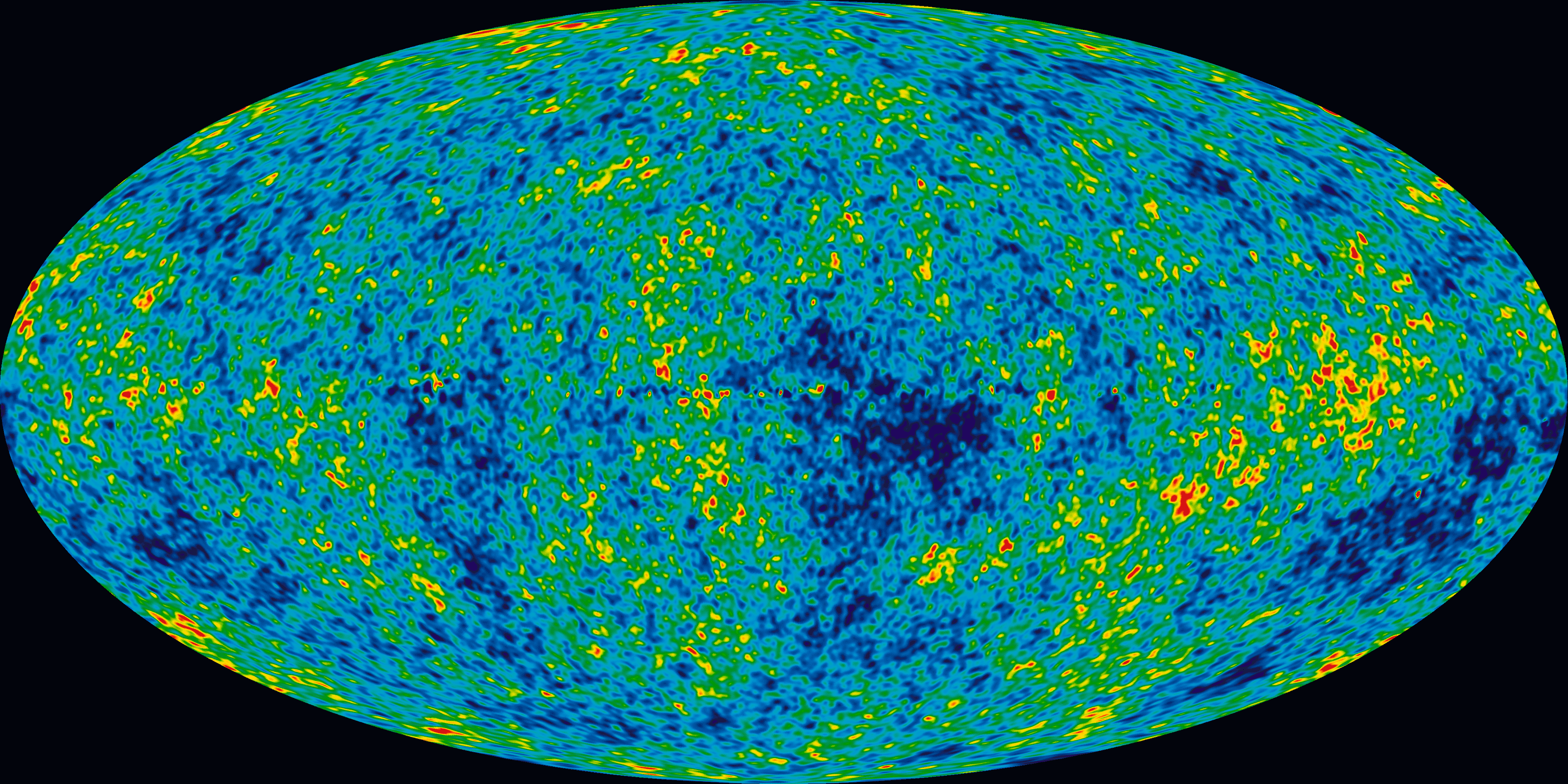
WMAP full Sky Image with Galaxy signal removed - 9 years of data used · Image credit: NASA / WMAP Science Team · Public domain (NASA)
Cosmology22 min read
Is the universe infinite?
Space looks almost perfectly flat. That still doesn’t tell us whether it goes on forever, and we may never find out.
Fast-moving topic New results arrive often. This article reflects the literature as of 13 October 2026; we re-check it when new data are published.
Imagine traveling in a straight line, forever. Do you hit an edge? Do you come back to where you started, like a ship sailing around the Earth? Or do you just keep going, past galaxy after galaxy, without end?
Cosmologists, who study the universe as a whole, have measured the shape of space precisely, using light that has traveled for almost the universe’s whole age. And yet the honest answer to “Is the universe infinite?” is still: we don’t know. Space could go on forever. It could also be finite but have no edge at all.
Two questions hiding in one
“Is the universe infinite?” is really two questions.
The first is about shape. Imagine an ant living on a sheet of paper. It can’t see the third dimension, but it can still tell whether its world is flat or curved by drawing triangles. On a flat sheet, the three angles of every triangle add up to 180°. On the surface of a ball, they add up to more. On a saddle, they add up to less. Space itself can be curved in the same three ways, one dimension up. Physicists call this spatial curvature: a measure of whether straight lines that start out parallel stay parallel, converge or spread apart.
The second question is about connection: how space is joined to itself overall. Think of the old arcade game Asteroids, where a ship that flies off the right edge of the screen reappears on the left. That screen is perfectly flat (triangles drawn on it still add up to 180°), but it is finite and has no edge. Mathematicians call this kind of global property topology. In three dimensions, the Asteroids trick gives a three-torus: a box of space where leaving through any face brings you back in through the opposite one.
Einstein’s general relativity, our theory of gravity, tells us how matter curves space at every point. It says nothing about how space is connected on the largest scales Reference 4. So measuring the shape of space doesn’t automatically tell us its size. These possibilities fit the data:
- Flat and infinite: in the words of the cosmologist Max Tegmark, writing in 2003, “the simplest and most popular one on the market” Reference 8.
- Flat but finite: a three-torus or one of its twisted cousins Reference 7Reference 4.
- Curved like a ball (“closed”): finite but edgeless, the three-dimensional version of a sphere’s surface, called a three-sphere.
- Curved like a saddle (“open”): infinite if it has the simplest connection, though it too can be wrapped up into something finite Reference 7.
How far can we see?
The universe is 13.8 billion years old Reference 1, so you might expect that we can see 13.8 billion light-years in every direction. We can see much farther. While light from distant regions was on its way to us, space kept expanding, carrying those regions away. The most distant material that could in principle have sent us any signal since the Big Bang, the hot, dense beginning of the expanding universe, is now about 46 billion light-years away, or about 4.4 × 10²⁶ meters Reference 6. That sphere, centered on us, is the observable universe. Its size follows from how fast space has stretched at each moment in the past, as inferred from measurements by the European Space Agency’s Planck satellite Reference 1.
The light we actually see comes from just inside that edge. The oldest light we can catch is the cosmic microwave background (CMB), a faint glow released about 380,000 years after the Big Bang Reference 1. Before then, the universe was a hot, glowing fog that light could not cross; the CMB was released when it first became transparent Reference 8. The gas that emitted it is now about 45.2 billion light-years away.
There is another distance that often gets confused with the edge. The expansion rate today, the Hubble constant, says how much faster a galaxy recedes for every extra light-year of distance. Go far enough and that speed reaches the speed of light. That distance, about 14.5 billion light-years, is called the Hubble radius, and galaxies beyond it are moving away from us faster than light Reference 6. Nothing is breaking the cosmic speed limit: it is space that is expanding, and nothing ever overtakes a beam of light right next to it Reference 6. And the Hubble radius is not an edge. Light from those galaxies starts out losing ground, like someone walking the wrong way up a moving walkway. But the expansion rate per light-year keeps falling. In the past, galaxies’ recession speeds were dropping; today they are rising, but distances grow faster still. Either way, speed divided by distance goes down Reference 6. The Hubble radius therefore creeps outward, as if the walkway near you slowed down; light that set out early enough ends up inside it, and from then on it gains on us. The Hubble radius keeps growing, but ever more slowly, leveling off as dark energy takes over. That is why we routinely see galaxies beyond it Reference 6.
Waiting doesn’t help much. The expansion of the universe is speeding up, driven by what is called dark energy, an unknown something that makes space push itself apart Reference 1. In cosmologists’ standard picture of the universe, the one that fits the data best, light that galaxies emit today will never reach us if they are now more than about 16.7 billion light-years away; that boundary is our cosmic event horizon. We still see galaxies far beyond it, but only by light they sent out billions of years ago. Even if we waited forever, and if dark energy stays constant, we would only ever receive light from within about 63 billion light-years; that larger figure counts light already on its way, which shows those regions only as they were long ago Reference 6Reference 1.
For physicistsWhere the 46 billion light-years comes from2 equations · flat ΛCDM · ~3 min
All distances are comoving (proper distance today). For a Friedmann–Lemaître–Robertson–Walker model with radiation, matter, curvature and a cosmological constant,
and the event horizon is , with the definitions of Davis & Lineweaver Reference 6. We use the Planck 2018 base-ΛCDM parameters from TT,TE,EE+lowE+lensing, and Reference 1, with , K and radiation from photons plus neutrino species treated as massless (Planck’s base model has one 0.06 eV state; negligible here, since matches Planck to 0.04%).
Numerical integration (calc/friedmann.ts) gives Gly, Mpc Gly, a distance to last scattering Mpc Gly, Gly and Gly (for a cosmological constant). Checks: age 13.795 Gyr (Planck: 13.797 ± 0.023); matches Planck’s Mpc to 0.04%. integrates from assuming radiation domination, i.e. effectively from the end of any inflationary phase; it is a causal horizon. Photons reach us only from ; neutrinos or gravitational waves could in principle arrive from closer to .
Step by step
From here to the edge — and the ways space could continue
Figure: Rings centered on Earth on a logarithmic scale, at 1 light-year, 1,000 light-years, 1 million light-years and 1 billion light-years.
Figure: Two more rings appear close together on the logarithmic scale: 13.8 billion light-years, labeled the naive answer, and 14.5 billion light-years, the Hubble radius.
Figure: The scale switches to linear. Rings at 13.8 and 14.5 billion light-years sit near the center; far outside them are the CMB at 45.2 billion light-years and the edge of the observable universe at 46.1 billion light-years, highlighted.
Figure: Two further rings: the cosmic event horizon at 16.7 billion light-years and, outside the observable universe, the largest region we could ever see, at 62.8 billion light-years.
Figure: Three schematic panels. Flat: a triangle with angles summing to 180 degrees. Closed: a triangle on a sphere with angles summing to more than 180 degrees. Open: a triangle on a saddle summing to less than 180 degrees. Computed values at the current limits are 180.4 and 178.9 degrees for a triangle 45 billion light-years on a side.
Figure: Drawn to scale: the observable universe as a small circle of radius 46 billion light-years beside a much larger circle of radius 343 billion light-years, the smallest radius allowed if the universe is closed, and a dashed circle marking the 215-billion-light-year curvature scale of an open universe, which is not an edge.
Figure: A flat three-torus seen in cross-section: a square box about 89 billion light-years across, repeated in a grid. Our CMB sphere, 90.5 billion light-years across, barely overlaps the copies of itself in the neighboring boxes.
Measuring the shape of space
You can’t step outside the universe to look at its shape. But you can do what the ant does: measure a very large triangle.
Nature has provided one. In the cosmic microwave background, there is a characteristic pattern of hot and cold spots whose true physical size can be calculated from well-understood physics of the early universe. That gives us a known ruler, painted on a shell 45 billion light-years away. If space is flat, the ruler appears at a certain angle on the sky. If space is curved like a ball, the light rays from its two ends bend toward each other on their way to us. Traced back, they seem to come from points farther apart, so the spots look bigger, as if seen through a magnifying glass. If space is saddle-shaped, they look smaller Reference 9Reference 8. Planck measured that angle to 0.03 percent Reference 1.
There is a catch. On its own, the CMB can’t fully separate curvature from other unknowns, such as how fast the universe is expanding today: different combinations can produce almost the same pattern on the sky Reference 1. To break the tie, cosmologists add a second ruler at a different distance. Pressure waves in the hot early universe left a preferred spacing in the way ordinary matter clumps, called baryon acoustic oscillations (BAO; “baryon” means ordinary matter, the stuff atoms are made of) Reference 2. Galaxies are slightly more likely to be found about 480 million light-years apart than slightly closer or farther apart Reference 1Reference 2. The Dark Energy Spectroscopic Instrument (DESI), which maps galaxies in three dimensions from Kitt Peak National Observatory, has now measured this spacing using more than 14 million galaxies and quasars, the brilliant cores of distant galaxies Reference 2. Each ruler on its own fits several combinations of curvature and expansion rate; only a narrow range fits both.
The result is expressed as a single number, ΩK (“omega-K”). How fast the universe expands depends on what it contains (matter, radiation, dark energy) plus a term for curvature; ΩK is curvature’s share of that budget Reference 5. Zero means perfectly flat. By convention, a negative value means closed, like a ball, and a positive value means open, like a saddle Reference 5. When we say curvature is below “half a percent”, we mean the size of ΩK is smaller than 0.005: a share of the budget, not a measure of how bent space looks.
Measurements come with a margin of error, the ± number, which is one standard deviation (σ). The true value lands within one margin of the best estimate about 68 percent of the time, and within two margins about 95 percent of the time. A result two or three margins away from zero sounds impressive, but when many measurements are made, gaps of that size often turn out to be flukes or hidden errors.
A short-lived closed universe
In 2018 the Planck team reported that its CMB maps alone, taken at face value, preferred a closed universe: ΩK = −0.044, with flat space outside the range they were 99 percent confident contained the true value Reference 1. For a while this was debated as a possible “crisis for cosmology” Reference 10Reference 11.
The CMB maps looked slightly more smeared than expected, as if extra matter were bending the light on its way to us; that bending is called gravitational lensing. A closed universe happens to produce the same kind of extra smearing, so the fit leaned that way. The Planck team traced the lean to this smearing, and noted that it shifted when part of the data was analyzed a different way Reference 1. When Planck measured the bending directly, it found the amount expected in a flat universe, and once BAO was added the lean disappeared. The combined answer was ΩK = 0.0007 ± 0.0019, consistent with flat Reference 1. A later reanalysis with an improved treatment of the Planck data also found the maps consistent with flat space Reference 12.
The newest measurements
Since 2025, new data have sharpened the picture, with a twist: the old hint toward a closed universe has faded (CMB data alone now lean closed by less than two standard deviations), and once galaxy maps are added a faint hint in the opposite direction, toward a slightly open universe, appears Reference 3. Two ground-based telescopes now add to Planck’s maps. Combining its maps with Planck’s, with lensing measurements from both, and with DESI’s first-year BAO, the Atacama Cosmology Telescope (ACT) in Chile finds ΩK = 0.0019 ± 0.0015, “fully consistent with spatial flatness” Reference 5. DESI’s second data release with CMB data gives 0.0023 ± 0.0011, the smallest uncertainty among these results; the DESI team says this is not a significant preference for curvature Reference 2. The South Pole Telescope’s current camera, SPT-3G, combined with Planck, ACT and DESI, gives 0.0027 ± 0.0012, which its authors place 2.5 standard deviations from flat (simply dividing the value by its margin would give about 2.3), and 3.0 without Planck Reference 3.
Three things keep this a hint rather than a discovery. It comes from a known mismatch: DESI’s maps suggest the universe has expanded a little differently from what the CMB predicts, and curvature is only one way to absorb that Reference 2Reference 3. If dark energy is allowed to change over time (in fits that also include supernova data), DESI’s preference for curvature disappears Reference 2. And the SPT team notes that using Planck’s instead of ACT’s small-scale CMB data could weaken it Reference 3. So the honest summary: every recent combination keeps curvature’s share below about half a percent at 95 percent confidence (one combination without Planck reaches about 0.8 percent); margins of error are now about ±0.1 percent; and the best estimates sit at 0.2–0.3 percent (0.5 without Planck), one to three standard deviations from zero depending on the data, which is not a detection.
FIG. 1With BAO added, every combination lands within one percent of flat
Show the numbers
| Data combination | ΩK (68% range) | Source |
|---|---|---|
| Planck 2018 CMB maps alone | −0.044 (+0.018 / −0.015) | Reference 1 Eq. 46b |
| Planck 2018 + lensing | −0.0106 ± 0.0065 | Reference 1 Eq. 47a |
| Planck 2018 + lensing + BAO | 0.0007 ± 0.0019 | Reference 1 Eq. 47b |
| ACT DR6 + Planck + lensing + DESI year 1 | 0.0019 ± 0.0015 | Reference 5 Eq. 59 |
| DESI DR2 BAO + CMB | 0.0023 ± 0.0011 | Reference 2 Table V |
| SPT-3G + ACT + Planck + DESI DR2 | 0.0027 ± 0.0012 | Reference 3 Eq. 87 |
| SPT-3G + ACT + DESI DR2 (no Planck) | 0.0051 ± 0.0017 | Reference 3 Eq. 86 |
DATA: Planck 2018 VI; ACT DR6; DESI DR2; SPT-3G D1 · COMPUTED: calc/curvature.ts · EQUATION NUMBERS AS IN THE ARXIV PDFS READ
For physicistsCurvature conventions, numbers and caveats1 equation · ~4 min
Conventions: , so is closed () and open (); the comoving curvature radius is
Planck 2018 Reference 1 (equation numbers of arXiv v4 PDF): TT,TE,EE+lowE gives (Eq. 46b), 99% region , ; the pull is the one that drives and is not robust at ~0.5σ to the polarization likelihood (CamSpec: ). Adding lensing: (47a); adding BAO: (47b), “flat to a 1σ accuracy of 0.2%”.
Current combinations (68%): ACT DR6 P-ACT-LB (Planck + ACT + lensing + DESI Y1 BAO) , Planck-LB Reference 5; DESI DR2 + CMB (Planck PR4 CamSpec + Planck/ACT lensing) , falling to , , in CDM+ with Pantheon+, Union3, DESY5 Reference 2; SPT-3G D1 (arXiv v2 PDF numbering): for CMB-SPA + DESI (Eq. 87) and for SPT+ACT+DESI (Eq. 86), quoted as 2.5σ and 3.0σ from flatness; the CMB-SPA+DESI corresponds to a 2.1σ model preference; CMB alone is within 2σ of flat Reference 3.
ACT quotes Gpc (closed) and Gpc (open) at 95% Reference 5. In our reconstruction, these are limits conditional on the sign of : a Gaussian posterior truncated to or gives 101 and 67 Gpc (calc/curvature.ts conditionalLimits), while the unconditional Gaussian 95% interval would give a tighter-looking closed bound (138 Gpc).
If space is curved, how big must it be?
A curved universe has a natural size: its curvature radius. For a closed universe, that is the radius of the giant four-dimensional ball whose three-dimensional “surface” our space would be. An open, saddle-shaped universe has a curvature radius too, but it is not a size: it is roughly the distance over which the saddle-like bending would become noticeable. The closer ΩK is to zero, the bigger the radius, so upper limits on curvature become lower limits on it.
The ACT team calculated these limits from its data combined with Planck and DESI. If space is closed, its curvature radius is at least 343 billion light-years, at 95 percent confidence; if it is open, at least 215 billion light-years Reference 5. (The limits differ because the measurements lean slightly toward open, so more curvature, and hence a smaller radius, is allowed on that side.) For a closed universe, 343 billion light-years is about 7.4 times the radius of our observable universe. By our calculation from ACT’s limit, such a three-sphere would hold at least about 1,900 times the volume we can see. That is more than 7.4³ ≈ 400 because a three-sphere holds about 4.7 times as much room as an ordinary ball of the same radius. Measured at one instant, the distance once around it would be at least about 2,150 billion light-years; because the expansion is speeding up, not even light could ever complete the trip (if dark energy stays constant).
Try other curvatures below.
Explorable · try it
Bend space: triangles and the size of the universe
A closed universe with this curvature is a three-sphere about 2,039 billion light-years around, measured at one instant. Because the expansion is speeding up, not even light could ever complete the trip (if dark energy stays constant).
Assumptions and simplifications
- Space is assumed to be curved by the same amount everywhere, and today’s expansion rate is the one Planck measured.
- The triangle is drawn with the straightest possible lines through space, all at the same moment; the angle sums are exact, not approximations.
- “Allowed” uses each data set’s 95 percent range assuming space is closed (for negative values) or open (for positive values), the same way ACT states its size limits. Real data are not exactly bell-shaped, so the edges are approximate.
- “Total volume” assumes a closed universe with the simplest connection (no wrapping), compared with a ball 46.1 billion light-years in radius.
- The drawing of the triangle exaggerates the bulge so it is visible; the numbers are not exaggerated.
Flat does not mean infinite
Suppose space really is perfectly flat. It could still be finite, if it is connected like the Asteroids screen Reference 7Reference 4. How would we ever know?
In a paper published in 1998, Neil Cornish, David Spergel and Glenn Starkman pointed out a striking signature Reference 13. On a small enough Asteroids screen, you would see your own ship ahead of you, having gone all the way around. Likewise, if space is wrapped so that the distance around it is less than the diameter of the sphere we see in the CMB, light from the same patch of the early universe can reach us along two different paths, from two different directions. Our CMB sphere would overlap with “copies” of itself, and two overlapping spheres meet in a circle, like two soap bubbles stuck together. So the sky would contain pairs of circles carrying the same pattern of hot and cold spots, a fingerprint of a finite universe (Figure 2).
FIG. 2A finite universe could show itself through matching circles, but twisted shapes can hide
ILLUSTRATION · GEOMETRY: calc/topology.ts · NOT TO SCALE
Astronomers searched. In 2004, using NASA’s WMAP satellite, Planck’s predecessor, they found no matched circles with a radius larger than 25° on the sky, ruling out a wide class of small universes Reference 14. Planck’s more sensitive maps found no evidence of a finite topology on scales smaller than the CMB sphere Reference 15. For the simplest case, a cubic three-torus, the box must be at least about 89 billion light-years on a side: very slightly smaller than the 90.5-billion-light-year diameter of our CMB sphere is still allowed, because the circles would then be small (about 10° in radius), below the size the searches could pick out reliably Reference 4. Such a box would hold only about 1.8 times the volume inside our CMB sphere: a finite universe barely bigger than what we can see is still allowed.
A loophole in the circles
Recent work by an international team known as the COMPACT collaboration has shown that the circle searches rule out less than many people assumed Reference 4. Call a “loop” the shortest straight-line round trip: set off in one direction and arrive back where you started. The searches imply that the shortest loop through our own position must be longer than 98.5 percent of the diameter of the CMB sphere, about 89 billion light-years Reference 4.
But in most of the finite flat shapes, the joins between opposite faces include a twist or a turn, and then not every location is equivalent. Imagine that going out the top of the box brings you back in through the bottom, but rotated half a turn about the direction you were traveling, so a point on your left comes back on your right: you are turned around, not mirrored (Figure 2, right). Start on the central axis and one trip up brings you straight home. Start off to one side and the half-turn drops you on the opposite side of the axis, so your round trip is longer. A short loop can therefore pass somewhere else, avoiding us. In these finite spaces, the shortest loop can be between a half and a sixth or less of the CMB sphere’s diameter without producing any circles we could have seen; in one shape that is infinite in two directions, a twisted “slab”, it can be shorter still Reference 4. In the team’s words, “a broader range of manifolds [possible shapes] is observationally allowed than widely appreciated” Reference 4.
The same group is developing subtler tests. A wrapped-up shape leaves faint links between the hot and cold spots in distant parts of the sky, which could in principle be detected if our nearest “copy” is closer than about 1.2 times the CMB sphere’s diameter Reference 16. A preprint posted in August 2026, not yet peer reviewed, suggests that future three-dimensional maps of galaxies or of hydrogen gas could detect wrapping on scales up to about 25 percent larger than the CMB alone can, in the two example shapes it studied Reference 17.
For physicistsTopology: manifolds, matched circles and the COMPACT limitsno equations · ~3 min
The non-trivial orientable Euclidean manifolds are –, , and ; is the covering space. Only – are finite; and are compact in two directions and in one Reference 4Reference 16. Matched circles arise wherever the last-scattering sphere intersects its images under the group of deck transformations (the identifications) Reference 13. Planck 2015 limits the radius of the largest inscribed sphere of the fundamental domain to for the cubic and for the slab (; matched circles give for at 99% CL from polarization alone) Reference 15: a cube side of about 88 Gly with our .
COMPACT Part I Reference 4 translates the generic circle limit (no closed geodesic through the observer shorter than ) into constraints on the nine non-trivial orientable Euclidean topologies. For and , (for the cubic , Gly and ); for –, , , corkscrew motions break homogeneity, so the bound on weakens by a factor from 2 (, ) to at least 6 (), arbitrarily for . For closed lens spaces , the absence of circles bounds as a function of Reference 18.
Why we might never know
Better measurements will help, but only up to a point. One analysis concluded that if ΩK is smaller than about one part in ten thousand, only about ten times the size of the natural ripples in the curvature of space itself, we will never be able to tell flat from curved Reference 19.
The question is lopsided. Observations could one day show that space is finite, through matched circles or subtler topology signals Reference 13Reference 16. A clear detection of closed curvature would strongly suggest it too, if space beyond our horizon is curved the same way as the part we see Reference 7. But no observation can ever prove that space goes on forever: everything we measure comes from inside our observable sphere. The cosmologist George Ellis writes that we can never prove that space continues in the same way without end; it is “an untestable concept” Reference 7.
Theory offers a hint. The simplest versions of the leading idea for the first instant of the universe, cosmic inflation, a brief burst of extremely rapid expansion, predict that space should look flat to within anything we can measure Reference 1. In eternal inflation, where the inflating stage never ends everywhere at once, some of its leading theorists argue that the region of space we live in is generically infinite Reference 20. In the version where our universe began as a bubble inside such an eternally inflating space, theorists predict a very slightly open universe Reference 21. These are predictions of theories, not observations. Inflation in general does not require space to be exactly flat or fix the sign of any tiny curvature Reference 7.
So the honest scorecard is this: curvature’s share of the cosmic budget is below about half a percent; we see out to 46 billion light-years; and whether the universe beyond is finite or infinite is unknown. But suppose it is infinite. Then something very strange seems to follow, which is the subject of Part 2: is there another you out there?
Open questions
- Is the slight “open” hint real? The CMB-plus-DESI preference for ΩK slightly above zero, two to three standard deviations depending on the data, could be a statistical fluctuation, a hidden error, or a sign of something else, such as dark energy that changes over time Reference 2Reference 3Reference 22. Future surveys of even more distant galaxies should be able to tell curvature apart from that alternative Reference 22. Euclid’s first major data release begins in November 2026, with its galaxy-clustering products due in mid-2027 Reference 23.
- Is the universe wrapped up? Many finite flat and curved shapes remain allowed Reference 4Reference 18. Statistical searches in the CMB and in 3D galaxy maps could reach somewhat beyond today’s limits Reference 16Reference 17.
- Can the question be answered at all? If the curvature is below about one part in ten thousand, observations cannot decide the shape Reference 19, and spatial infinity itself can never be directly confirmed Reference 7.
How sure are we?
EVIDENCE LEVELS ARE EDITORIAL JUDGEMENTS OF THE WHOLE BODY OF EVIDENCE — NOT σ VALUES · What these mean
The observable universe extends about 46 billion light-years in every direction; the Hubble radius (14.5 billion light-years) is not its edge.
Evidence level: EstablishedFollows directly from the measured expansion history Reference 1Reference 6.Space is close to flat: every recent CMB-plus-BAO combination but one keeps curvature’s share below about half a percent at 95% confidence.
Evidence level: EstablishedSeveral combinations agree (all share Planck and/or DESI data); the exception, without Planck, allows up to about 0.8 percent Reference 1Reference 5Reference 2Reference 3.If space is closed, then at 95% confidence it holds at least about 1,900 times the volume of the observable universe.
Evidence level: Strong evidenceA limit from one combination, assuming closed geometry and the standard model; the tightest data disfavor closed space about as much as flat (about two standard deviations), a lean that disappears if dark energy evolves Reference 5Reference 2.No sign of a finite, wrapped-up universe smaller than the CMB sphere along loops through our position.
Evidence level: Strong evidenceRepeated circle searches and likelihood tests found nothing Reference 14Reference 15Reference 4.Space is very slightly open (curvature parameter a little above zero).
Evidence level: Hint / tensionDepends on the data combination and vanishes if dark energy evolves; tied to the DESI–CMB mismatch Reference 2Reference 3. Reported: 2.5 and 3.0 standard deviations (σ) from flat, for SPT + ACT + Planck + DESI and for SPT + ACT + DESI; a second way of scoring the first combination gives 2.1σ Reference 3The universe is infinite.
Evidence level: SpeculativeExpected in eternal inflation, but it can never be confirmed by observation Reference 20Reference 7.
What the video simplified
In the video: Space is flat to within about 0.4%.
More precisely: That figure matches roughly the 95 percent range of the 2018 Planck-plus-BAO result (ΩK between about −0.003 and +0.004) Reference 1. Newer combinations keep curvature’s share below about half a percent, with best values slightly above zero Reference 2Reference 3. ΩK is a share of the cosmic budget, not a percentage of flatness.In the video: Measurements show space is flat, within their precision.
More precisely: True, but the central value has moved: Planck’s CMB maps alone leaned closed, while the newest CMB-plus-DESI combinations lean slightly open, at two to three standard deviations. Neither is a detection of curvature Reference 1Reference 3.In the video: Searches for repeating patterns in the CMB have found nothing.
More precisely: Correct, but the circle searches only constrain loops through our own position. In finite twisted shapes, a loop elsewhere can be between a half and a sixth or less of the CMB sphere’s diameter without leaving circles we could have seen Reference 4.In the video: (Implicitly) measuring the curvature tells us the shape of the whole universe.
More precisely: Measurements only tell us the curvature inside our observable sphere. Extending it to the whole universe is an assumption that can’t be tested Reference 7.
Further reading
Start here Accessible
T. M. Davis and C. H. Lineweaver, Expanding Confusion: Common Misconceptions of Cosmological Horizons and the Superluminal Expansion of the Universe, Publ. Astron. Soc. Aust. 21, 97–109 (2004). https://doi.org/10.1071/AS03040 · Free version: arXiv:astro-ph/0310808 [astro-ph]Free on arXiv
The clearest explanation of horizons, the Hubble radius and why we see more than 13.8 billion light-years.M. Tegmark, Parallel Universes, Sci. Am. 288, 40–51 (2003). https://doi.org/10.1038/scientificamerican0503-40Paywall
A lively tour of what an infinite universe would imply, by a cosmologist who takes it seriously.G. F. R. Ellis, Does the Multiverse Really Exist?, Sci. Am. 305, 38–43 (2011). https://doi.org/10.1038/scientificamerican0811-38Paywall
The skeptic’s view: why claims about what lies beyond the horizon can’t be tested.
Go deeper Intermediate
N. J. Cornish, D. N. Spergel, and G. D. Starkman, Circles in the sky: finding topology with the microwave background radiation, Class. Quantum Grav. 15, 2657–2670 (1998). https://doi.org/10.1088/0264-9381/15/9/013 · Free version: arXiv:astro-ph/9801212 [astro-ph]Free on arXiv
The original “circles in the sky” idea for detecting a finite universe.Y. Akrami, S. Anselmi, and C. J. Copi, Promise of Future Searches for Cosmic Topology, Phys. Rev. Lett. 132, 171501 (2024). https://doi.org/10.1103/PhysRevLett.132.171501 · Free version: arXiv:2210.11426 [astro-ph.CO]Free on arXiv
A short letter on why cosmic topology is worth searching for again.G. Efstathiou and S. Gratton, The evidence for a spatially flat Universe, Monthly Notices of the Royal Astronomical Society: Letters 496, L91-L95 (2020). https://doi.org/10.1093/mnrasl/slaa093 · Free version: arXiv:2002.06892 [astro-ph.CO]Free on arXiv
A brief, readable rebuttal of the claim that Planck data favor a closed universe.
Technical Primary literature
Planck Collaboration, Planck 2018 results. VI. Cosmological parameters, Astron. Astrophys. 641, A6 (2020). https://doi.org/10.1051/0004-6361/201833910 · Free version: arXiv:1807.06209 [astro-ph.CO]Free
Section 7.3 is the reference treatment of curvature from Planck.DESI Collaboration, DESI DR2 results. II. Measurements of baryon acoustic oscillations and cosmological constraints, Phys. Rev. D 112, 083515 (2025). https://doi.org/10.1103/tr6y-kpc6 · Free version: arXiv:2503.14738 [astro-ph.CO]Free on arXiv
DESI’s 2025 BAO results, including curvature fits (Table V).P. Petersen et al., Cosmic topology. Part I. Limits on orientable Euclidean manifolds from circle searches, J. Cosmol. Astropart. Phys. 2023, 030 (2023). https://doi.org/10.1088/1475-7516/2023/01/030 · Free version: arXiv:2211.02603 [astro-ph.CO]Free on arXiv
COMPACT’s reassessment of what the circle searches actually rule out.
References
Numbered in order of first citation. Journal articles link to their DOI; where a free version exists on arXiv we link it too. Preprints are marked as not peer reviewed.
- Reference 1: Planck Collaboration, Planck 2018 results. VI. Cosmological parameters, Astron. Astrophys. 641, A6 (2020). https://doi.org/10.1051/0004-6361/201833910 · Free version: arXiv:1807.06209 [astro-ph.CO]Back to citation 1 of reference 1Back to citation 2 of reference 1Back to citation 3 of reference 1Back to citation 4 of reference 1Back to citation 5 of reference 1Back to citation 6 of reference 1Back to citation 7 of reference 1Back to citation 8 of reference 1Back to citation 9 of reference 1Back to citation 10 of reference 1Back to citation 11 of reference 1Back to citation 12 of reference 1Back to citation 13 of reference 1Back to citation 14 of reference 1Back to citation 15 of reference 1Back to citation 16 of reference 1Back to citation 17 of reference 1Back to citation 18 of reference 1Back to citation 19 of reference 1Back to citation 20 of reference 1Back to citation 21 of reference 1Back to citation 22 of reference 1Back to citation 23 of reference 1
- Reference 2: DESI Collaboration, DESI DR2 results. II. Measurements of baryon acoustic oscillations and cosmological constraints, Phys. Rev. D 112, 083515 (2025). https://doi.org/10.1103/tr6y-kpc6 · Free version: arXiv:2503.14738 [astro-ph.CO]Back to citation 1 of reference 2Back to citation 2 of reference 2Back to citation 3 of reference 2Back to citation 4 of reference 2Back to citation 5 of reference 2Back to citation 6 of reference 2Back to citation 7 of reference 2Back to citation 8 of reference 2Back to citation 9 of reference 2Back to citation 10 of reference 2Back to citation 11 of reference 2Back to citation 12 of reference 2Back to citation 13 of reference 2Back to citation 14 of reference 2Back to citation 15 of reference 2
- Reference 3: E. Camphuis, W. Quan, and L. Balkenhol, SPT-3G D1: CMB temperature and polarization power spectra and cosmology from 2019 and 2020 observations of the SPT-3G main field, Phys. Rev. D 113, 083504 (2026). https://doi.org/10.1103/7wt3-9v2y · Free version: arXiv:2506.20707 [astro-ph.CO]Back to citation 1 of reference 3Back to citation 2 of reference 3Back to citation 3 of reference 3Back to citation 4 of reference 3Back to citation 5 of reference 3Back to citation 6 of reference 3Back to citation 7 of reference 3Back to citation 8 of reference 3Back to citation 9 of reference 3Back to citation 10 of reference 3Back to citation 11 of reference 3Back to citation 12 of reference 3Back to citation 13 of reference 3Back to citation 14 of reference 3Back to citation 15 of reference 3
- Reference 4: P. Petersen et al., Cosmic topology. Part I. Limits on orientable Euclidean manifolds from circle searches, J. Cosmol. Astropart. Phys. 2023, 030 (2023). https://doi.org/10.1088/1475-7516/2023/01/030 · Free version: arXiv:2211.02603 [astro-ph.CO]Back to citation 1 of reference 4Back to citation 2 of reference 4Back to citation 3 of reference 4Back to citation 4 of reference 4Back to citation 5 of reference 4Back to citation 6 of reference 4Back to citation 7 of reference 4Back to citation 8 of reference 4Back to citation 9 of reference 4Back to citation 10 of reference 4Back to citation 11 of reference 4Back to citation 12 of reference 4Back to citation 13 of reference 4Back to citation 14 of reference 4Back to citation 15 of reference 4
- Reference 5: E. Calabrese, J. C. Hill, H. T. Jense, and A. La Posta, The Atacama Cosmology Telescope: DR6 constraints on extended cosmological models, J. Cosmol. Astropart. Phys. 2025, 063 (2025). https://doi.org/10.1088/1475-7516/2025/11/063 · Free version: arXiv:2503.14454 [astro-ph.CO]Back to citation 1 of reference 5Back to citation 2 of reference 5Back to citation 3 of reference 5Back to citation 4 of reference 5Back to citation 5 of reference 5Back to citation 6 of reference 5Back to citation 7 of reference 5Back to citation 8 of reference 5Back to citation 9 of reference 5Back to citation 10 of reference 5Back to citation 11 of reference 5
- Reference 6: T. M. Davis and C. H. Lineweaver, Expanding Confusion: Common Misconceptions of Cosmological Horizons and the Superluminal Expansion of the Universe, Publ. Astron. Soc. Aust. 21, 97–109 (2004). https://doi.org/10.1071/AS03040 · Free version: arXiv:astro-ph/0310808 [astro-ph]Back to citation 1 of reference 6Back to citation 2 of reference 6Back to citation 3 of reference 6Back to citation 4 of reference 6Back to citation 5 of reference 6Back to citation 6 of reference 6Back to citation 7 of reference 6Back to citation 8 of reference 6Back to citation 9 of reference 6
- Reference 7: G. F. R. Ellis, Issues in the Philosophy of Cosmology, in Philosophy of Physics (Elsevier, 2007), pp. 1183–1285. https://doi.org/10.1016/B978-044451560-5/50014-2 · Free version: arXiv:astro-ph/0602280 [astro-ph]Back to citation 1 of reference 7Back to citation 2 of reference 7Back to citation 3 of reference 7Back to citation 4 of reference 7Back to citation 5 of reference 7Back to citation 6 of reference 7Back to citation 7 of reference 7Back to citation 8 of reference 7Back to citation 9 of reference 7Back to citation 10 of reference 7
- Reference 8: M. Tegmark, Parallel universes, in Science and Ultimate Reality (Cambridge University Press, 2004), pp. 459–491. https://doi.org/10.1017/CBO9780511814990.024 · Free version: arXiv:astro-ph/0302131 [astro-ph]Back to citation 1 of reference 8Back to citation 2 of reference 8Back to citation 3 of reference 8
- Reference 9: M. Tegmark, Parallel Universes, Sci. Am. 288, 40–51 (2003). https://doi.org/10.1038/scientificamerican0503-40Back to citation 1 of reference 9
- Reference 10: E. Di Valentino, A. Melchiorri, and J. Silk, Planck evidence for a closed Universe and a possible crisis for cosmology, Nat. Astron. 4, 196–203 (2019). https://doi.org/10.1038/s41550-019-0906-9 · Free version: arXiv:1911.02087 [astro-ph.CO]Back to citation 1 of reference 10
- Reference 11: W. Handley, Curvature tension: Evidence for a closed universe, Phys. Rev. D 103, L041301 (2021). https://doi.org/10.1103/PhysRevD.103.L041301 · Free version: arXiv:1908.09139 [astro-ph.CO]Back to citation 1 of reference 11
- Reference 12: G. Efstathiou and S. Gratton, The evidence for a spatially flat Universe, Monthly Notices of the Royal Astronomical Society: Letters 496, L91-L95 (2020). https://doi.org/10.1093/mnrasl/slaa093 · Free version: arXiv:2002.06892 [astro-ph.CO]Back to citation 1 of reference 12
- Reference 13: N. J. Cornish, D. N. Spergel, and G. D. Starkman, Circles in the sky: finding topology with the microwave background radiation, Class. Quantum Grav. 15, 2657–2670 (1998). https://doi.org/10.1088/0264-9381/15/9/013 · Free version: arXiv:astro-ph/9801212 [astro-ph]Back to citation 1 of reference 13Back to citation 2 of reference 13Back to citation 3 of reference 13Back to citation 4 of reference 13
- Reference 14: N. J. Cornish, D. N. Spergel, G. D. Starkman, and E. Komatsu, Constraining the Topology of the Universe, Phys. Rev. Lett. 92, 201302 (2004). https://doi.org/10.1103/PhysRevLett.92.201302 · Free version: arXiv:astro-ph/0310233 [astro-ph]Back to citation 1 of reference 14Back to citation 2 of reference 14
- Reference 15: Planck Collaboration, Planck 2015 results. XVIII. Background geometry and topology of the Universe, Astron. Astrophys. 594, A18 (2016). https://doi.org/10.1051/0004-6361/201525829 · Free version: arXiv:1502.01593 [astro-ph.CO]Back to citation 1 of reference 15Back to citation 2 of reference 15Back to citation 3 of reference 15
- Reference 16: J. R. Eskilt, Y. Akrami, and S. Anselmi, Cosmic topology. Part IIa. Eigenmodes, correlation matrices, and detectability of orientable Euclidean manifolds, J. Cosmol. Astropart. Phys. 2024, 036 (2024). https://doi.org/10.1088/1475-7516/2024/03/036 · Free version: arXiv:2306.17112 [astro-ph.CO]Back to citation 1 of reference 16Back to citation 2 of reference 16Back to citation 3 of reference 16Back to citation 4 of reference 16
- Reference 17: D. P. Mihaylov, M. Martin Barandiaran, and S. Anselmi, Cosmic topology. Part Va. Information content of the observable Universe, arXiv:2608.25033 [astro-ph.CO] (2026).Preprint · not peer reviewedBack to citation 1 of reference 17Back to citation 2 of reference 17
- Reference 18: S. Saha, C. J. Copi, and G. D. Starkman, Cosmic topology. Part Ic. Limits on lens spaces from circle searches, J. Cosmol. Astropart. Phys. 2025, 004 (2025). https://doi.org/10.1088/1475-7516/2025/01/004 · Free version: arXiv:2409.02226 [astro-ph.CO]Back to citation 1 of reference 18Back to citation 2 of reference 18
- Reference 19: M. Vardanyan, R. Trotta, and J. Silk, How flat can you get? A model comparison perspective on the curvature of the Universe, Mon. Not. R. Astron. Soc. 397, 431–444 (2009). https://doi.org/10.1111/j.1365-2966.2009.14938.x · Free version: arXiv:0901.3354 [astro-ph.CO]Back to citation 1 of reference 19Back to citation 2 of reference 19
- Reference 20: J. Garriga and A. Vilenkin, Many worlds in one, Phys. Rev. D 64, 043511 (2001). https://doi.org/10.1103/PhysRevD.64.043511 · Free version: arXiv:gr-qc/0102010 [gr-qc]Back to citation 1 of reference 20Back to citation 2 of reference 20
- Reference 21: B. Freivogel, M. Kleban, M. R. Martínez, and L. Susskind, Observational consequences of a landscape, J. High Energy Phys. 2006, 039 (2006). https://doi.org/10.1088/1126-6708/2006/03/039 · Free version: arXiv:hep-th/0505232 [hep-th]Back to citation 1 of reference 21
- Reference 22: S.-F. Chen and M. Zaldarriaga, It's all Ok: curvature in light of BAO from DESI DR2, J. Cosmol. Astropart. Phys. 2025, 014 (2025). https://doi.org/10.1088/1475-7516/2025/08/014 · Free version: arXiv:2505.00659 [astro-ph.CO]Back to citation 1 of reference 22Back to citation 2 of reference 22
- Reference 23: European Space Agency, DR1 Timeline - Euclid (2026). https://www.cosmos.esa.int/web/euclid/dr1-timeline (accessed 12 October 2026)Back to citation 1 of reference 23
Cite this article
Five Sigma, “Is the universe infinite?,” Five Sigma (12 October 2026), https://thefivesigma.com/articles/is-the-universe-infinite. Version of 12 October 2026.
Spotted an error?
We correct mistakes openly and log every change on our corrections page. Report an error in this article.
Was this article clear?
The video
60-second video · coming soonIs the universe infinite?
Terms in this article
Keep reading
If the universe is infinite, is there another you?
If space goes on forever, a simple counting argument says copies of you are out there. The logic is tidy, but it rests on assumptions that can’t be checked beyond what we can see.
Part 2 of the series “Is the universe infinite?”