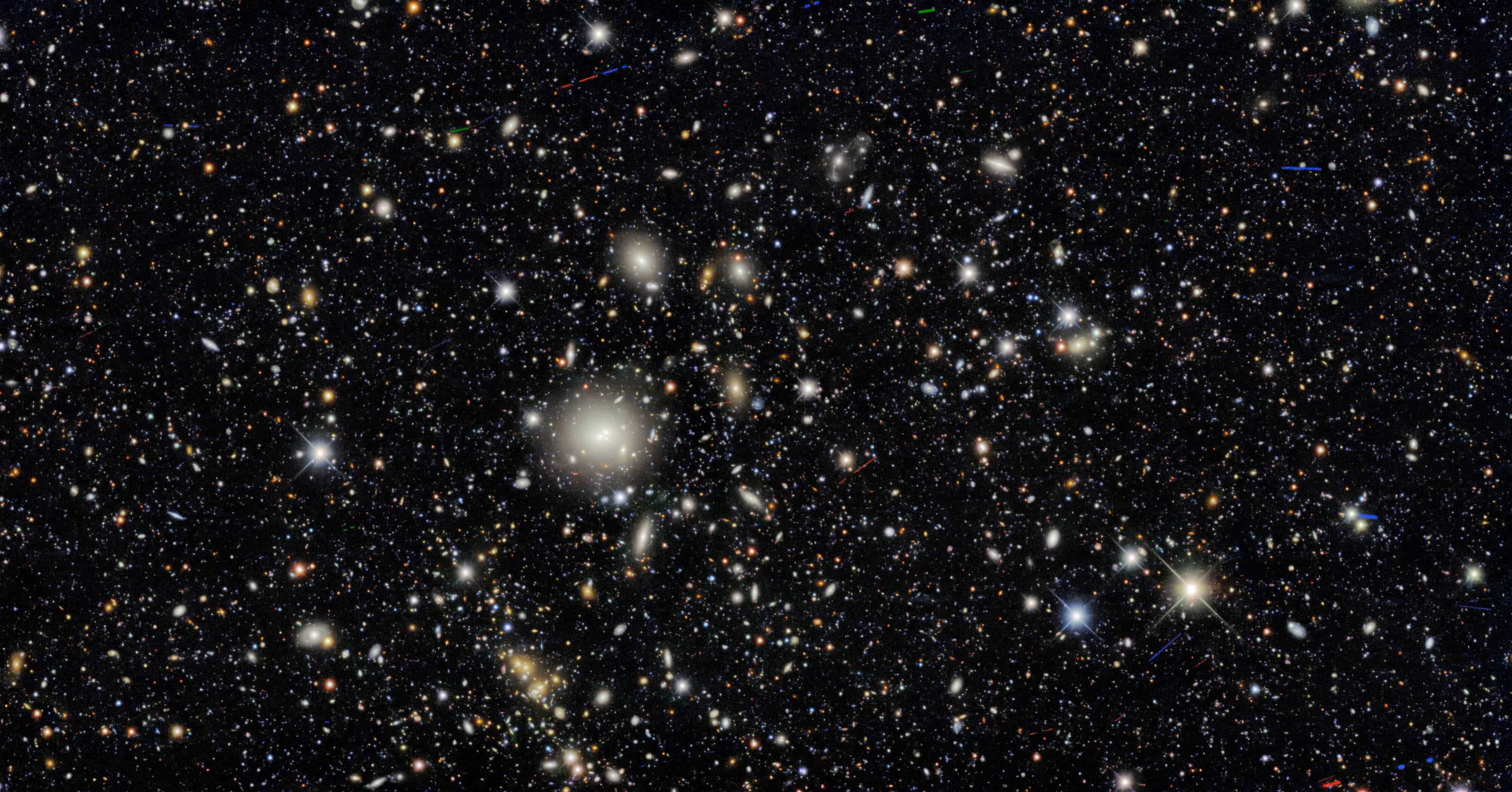
Dark Energy Survey deep field image · Image credit: Dark Energy Survey/DOE/FNAL/DECam/CTIO/NOIRLab/NSF/AURA. Acknowledgments: T.A. Rector (University of Alaska Anchorage/NSF NOIRLab), J. Miller, M. Zamani & D. de Martin (NSF NOIRLab) · CC BY 4.0
Cosmology20 min read
If the universe is infinite, is there another you?
If space goes on forever, a simple counting argument says copies of you are out there. The logic is tidy, but it rests on assumptions that can’t be checked beyond what we can see.
Companion video: Is there another you out there? ↓
Contents
- The argument, in six assumptions
- Why the number of possibilities is finite
- How far away? Tegmark’s numbers, and why they disagree
- How big is that number?
- Probability 1 is not certainty
- Counting infinities is harder than it looks
- The case against
- What about life out there?
- Open questions
- How sure are we?
- What the video simplified
- Further reading
- References
Somewhere, very far away, a person with your face, your name and your memories might be reading this sentence. Not a lookalike: a copy identical in every detail we could observe. Some cosmologists, scientists who study the universe as a whole, have argued that this follows from a few assumptions that sound simple Reference 1Reference 2.
Here is the catch, up front. The argument only works if several things are true, and none of them can be checked beyond the part of the universe we can see: that space really goes on forever, that the matter in it was scattered at random in a particular statistical way, and that any region of space can only be arranged in a finite number of distinguishable ways. Grant all of that and the copies follow from simple counting. Doubt any of it, and they may not exist at all.
The argument, in six assumptions
The reasoning is old. In 1979 George Ellis and G. B. Brundrit argued that an infinite, roughly uniform universe should contain regions with histories very similar to ours Reference 3. In 2001 Jaume Garriga and Alexander Vilenkin sharpened it into a claim about identical histories Reference 2, and in 2003 Max Tegmark popularized it, calling each faraway region the size of our observable universe (the bubble of space around us from which signals have had time to reach us) a “parallel universe”, even though it is really just a distant part of our own space Reference 1.
It rests on four big assumptions and two hidden ones. Each deserves a label.
- Space is infinite, or at least unimaginably larger than the distances below. Status: unknown. Space is measured to be very nearly flat, which means the geometry you learned in school works on huge scales: parallel lines stay parallel. But a flat universe can still be finite, wrapped around like a video-game screen where leaving on the right brings you back on the left, and a curved one could be enormous but finite (Part 1) Reference 6Reference 7.
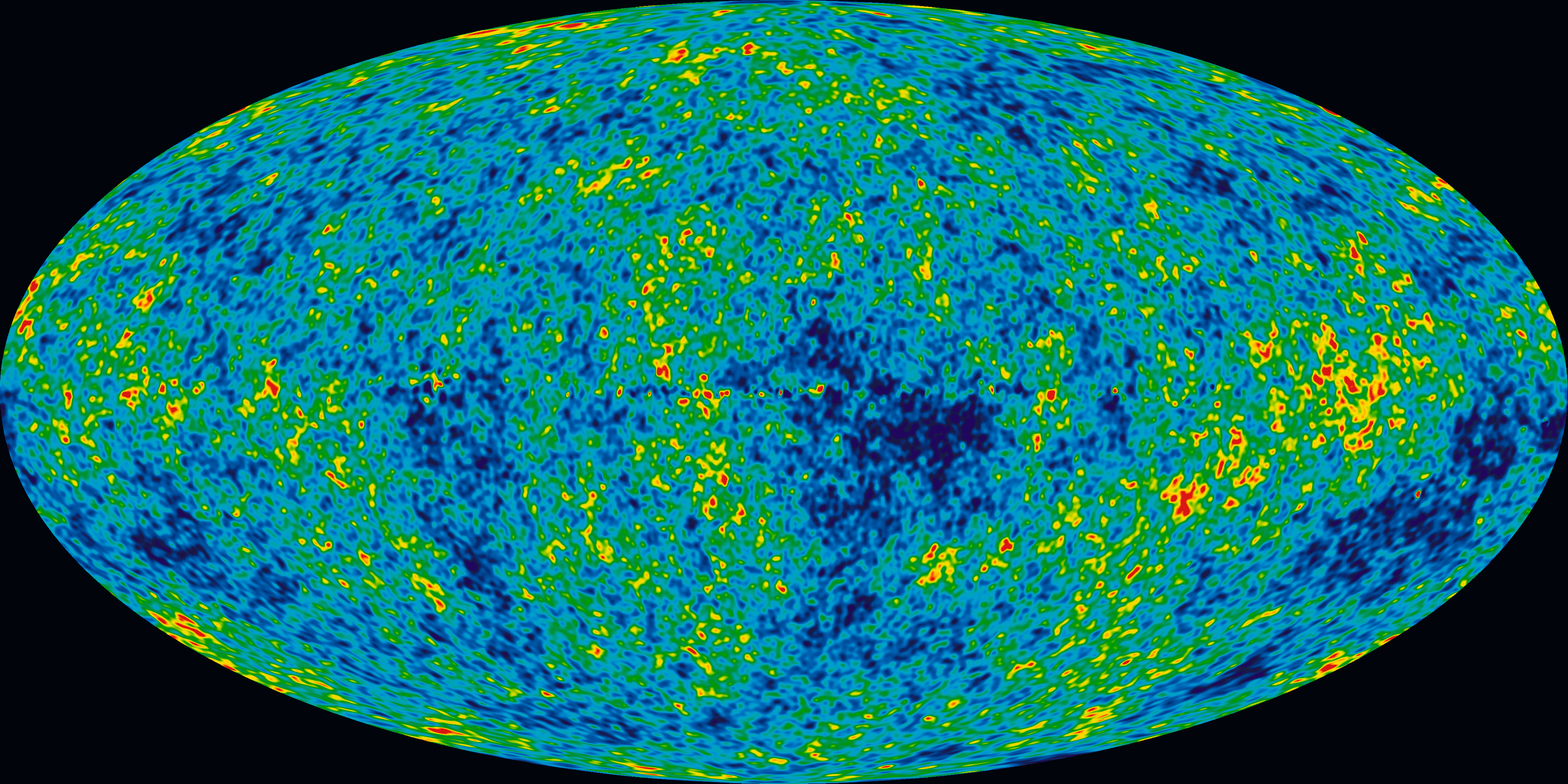
- Matter is spread roughly evenly, with the same laws of physics everywhere. Status: well supported within the part we can see. The density of the early universe, seen in its afterglow (faint leftover light from the hot early universe that we still detect today), varied by only about one part in 100,000 from place to place Reference 1Reference 8. Whether it stays that way far beyond is an extrapolation.
- The starting conditions were random, in a specific sense. The tiny ripples that grew into galaxies are thought to have come from quantum jitters, the tiny random flickers quantum physics says happen everywhere, in the very early universe; Tegmark calls the result random “for all practical purposes” Reference 8. His version assumes the ripples form an ergodic random pattern: watching one coin flipped a million times tells you the same as flipping a million coins once. In space terms: looking at many far-apart regions of our one universe tells you the same as looking at many possible versions of our region. Tegmark’s summary is that “everything that could in principle have happened here did in fact happen somewhere else”; his own definition of this randomness assumes space is infinite, so it can’t be used to prove that it is Reference 8. Status: a theoretical assumption, consistent with what we see but untestable beyond our horizon, the distance beyond which light has not had time to reach us.
- Any finite region with a limited amount of energy can be arranged in only finitely many distinguishable ways. Status: standard quantum physics for ordinary matter whose energy is limited. But once gravity is included, energy no longer sets a limit, and the finiteness has to be assumed; Garriga and Vilenkin do exactly that Reference 2. Untested in that regime (see below).
- (Hidden) Distant regions develop independently of each other Reference 3. Status: plausible; untestable for regions beyond our horizon.
- (Hidden) Probabilities about an imagined collection of possible universes apply to the one universe we have. “Probability 1” is a statement about that imagined collection. A forecast of “90 percent chance of rain” means something because there are many days like today; we get only one universe. Ellis points out that probability arguments are weakest “when there is only one case to consider” Reference 9. Status: a philosophical step, rarely stated.
If all of that holds, the conclusion is simple. An infinite space contains infinitely many regions the size of our observable universe. Each can turn out in only finitely many ways. So every possible way, including the exact way our region turned out, keeps happening, again and again, with probability 1 Reference 2Reference 3. A copy of you does not need a copy of everything around you. Matching a person-sized region is far likelier than matching a whole observable universe, which is why Tegmark’s distance for “you” (101028 m) is so much smaller than his distance for a whole region (1010118 m) Reference 1. A copy whose whole life story matched yours, though, would need matching surroundings too.
Why the number of possibilities is finite
Think of a phone screen. It has a fixed number of pixels and colors, so it can only show a finite number of different images: a huge number, but finite. A deck of 52 cards can be shuffled into “only” about 8 × 10⁶⁷ orders. Shuffle infinitely many decks and every order turns up again and again.
In everyday physics, it seems a box of gas could be arranged in infinitely many ways: shift one atom by a billionth of a millimeter, and you have a new arrangement. Quantum mechanics says nature has a resolution limit, like pixels: below a certain level of detail, two arrangements of a region with limited energy stop being distinguishable, so there is only a finite number of genuinely different states Reference 2Reference 3. Gravity complicates this, because gravitational energy can be negative, so energy no longer caps what is possible; Garriga and Vilenkin, who make the argument most carefully, end up simply assuming that the amount of information in a region cannot be arbitrarily large Reference 2.
Physicists have precise versions of such limits. The Bekenstein bound caps the information that can fit inside a region of a given size and energy (mass counts as energy, through E = mc²) Reference 10. For a 70-kilogram person inside a sphere 2 meters across, it allows at most about 2 × 10⁴⁵ bits, or yes/no answers. Since N yes/no answers can describe 2N different things, such a region can be in at most about 101045 distinguishable states: mind-bogglingly many, but finite. Garriga and Vilenkin estimated that the number of distinguishable histories (possible “movies” rather than “photos”) of a region the size of our observable universe, from when the universe first became transparent, about 380,000 years after the Big Bang Reference 11, until today, is finite too Reference 2.
For physicistsCounting states and histories3 bounds · ~3 min
Garriga and Vilenkin Reference 2 count coarse-grained, decoherent histories of an “O-region” (the interior of our past light cone since recombination). Decoherence forbids arbitrarily fine cells and field bins, so is finite if field values are bounded. Without gravity this follows from finite energy; with gravity it does not (gravitational energy is not positive-definite), so they put all super-Planckian densities in one bin, an identification they call “somewhat subjective”. Their “objective” route, the holographic bound , “cannot be true in general”, and they “simply assume” the entropy of a finite region is bounded. With Planck-scale cells over Planck 4-volumes they find ; with atomic-size cells, .
The Bekenstein bound Reference 10 is ( in units of ; for weakly gravitating systems). For m and : nats bits, so for that system. For Tegmark’s Hubble volume ( m), allows up to states, against his proton-packing (calc/twin.ts). This is the naive spacelike bound, which G&V note fails for large enough regions of an expanding universe; we use it only as an indicative count. The argument needs only finiteness; the different counts move the top exponent by several units.
Step by step
Tiling an infinite space with regions like ours
Figure: A single circle in the middle of the frame, labeled as our observable universe, 46 billion light-years in radius, surrounded by faint outlines of identical regions.
Figure: A grid of 96 square regions, each filled with a random pattern of four dark or light slots. Our region, in the center, is outlined.
Figure: The same grid with six regions highlighted whose pattern exactly matches ours. A readout says 6 copies among 95 other regions; about 6 were expected.
Figure: A much larger grid of 960 tiny regions with nine slots each. One region far from ours is highlighted as an exact copy. Expected number about 1.9.
Figure: A line chart: the number of slots on the horizontal axis (log scale) against the top exponent of the distance to the nearest copy. Marked points: a 100-light-year sphere at about 91 and a Hubble volume at about 117.
Figure: A curve of the probability of finding at least one copy against the number of regions searched, on a log scale. It reaches 63 percent when the number searched equals the number of patterns and approaches but never reaches 1 for any finite number.
How far away? Tegmark’s numbers, and why they disagree
Tegmark made the argument concrete with a back-of-the-envelope count Reference 1. Take a region the size of our observable universe, which he calls a Hubble volume and gives a radius of about 4 × 10²⁶ meters (about 42 billion light-years in his 2003 figures, an older, rounder estimate). Ask how many protons could be packed into it if it were no hotter than 100 million kelvin, a temperature scale starting at absolute zero. His answer: about 10¹¹⁸ Reference 1. In the longer version of the essay, Tegmark says the count rests on the Pauli exclusion principle, which forbids two protons from sharing a quantum state Reference 8. In our reading, that is why temperature matters: quantum mechanics gives each particle a “fuzziness” that shrinks as it gets hotter, so the fuzziness sets how small each slot can be, and capping the temperature caps the number of slots. Most slots are empty: the observable universe actually contains only about 10⁸⁰ protons Reference 8. What matters is how many places they could be.
Treat each slot as filled or empty. Then the number of possible arrangements is 2 multiplied by itself 10¹¹⁸ times, roughly 1010118 Reference 1. That needs a moment. 10¹¹⁸ is a 1 followed by 118 zeros. But 1010118 is a 1 followed by 10¹¹⁸ zeros: more zeros than there are protons in the observable universe, by a factor of about 10³⁸. In this notation, changing the 118 at the top to 119 would multiply the number of zeros by ten.
If every arrangement were equally likely and regions independent, you would have to look through about that many regions before expecting a repeat of ours. Pack them into a cube (a cube with 10 regions along each side holds 1,000): its side, in meters, is the cube root of that count times the size of one region. Strictly, 2 multiplied by itself 10¹¹⁸ times has about 3 × 10¹¹⁷ digits, not 10¹¹⁸. Taking a cube root divides that by three, to about 10¹¹⁷ digits, and multiplying by 10²⁷ meters adds only 27 more. So the cube is about 1010117 meters across, which Tegmark rounds to 1010118. Beyond that, Tegmark wrote, universes, “including ours”, must repeat Reference 1. Strictly, that distance only makes a copy of our region somewhat better than even (63 percent, like the two-in-three chance of rolling at least one six in six throws of a die); no finite distance guarantees one.
Tegmark then shrank the target to a sphere 100 light-years in radius, so that “all perceptions that we have during the next century will be identical”, since nothing from farther away can reach us within a century: about 101092 meters. A copy of you: about 101028 meters Reference 1.
How rough are these numbers? Rougher than they look. Changing the 28 at the top to 29 multiplies the number of zeros by ten, so these are guesses at the size of the size of the distance. Treat any precise-sounding figure you see quoted as a guess.
- Tegmark published two versions of this essay. The arXiv preprint (arXiv is a free website where scientists share papers), later a book chapter, gives 101029 m for you, 101091 m for the 100-light-year sphere and 1010115 m for a whole Hubble volume, based on 10¹¹⁵ slots Reference 8. That is three units below the magazine’s 118.
- Neither version shows how the figure for you was obtained Reference 1Reference 8. The same recipe applied to a sphere big enough to hold a person gives about 101038 m.
- Other ways of counting states give bigger numbers: a conjectured limit on information based on a region’s surface area (the holographic bound) allows up to about 1010123 states for a Hubble volume, against Tegmark’s 1010118 arrangements.
- Rounding choices alone (counting in powers of 2 or of 10, the cube root, the region’s size) shift the top number by about one.
Tegmark himself called the estimates “extremely conservative”, since they simply count every possible quantum state, and added that your nearest copy is probably much closer, because planet formation and evolution “tip the odds in your favor” Reference 1. The honest message: even the top exponent is uncertain by many units, and the true distance is probably much smaller.
10 to the 10²⁸ meters
Tegmark’s 2003 estimate to a copy of you (Sci. Am.)
For physicistsReproducing the estimate step by step6 steps · ~4 min
Inputs from Tegmark Reference 1Reference 8: Hubble-volume radius m; K; proton slots (Sci. Am.) or (arXiv: “roughly the number of protons that the Pauli exclusion principle would allow you to pack into a Hubble volume at this temperature”).
- Slots (our reconstruction, not stated by Tegmark). At K the proton thermal de Broglie wavelength is m, close to the m cell in the Sci. Am. box; .
- Configurations. for .
- Distance. Independent, equiprobable configurations: a cube of regions has side , so . Inside it, ; seeing every configuration would need regions.
- 100-ly sphere. slots, m (Sci. Am. quotes ). From the arXiv’s slots the same scaling gives m, not the arXiv’s quoted .
- “You”. Not derived in either text. – m corresponds to with –, the order of the nucleon count of a 70 kg body (); this is our interpretation only. The proton-packing recipe on a 2 m sphere at K gives m; top exponent 28 requires m (i.e. K in this model).
- Alternative counts. Holographic bound at m: states. Garriga–Vilenkin histories: .
Equiprobability is the weakest step: the real distribution over configurations is dominated by gravity, chemistry and biology, which is why Tegmark expects a copy of you much closer. Calculations: calc/twin.ts.
How big is that number?
Try to picture 101028. It has 10²⁸ + 1 digits. Write it out at one digit per millimeter, and the string of digits would stretch about a billion light-years (1.06 billion), about a hundredth of the way across the observable universe. Write one digit every tenth of a nanometer, and it still runs to about 106 light-years. Writing one digit per second would take about 23 billion times the current age of the universe, 13.8 billion years Reference 11.
And that is just the number of digits in the distance. The distance itself, in meters, is 1 followed by all those zeros. For comparison, the whole observable universe is about 10²⁷ meters across. In this notation, our entire visible cosmos is 10101.43 meters, and a copy of you is at 101028.
Now try your own version of the calculation. Choose what has to match, how finely it has to match, and see how far away the nearest copy would be expected.
Explorable · try it
How far to your twin?
Region that must match exactly: a sphere of radius 100 light-years (Tegmark’s example).
Written out in meters, that distance would need about 1092 digits. Treat it as a very rough guess: rounding choices alone (base 2 or 10, the cube root, the region size) move the top exponent by about one, while the slot size and counting rule move it by many units. A 2 m sphere at 108 K gives about 101038 m; Tegmark’s 101028 m for “you” would need slots about 0.3 nm across (around 25 K here). His published values for a 100-light-year sphere are 101092 m (Sci. Am.) or 101091 m (arXiv); for a Hubble volume, 1010118 or 1010115 m.
Assumptions and simplifications
- Space is infinite. If it is finite but far bigger than the distance shown, copies are likely but finitely many; if smaller, there may be none. Switch the toggle to see why.
- Matter is spread roughly evenly and the laws of physics are the same everywhere.
- Every arrangement of the region is equally likely, and distant regions are independent (Tegmark’s counting). Real physics makes ordered outcomes like stars and planets far more likely, so a copy of a person could be much closer.
- The region is cut into slots the size of a proton’s quantum “fuzziness” at the chosen temperature; each slot has a fixed number of states (2 = filled or empty).
- The expected distance is the cube root of the number of arrangements, times the region’s diameter.
- The result is a very rough guess. Rounding choices alone move the top exponent by about one; choosing a different slot size or counting rule moves it by many units.
- This counts exact copies of the region, not people who merely look and think like you.
Probability 1 is not certainty
Suppose each region has some tiny chance of being an exact copy of ours. Search more regions and the chance of finding at least one copy rises. If every pattern is equally likely, searching as many regions as there are possible patterns gives a chance of about 63 percent. Search ten times as many, and it is 99.995 percent. Only in the limit of infinitely many regions does it reach 1.
Joshua Knobe, Ken Olum and Alexander Vilenkin put the conclusion carefully: in such a universe, every possible history occurs in infinitely many regions “with probability 1” Reference 3. They add a crucial caveat: it is still possible for an infinite universe to contain only finitely many copies; that possibility simply has probability zero Reference 3. Mathematicians call this kind of statement almost sure. Think of flipping a coin forever: getting tails every single time has probability zero, yet nothing in the rules forbids it. As Ellis puts it, probability arguments can show that something is very improbable, but that “does not prove it is impossible” Reference 9.
There is also the sixth assumption hiding here. “Probability 1” is computed over an imagined collection of possible universes, each with its own random starting conditions. We have exactly one universe. Saying that what is almost certain in the collection is true of ours is a further step, and Ellis argues that probability arguments carry least weight precisely when there is only one case to examine Reference 9. Knobe, Olum and Vilenkin, for their part, argue that an infinite universe supplies its own collection: it contains infinitely many systems just like any given one Reference 3.
Counting infinities is harder than it looks
A separate problem appears when we try to test theories by their predictions, such as “what should a typical copy of me expect to see next?”. Those are fractions: what share of all observers see something. With infinitely many observers, fractions become slippery. What fraction of whole numbers is even? Counting 1, 2, 3, 4, …, the answer is one half. But list every whole number in a different order, two odd numbers then one even (1, 3, 2, 5, 7, 4, 9, 11, 6, …), and only a third are even, even though every number still appears exactly once. Tegmark makes the same point with a different ordering: the answer depends on how you count Reference 8.
This is the measure problem. Tegmark argued that it is mild and treatable for a single infinite space, but severe for theories in which cosmic inflation, a proposed split-second burst of enormously fast expansion at the start, never ends (called eternal inflation), endlessly creating new regions, each itself infinite Reference 8. In a single, evenly mixed infinite space there is a natural way to count: in bigger and bigger spheres, where the fractions settle down to the same answer wherever you center them Reference 3. In eternal inflation there is no agreed way to tame the infinities, and different ways give different predictions Reference 13. Assuming we are typical observers (not special: one of the crowd), several proposed ways of counting have already been ruled out, because they predict we should see something very different from what we do Reference 13.
The case against
Not everyone is persuaded. George Ellis, a leading cosmologist and a co-author of the original 1979 argument, has become a prominent critic of where it leads. His central point: you can never count to infinity, so no observation can ever confirm that space is infinite, and claims about regions beyond our horizon are, in his words, “an extrapolation of an extraordinary kind” Reference 14Reference 9. He doubts that real, physical infinities exist at all: infinity “is quite different from a very large number” Reference 9. “Maybe the universe closes up on a very large scale,” he writes, “and there is no infinity out there” Reference 14.
That possibility matters. In a finite universe the infinitely many copies disappear. Copies remain likely only if the universe is bigger than these enormous distances; if it is smaller, there may be none. And in a small universe that wraps around on itself, like a three-torus (the 3D version of the wrap-around screen), looking far enough you would see the back of our own galaxy, not a twin: the same region seen again from around the universe Reference 15. A universe that small along loops through us has already been ruled out: such a loop must be longer than 98.5 percent of the diameter of the sphere from which the oldest light reaches us Reference 7.
Defenders argue that infinite space isn’t an arbitrary add-on. Garriga and Vilenkin argue that, in eternal inflation, the region we live in is naturally infinite Reference 2. But that route has a price. In relativity, “now” is not the same for observers far apart; in their picture, whether our region is infinite, and whether a distant copy exists “now”, depends on how you define “now” across the universe Reference 2. And eternal inflation is exactly where the measure problem is at its worst Reference 13. On one point there is no dispute: today, no information can reach us from these other regions Reference 2Reference 14.
What about life out there?
A copy of you would, of course, be life beyond Earth. The same logic gives a striking conditional: if the assumptions hold, and life can arise somewhere with non-zero probability (Earth shows it isn’t forbidden), an infinite universe contains infinitely many inhabited planets, with probability 1 Reference 1Reference 3. That is a statement about a model, not evidence.
The evidence, so far, is this: no life beyond Earth has ever been found Reference 4, and in 2021 NASA said there was no scientifically supported evidence for extraterrestrial life Reference 16. The most intriguing recent result is a rock sample collected by the Perseverance rover on Mars, which NASA announced in September 2025 as a “potential biosignature”: a feature that might have a biological origin but needs more study before anyone can say whether life was involved Reference 5. Non-biological explanations have not been ruled out Reference 5.
So the honest summary of this whole series is a nested set of “ifs”. If space is infinite, which we can’t establish (Part 1); if matter is scattered at random in the right way; if the number of possible arrangements is finite; and if probabilities about imagined universes apply to ours, then there are copies of you out there, almost surely. We will never meet them.
Open questions
- Is space infinite? Unknown, and possibly unknowable; curvature measurements and topology searches can tighten the limits but cannot prove infinity Reference 6Reference 7Reference 9.
- What is the right way to count infinitely many observers? The measure problem is unsolved in general, and different proposals give different predictions Reference 13Reference 8.
- Are distant regions really independent and “typical”? Inflation makes this plausible, but it cannot be tested beyond our horizon Reference 8Reference 2.
- What counts as “you”? An exact quantum copy and a person with the same memories are very different targets, and the estimated distance depends enormously on which one you mean Reference 2Reference 3.
- Is there life elsewhere? NASA says the Perseverance sample needs further study to confirm or refute its biological potential Reference 5; beyond that, only future searches can tell.
How sure are we?
EVIDENCE LEVELS ARE EDITORIAL JUDGEMENTS OF THE WHOLE BODY OF EVIDENCE — NOT σ VALUES · What these mean
No life beyond Earth has been confirmed.
Evidence level: EstablishedNASA states no life beyond Earth has been found; the 2025 Mars result is only a potential biosignature Reference 4Reference 5.Any finite region of our universe, gravity included, can be in only finitely many distinguishable states.
Evidence level: SpeculativeTrue for matter with limited energy in standard quantum physics; with gravity, energy sets no cap, so Garriga and Vilenkin assume an entropy bound Reference 2Reference 10.Space is infinite.
Evidence level: SpeculativeNot measured; generic in eternal inflation; finite shapes are still allowed Reference 2Reference 7Reference 9.If space is infinite and randomly seeded, every allowed arrangement, including a copy of you, recurs infinitely often.
Evidence level: SpeculativeA conditional argument whose premises can’t be checked; “probability 1”, not certainty Reference 3Reference 9.If all the assumptions hold, a copy of you is about 10 to the 10²⁸ meters away (Tegmark’s crude estimate).
Evidence level: SpeculativeHis two versions differ; the top exponent is uncertain by many units and the true distance is probably much smaller Reference 1Reference 8.
What the video simplified
In the video: Tegmark calculated that your twin is 10^(10^29) meters away.
More precisely: That is the arXiv version. His Scientific American article says 101028 m, and neither shows the derivation for “you”. Different reasonable ways of counting change the top exponent by many units Reference 1Reference 8.In the video: An identical Hubble volume is 10^(10^115) meters away.
More precisely: Again the arXiv figure (10¹¹⁵ slots). The magazine version uses 10¹¹⁸ slots and gives 1010118 m; following the recipe strictly gives about 1010117 m Reference 1Reference 8.In the video: The Bekenstein bound gives about 10^118 states for a Hubble volume.
More precisely: 10¹¹⁸ is Tegmark’s count of proton slots at up to 100 million kelvin, not the Bekenstein bound, and the observable universe actually holds about 10⁸⁰ protons. Tegmark says “thermodynamic or quantum-gravitational estimates of the total information content of the universe” give “roughly the same number”; one such limit, the holographic bound, allows up to about 1010123 states for a Hubble volume, five units higher at the top. The argument only needs the count to be finite Reference 1Reference 8Reference 10.In the video: If something has a non-zero probability, in an infinite universe it will happen infinitely often.
More precisely: It happens infinitely often with probability 1, which is not logical certainty. It also needs independent regions, and the step from an imagined collection of universes to our one universe Reference 3Reference 9.
Further reading
Start here Accessible
M. Tegmark, Parallel Universes, Sci. Am. 288, 40–51 (2003). https://doi.org/10.1038/scientificamerican0503-40Paywall
The essay that made the argument famous, with the toy box-of-protons calculation.G. F. R. Ellis, Does the Multiverse Really Exist?, Sci. Am. 305, 38–43 (2011). https://doi.org/10.1038/scientificamerican0811-38Paywall
A leading cosmologist explains why he thinks the multiverse can’t be tested.NASA, Do Aliens Exist? We Asked a NASA Scientist: Episode 5 (2021). https://www.nasa.gov/science-research/planetary-science/do-aliens-exist-we-asked-a-nasa-scientist-episode-5/ (accessed 12 October 2026)Free
NASA’s plain-language answer to “Do aliens exist?”.
Go deeper Intermediate
J. Garriga and A. Vilenkin, Many worlds in one, Phys. Rev. D 64, 043511 (2001). https://doi.org/10.1103/PhysRevD.64.043511 · Free version: arXiv:gr-qc/0102010 [gr-qc]Free on arXiv
A short, readable paper arguing that every allowed history repeats in an infinite universe.J. Knobe, K. D. Olum, and A. Vilenkin, Philosophical Implications of Inflationary Cosmology, The British Journal for the Philosophy of Science 57, 47–67 (2006). https://doi.org/10.1093/bjps/axi155 · Free version: arXiv:physics/0302071 [physics.soc-ph]Free on arXiv
The philosophical consequences, written for non-specialists, including the “probability 1” point.M. Tegmark, Parallel universes, in Science and Ultimate Reality (Cambridge University Press, 2004), pp. 459–491. https://doi.org/10.1017/CBO9780511814990.024 · Free version: arXiv:astro-ph/0302131 [astro-ph]Free on arXiv
The longer version of Tegmark’s essay, with the measure problem.
Technical Primary literature
B. Freivogel, Making predictions in the multiverse, Class. Quantum Grav. 28, 204007 (2011). https://doi.org/10.1088/0264-9381/28/20/204007 · Free version: arXiv:1105.0244 [hep-th]Free on arXiv
A review of the measure problem in eternal inflation.J. D. Bekenstein, Universal upper bound on the entropy-to-energy ratio for bounded systems, Phys. Rev. D 23, 287–298 (1981). https://doi.org/10.1103/PhysRevD.23.287Paywall
The original bound on how much information a region can hold.G. F. R. Ellis, Issues in the Philosophy of Cosmology, in Philosophy of Physics (Elsevier, 2007), pp. 1183–1285. https://doi.org/10.1016/B978-044451560-5/50014-2 · Free version: arXiv:astro-ph/0602280 [astro-ph]Free on arXiv
A long survey of the philosophy of cosmology, including the problem of infinities.
References
Numbered in order of first citation. Journal articles link to their DOI; where a free version exists on arXiv we link it too. Preprints are marked as not peer reviewed.
- Reference 1: M. Tegmark, Parallel Universes, Sci. Am. 288, 40–51 (2003). https://doi.org/10.1038/scientificamerican0503-40Back to citation 1 of reference 1Back to citation 2 of reference 1Back to citation 3 of reference 1Back to citation 4 of reference 1Back to citation 5 of reference 1Back to citation 6 of reference 1Back to citation 7 of reference 1Back to citation 8 of reference 1Back to citation 9 of reference 1Back to citation 10 of reference 1Back to citation 11 of reference 1Back to citation 12 of reference 1Back to citation 13 of reference 1Back to citation 14 of reference 1Back to citation 15 of reference 1Back to citation 16 of reference 1Back to citation 17 of reference 1Back to citation 18 of reference 1Back to citation 19 of reference 1Back to citation 20 of reference 1
- Reference 2: J. Garriga and A. Vilenkin, Many worlds in one, Phys. Rev. D 64, 043511 (2001). https://doi.org/10.1103/PhysRevD.64.043511 · Free version: arXiv:gr-qc/0102010 [gr-qc]Back to citation 1 of reference 2Back to citation 2 of reference 2Back to citation 3 of reference 2Back to citation 4 of reference 2Back to citation 5 of reference 2Back to citation 6 of reference 2Back to citation 7 of reference 2Back to citation 8 of reference 2Back to citation 9 of reference 2Back to citation 10 of reference 2Back to citation 11 of reference 2Back to citation 12 of reference 2Back to citation 13 of reference 2Back to citation 14 of reference 2Back to citation 15 of reference 2Back to citation 16 of reference 2
- Reference 3: J. Knobe, K. D. Olum, and A. Vilenkin, Philosophical Implications of Inflationary Cosmology, The British Journal for the Philosophy of Science 57, 47–67 (2006). https://doi.org/10.1093/bjps/axi155 · Free version: arXiv:physics/0302071 [physics.soc-ph]Back to citation 1 of reference 3Back to citation 2 of reference 3Back to citation 3 of reference 3Back to citation 4 of reference 3Back to citation 5 of reference 3Back to citation 6 of reference 3Back to citation 7 of reference 3Back to citation 8 of reference 3Back to citation 9 of reference 3Back to citation 10 of reference 3Back to citation 11 of reference 3Back to citation 12 of reference 3Back to citation 13 of reference 3
- Reference 4: NASA Astrobiology Program, About Astrobiology, NASA. https://astrobiology.nasa.gov/about/ (accessed 12 October 2026)Back to citation 1 of reference 4Back to citation 2 of reference 4Back to citation 3 of reference 4
- Reference 5: NASA, NASA Says Mars Rover Discovered Potential Biosignature Last Year (2025). https://www.nasa.gov/news-release/nasa-says-mars-rover-discovered-potential-biosignature-last-year/ (accessed 12 October 2026)Back to citation 1 of reference 5Back to citation 2 of reference 5Back to citation 3 of reference 5Back to citation 4 of reference 5Back to citation 5 of reference 5
- Reference 6: DESI Collaboration, DESI DR2 results. II. Measurements of baryon acoustic oscillations and cosmological constraints, Phys. Rev. D 112, 083515 (2025). https://doi.org/10.1103/tr6y-kpc6 · Free version: arXiv:2503.14738 [astro-ph.CO]Back to citation 1 of reference 6Back to citation 2 of reference 6
- Reference 7: P. Petersen et al., Cosmic topology. Part I. Limits on orientable Euclidean manifolds from circle searches, J. Cosmol. Astropart. Phys. 2023, 030 (2023). https://doi.org/10.1088/1475-7516/2023/01/030 · Free version: arXiv:2211.02603 [astro-ph.CO]Back to citation 1 of reference 7Back to citation 2 of reference 7Back to citation 3 of reference 7Back to citation 4 of reference 7
- Reference 8: M. Tegmark, Parallel universes, in Science and Ultimate Reality (Cambridge University Press, 2004), pp. 459–491. https://doi.org/10.1017/CBO9780511814990.024 · Free version: arXiv:astro-ph/0302131 [astro-ph]Back to citation 1 of reference 8Back to citation 2 of reference 8Back to citation 3 of reference 8Back to citation 4 of reference 8Back to citation 5 of reference 8Back to citation 6 of reference 8Back to citation 7 of reference 8Back to citation 8 of reference 8Back to citation 9 of reference 8Back to citation 10 of reference 8Back to citation 11 of reference 8Back to citation 12 of reference 8Back to citation 13 of reference 8Back to citation 14 of reference 8Back to citation 15 of reference 8Back to citation 16 of reference 8Back to citation 17 of reference 8
- Reference 9: G. F. R. Ellis, Issues in the Philosophy of Cosmology, in Philosophy of Physics (Elsevier, 2007), pp. 1183–1285. https://doi.org/10.1016/B978-044451560-5/50014-2 · Free version: arXiv:astro-ph/0602280 [astro-ph]Back to citation 1 of reference 9Back to citation 2 of reference 9Back to citation 3 of reference 9Back to citation 4 of reference 9Back to citation 5 of reference 9Back to citation 6 of reference 9Back to citation 7 of reference 9Back to citation 8 of reference 9Back to citation 9 of reference 9
- Reference 10: J. D. Bekenstein, Universal upper bound on the entropy-to-energy ratio for bounded systems, Phys. Rev. D 23, 287–298 (1981). https://doi.org/10.1103/PhysRevD.23.287Back to citation 1 of reference 10Back to citation 2 of reference 10Back to citation 3 of reference 10Back to citation 4 of reference 10
- Reference 11: Planck Collaboration, Planck 2018 results. VI. Cosmological parameters, Astron. Astrophys. 641, A6 (2020). https://doi.org/10.1051/0004-6361/201833910 · Free version: arXiv:1807.06209 [astro-ph.CO]Back to citation 1 of reference 11Back to citation 2 of reference 11Back to citation 3 of reference 11
- Reference 12: T. M. Davis and C. H. Lineweaver, Expanding Confusion: Common Misconceptions of Cosmological Horizons and the Superluminal Expansion of the Universe, Publ. Astron. Soc. Aust. 21, 97–109 (2004). https://doi.org/10.1071/AS03040 · Free version: arXiv:astro-ph/0310808 [astro-ph]Back to citation 1 of reference 12
- Reference 13: B. Freivogel, Making predictions in the multiverse, Class. Quantum Grav. 28, 204007 (2011). https://doi.org/10.1088/0264-9381/28/20/204007 · Free version: arXiv:1105.0244 [hep-th]Back to citation 1 of reference 13Back to citation 2 of reference 13Back to citation 3 of reference 13Back to citation 4 of reference 13
- Reference 14: G. F. R. Ellis, Does the Multiverse Really Exist?, Sci. Am. 305, 38–43 (2011). https://doi.org/10.1038/scientificamerican0811-38Back to citation 1 of reference 14Back to citation 2 of reference 14Back to citation 3 of reference 14
- Reference 15: N. J. Cornish, D. N. Spergel, and G. D. Starkman, Circles in the sky: finding topology with the microwave background radiation, Class. Quantum Grav. 15, 2657–2670 (1998). https://doi.org/10.1088/0264-9381/15/9/013 · Free version: arXiv:astro-ph/9801212 [astro-ph]Back to citation 1 of reference 15
- Reference 16: NASA, Do Aliens Exist? We Asked a NASA Scientist: Episode 5 (2021). https://www.nasa.gov/science-research/planetary-science/do-aliens-exist-we-asked-a-nasa-scientist-episode-5/ (accessed 12 October 2026)Back to citation 1 of reference 16
Cite this article
Five Sigma, “If the universe is infinite, is there another you?,” Five Sigma (12 October 2026), https://thefivesigma.com/articles/another-you. Version of 12 October 2026.
Spotted an error?
We correct mistakes openly and log every change on our corrections page. Report an error in this article.
Was this article clear?
The video
60-second video · coming soonIs there another you out there?
Terms in this article
Keep reading
Is the universe infinite?
Space looks almost perfectly flat. That still doesn’t tell us whether it goes on forever, and we may never find out.
Part 1 of the series “Is the universe infinite?”